Advanced Physical Therapy Techniques for Spinal Disorders
Quiz this lecture (72 questions)Dr. Maha Alibeiny’s lecture has three parts: (1) MDT (McKenzie)A system of assessment, diagnosis and treatment for the spine and extremities that classifies patients by clinical presentation and relies mainly on self-treatment. (MDT / McKenzie), (2) Core stabilityThe ability to control the position and motion of the trunk over the pelvis and leg, so force and motion can be produced, transferred and controlled in kinetic chain activities., and (3) Spinal tractionTraction forces applied to the cervical and lumbar spine through mechanical systems such as tables, pulleys, cables and weights, to treat neck and back pain..
Part 1 — Mechanical Diagnosis and Therapy (MDT)
Objectives
- Describe the MDT (McKenzie)A system of assessment, diagnosis and treatment for the spine and extremities that classifies patients by clinical presentation and relies mainly on self-treatment. approach.
- Understand the basic MDT syndromes.
- Differentiate CentralizationSymptoms moving proximally, toward the spine. A good sign. from PeripheralizationSymptoms moving distally, away from the spine and down the limb..
- Identify the clinical picture of each syndrome.
- Recognize the MDT exercises for LumbarRelating to the lower back, the part of the spine between the chest and the pelvis.General meaning, not from the slides disorders.
What MDT is
- Developed by New Zealand physiotherapist Robin McKenzie (1931–2013) in the late 1950s; launched as “Mechanical Diagnosis and Therapy” in 1981.
- A system of assessment, diagnosis and treatment for the spine and extremities.
- Classifies patients by clinical presentation, not by anatomy.
- Relies mainly on self-treatment; it minimizes Manual therapyHands-on treatment by the therapist, such as joint mobilization or manipulation.General meaning, not from the slides. The therapist adds passive procedures only if self-treatment isn’t fully effective.
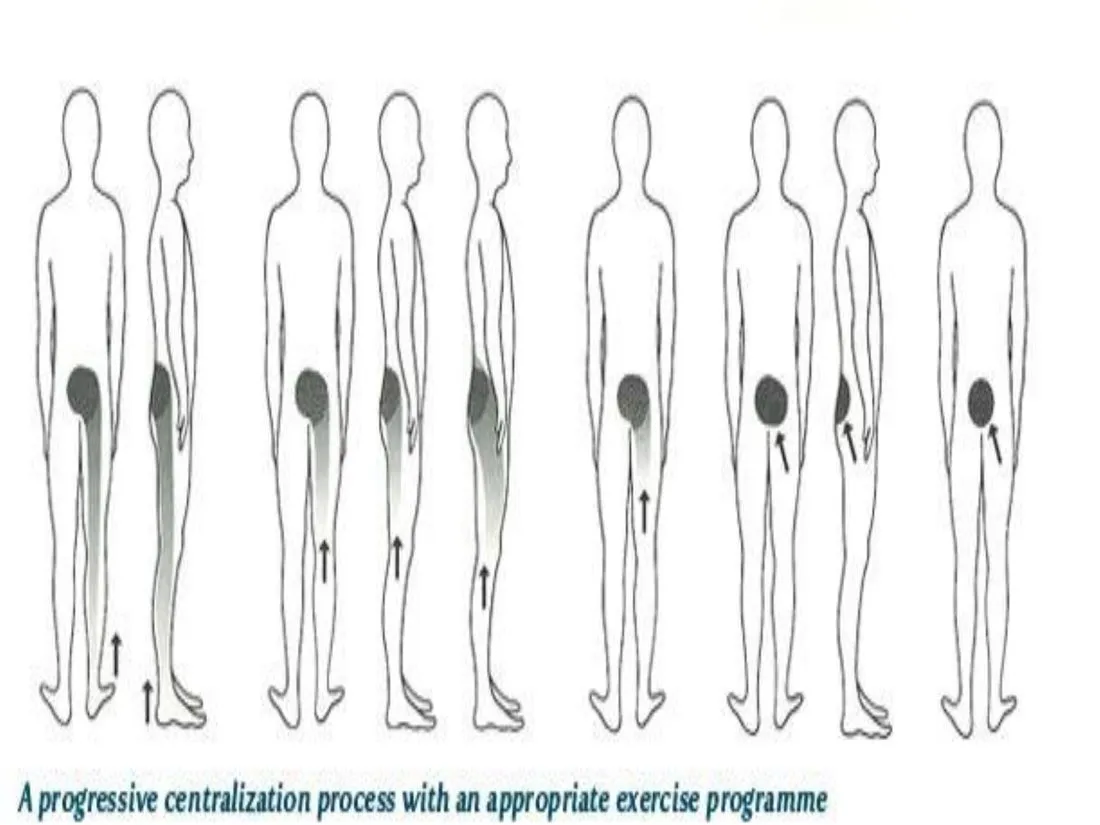
Centralization
The slide figure shows a progressive centralization process with an appropriate exercise programme: leg pain retreats step by step from the foot, up the leg, to the buttock and finally to the spine. Centralization = symptoms moving ProximalCloser to the trunk or the point of attachment of a limb; proximally means in that direction.General meaning, not from the slides (a good sign); peripheralization = symptoms moving DistalFarther from the trunk or the point of attachment of a limb; distally means in that direction.General meaning, not from the slides (see W2-L2).
McKenzie’s three syndromes
| Postural syndromeRelating to posture. In McKenzie's system, a syndrome of normal tissues where pain comes from static loading at end-range, not movement, and is never referred. | DysfunctionImpaired working of a body part. In McKenzie's system, a syndrome of shortened soft tissues with reduced elasticity, painful at end-range under tension, never during movement. | DerangementIn McKenzie's system, a syndrome of misaligned disc material that causes a blockage; specific movements make pain worse or better, and pain can be referred distally. | |
|---|---|---|---|
| Tissue | Normal, healthy tissues | Shortened soft tissues with reduced elasticity | Misalignment of disc material (Annulus fibrosusThe tough outer rings of the intervertebral disc.General meaning, not from the slides or Nucleus pulposusThe soft, jelly-like centre of the intervertebral disc.General meaning, not from the slides) causing a blockage |
| Pain trigger | Static loading at End-rangeThe very end of a joint's available movement.General meaning, not from the slides, not by movement | End-range when the shortened structures are put under tension | Specific movements make it worse or better |
| Pain during movement | — | Never felt during movement | Yes, varies |
| Referral | Never Referred painPain felt in a different place from where it starts.General meaning, not from the slides, never constant | Never referred | Can be referred distally; often constant and severe |
| Extra | — | — | May present with sudden acute deformity (KyphosisAn excessive forward rounding of the upper back.General meaning, not from the slides, TorticollisA twisted neck, with the head tilted to one side.General meaning, not from the slides, Lateral shiftA sideways shift of the trunk relative to the pelvis.General meaning, not from the slides), often dramatically improved by manual therapy/exercise |
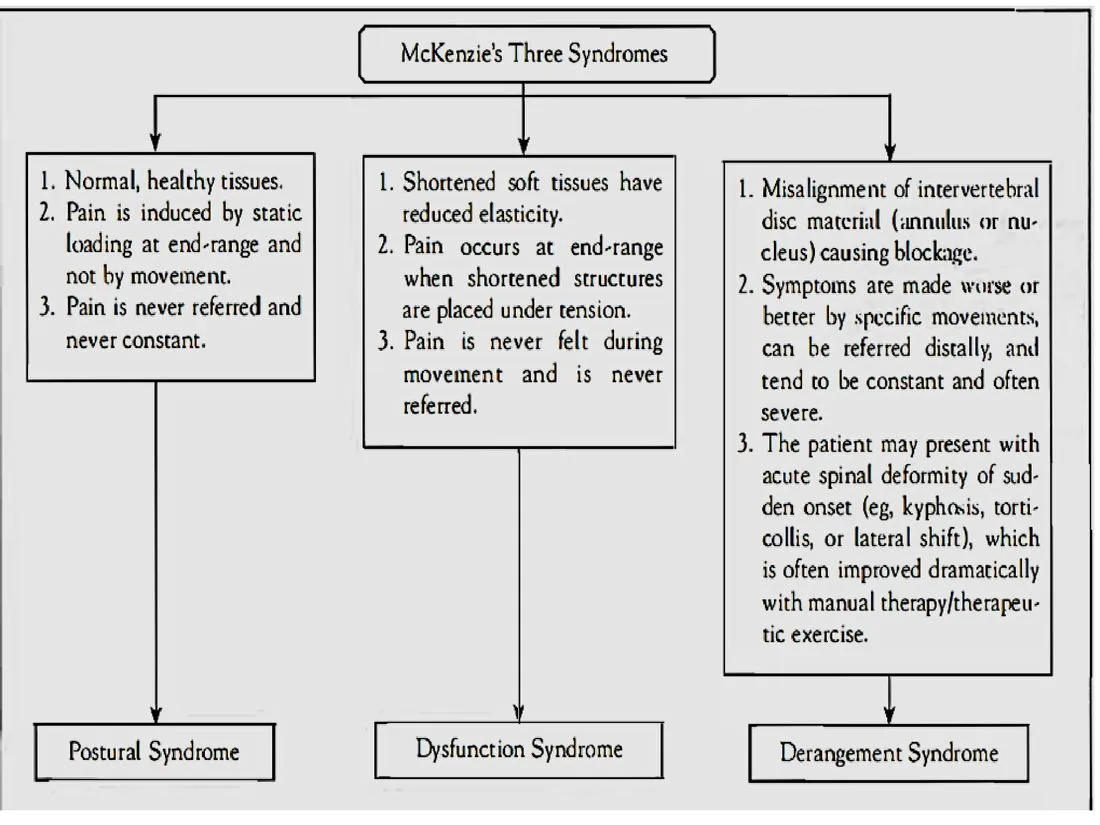
Quick sort: only derangement refers pain down the limb and can centralize. Postural = normal tissue overloaded by sustained end-range; dysfunction = short tissue stretched at end-range.
McKenzie techniques (slide figures)
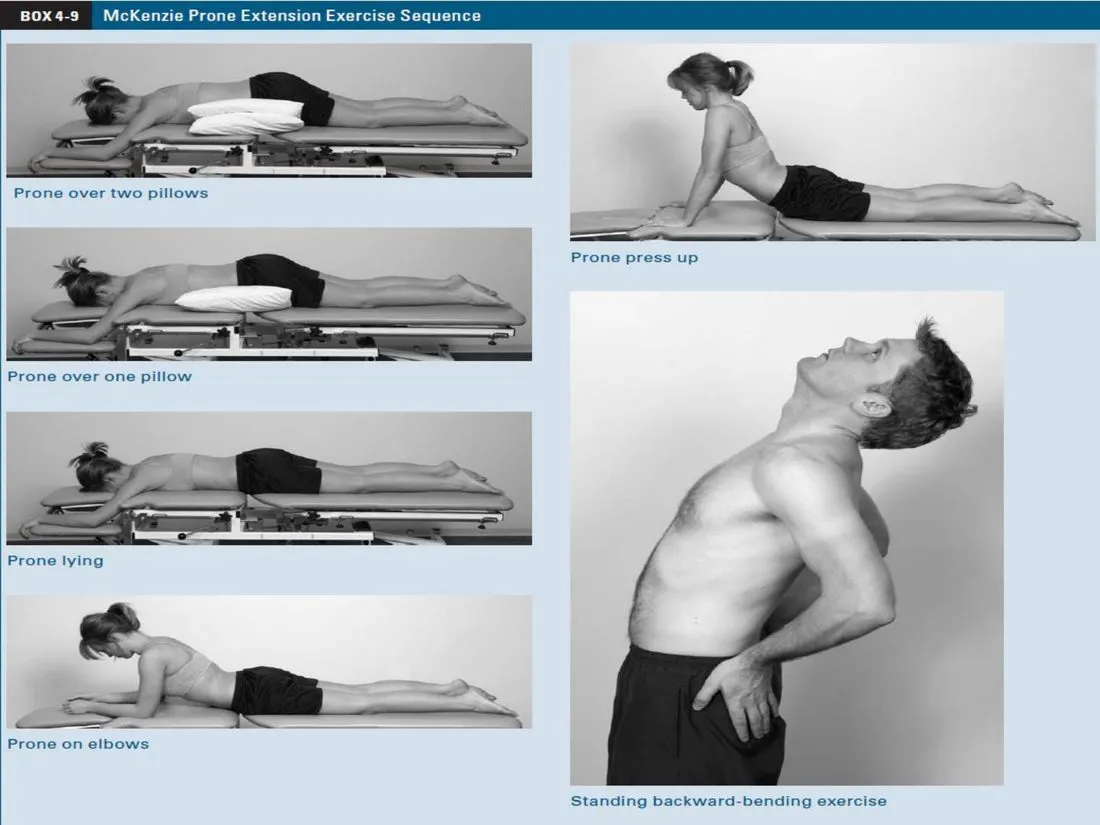
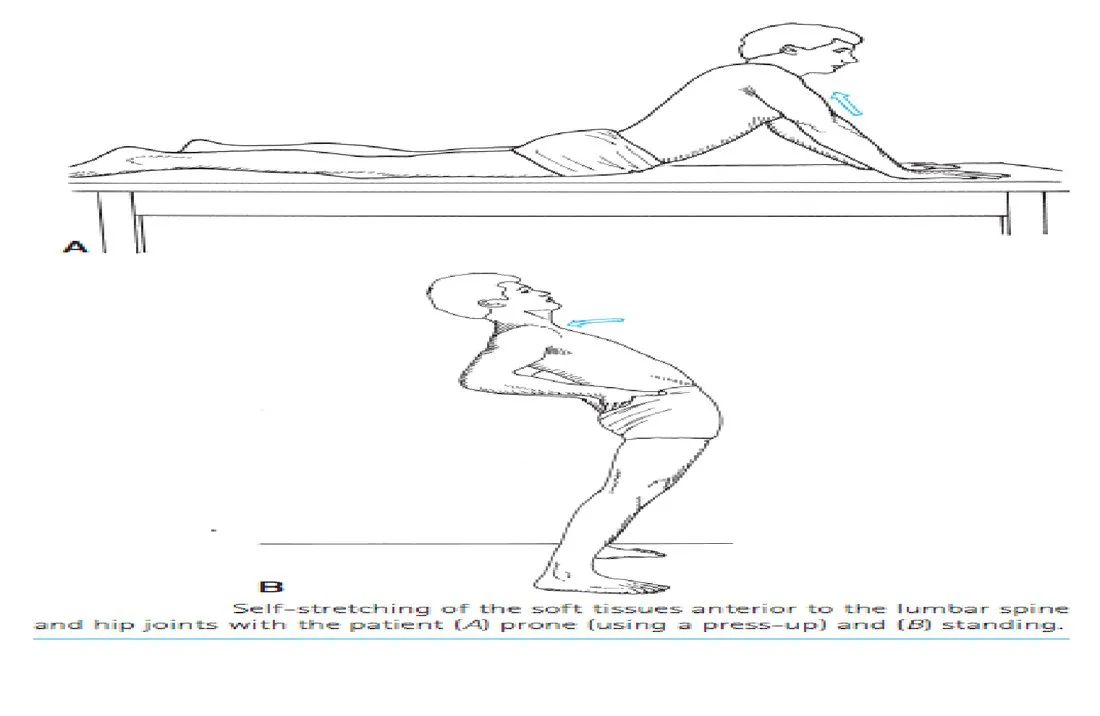
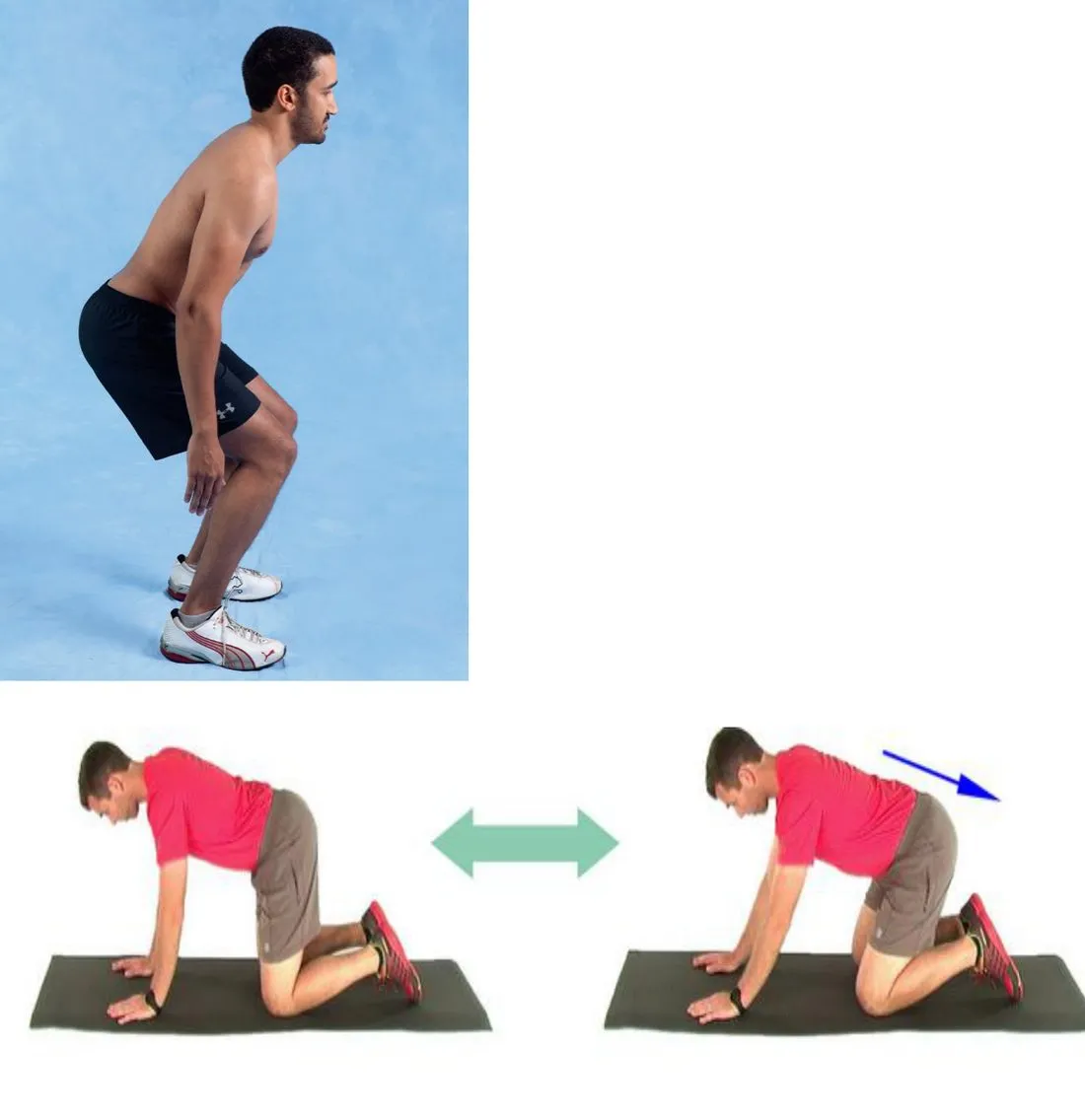
- Prone extension sequenceA McKenzie progression: prone over two pillows, one pillow, prone lying, prone on elbows, then prone press-up. (Box 4-9): ProneLying face down.General meaning, not from the slides over two pillows → one pillow → prone lying → prone on elbows → prone Press-upLying face down and pushing the upper body up with the arms while the pelvis stays on the surface.General meaning, not from the slides; plus standing backward bending.
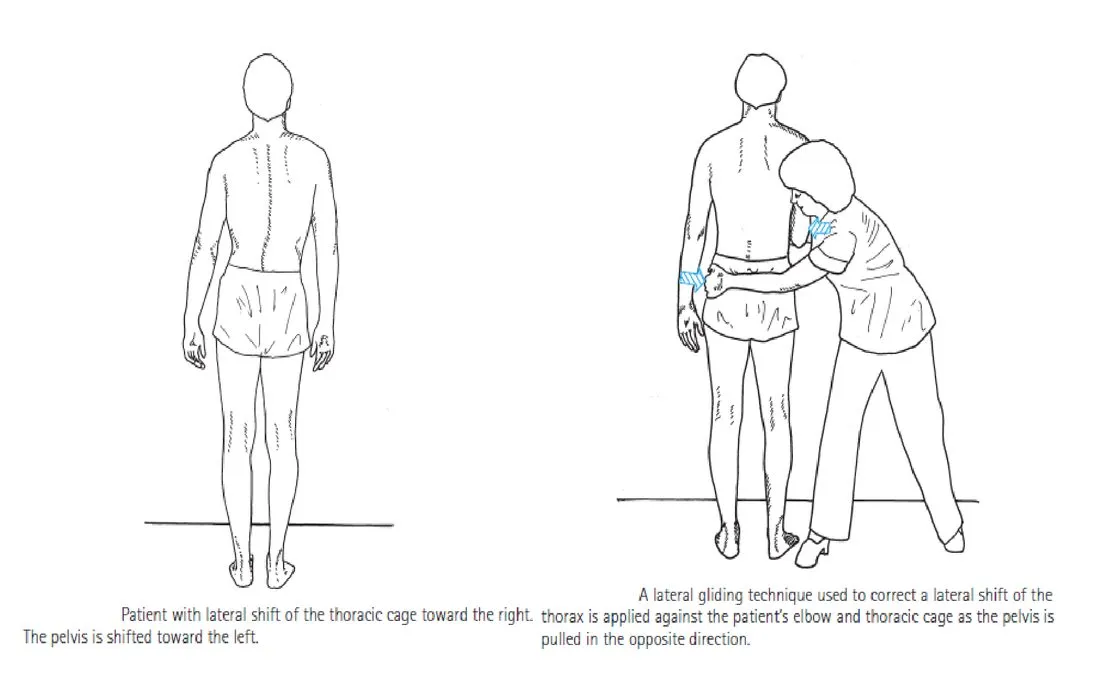
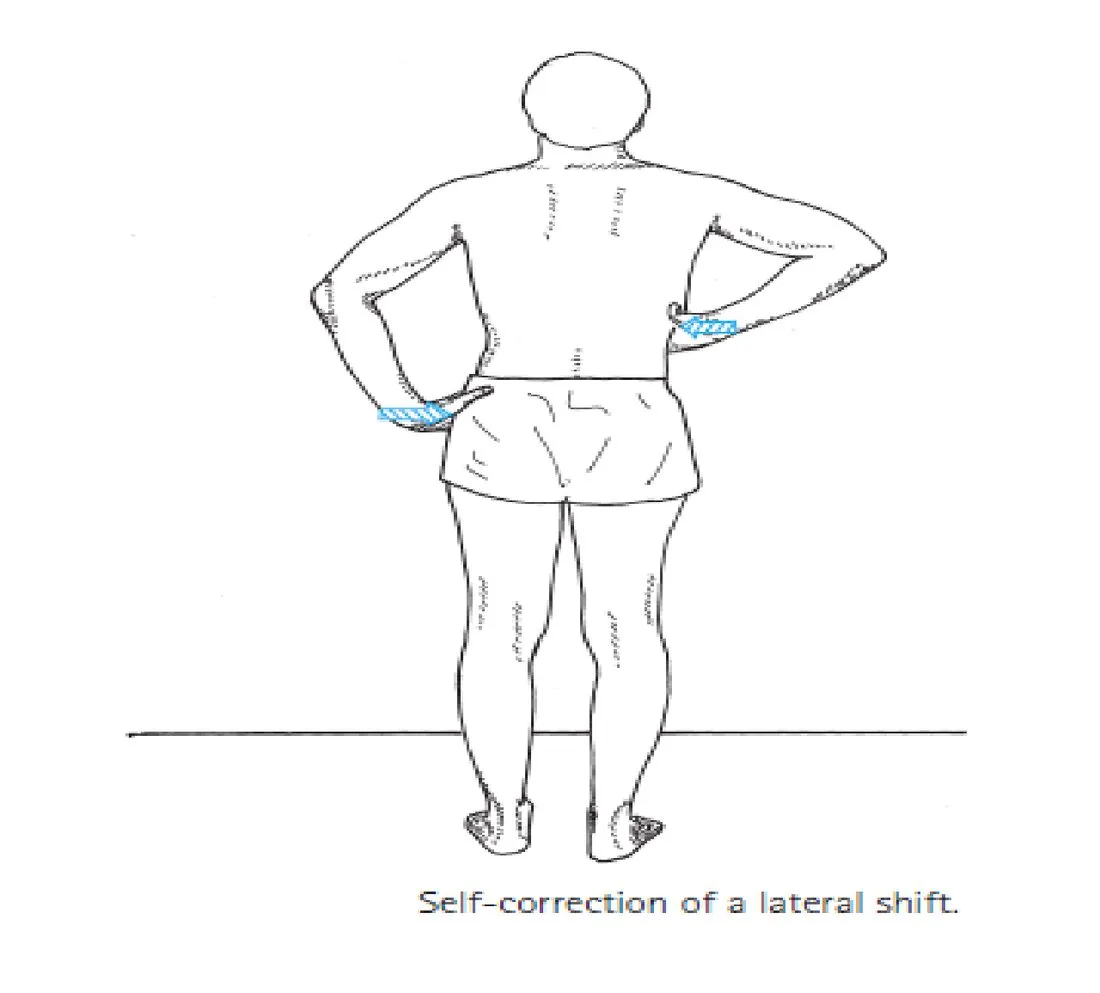
- Lateral shift correction: the patient’s thorax is shifted (e.g. toward the right, pelvis to the left). The therapist applies a Lateral glideA sideways sliding movement of the trunk over the pelvis.General meaning, not from the slides: pressure against the patient’s elbow and Thoracic cageThe rib cage: the ribs, breastbone and the thoracic part of the spine.General meaning, not from the slides while pulling the pelvis the opposite way.
- Self-correction of a lateral shift: hands on the hips, the patient glides the pelvis back under the trunk.
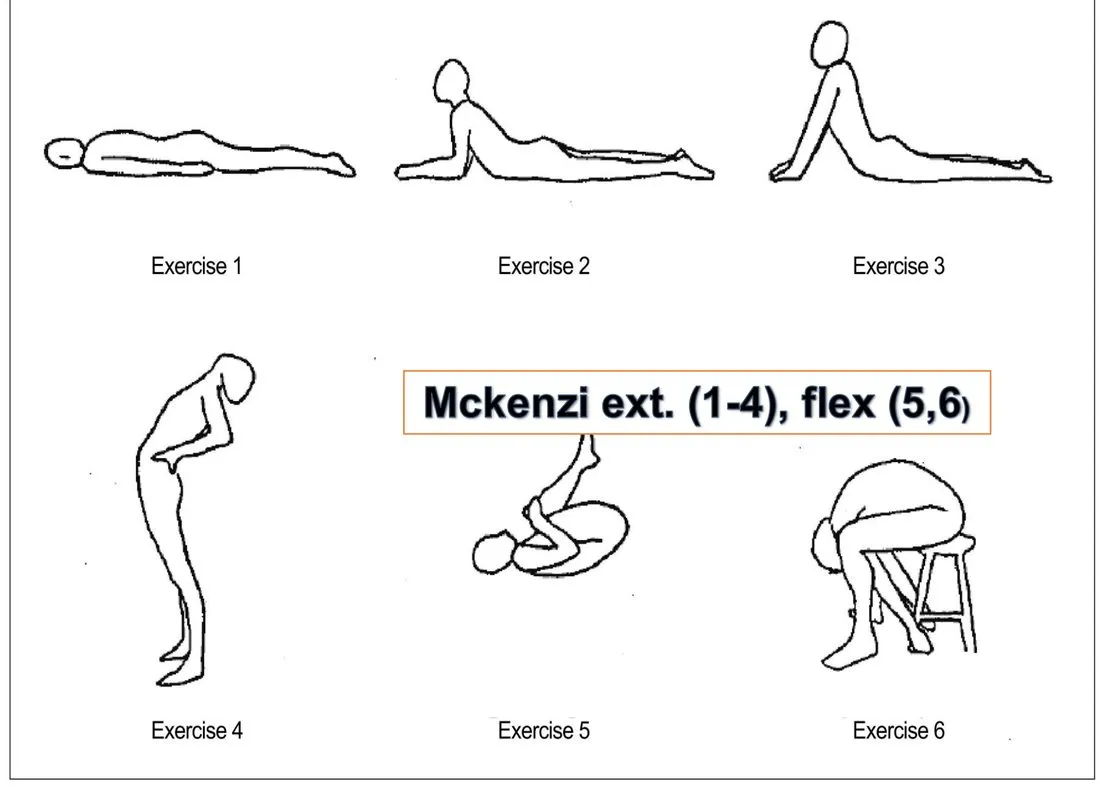
- McKenzie exercises: 1–4 = extension (prone lying, prone on elbows, press-up, standing extension); 5–6 = flexion (knees to chest in lying, sitting flexion).
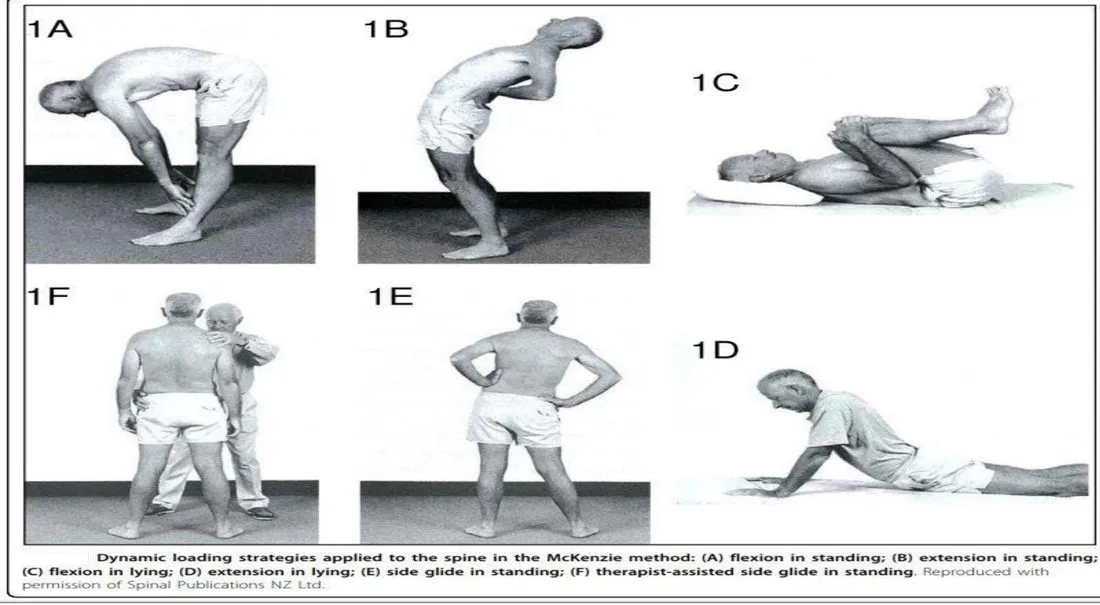
- Dynamic loading strategies: flexion in standing, extension in standing, flexion in lying, extension in lying, side glide in standing, therapist-assisted side glide.
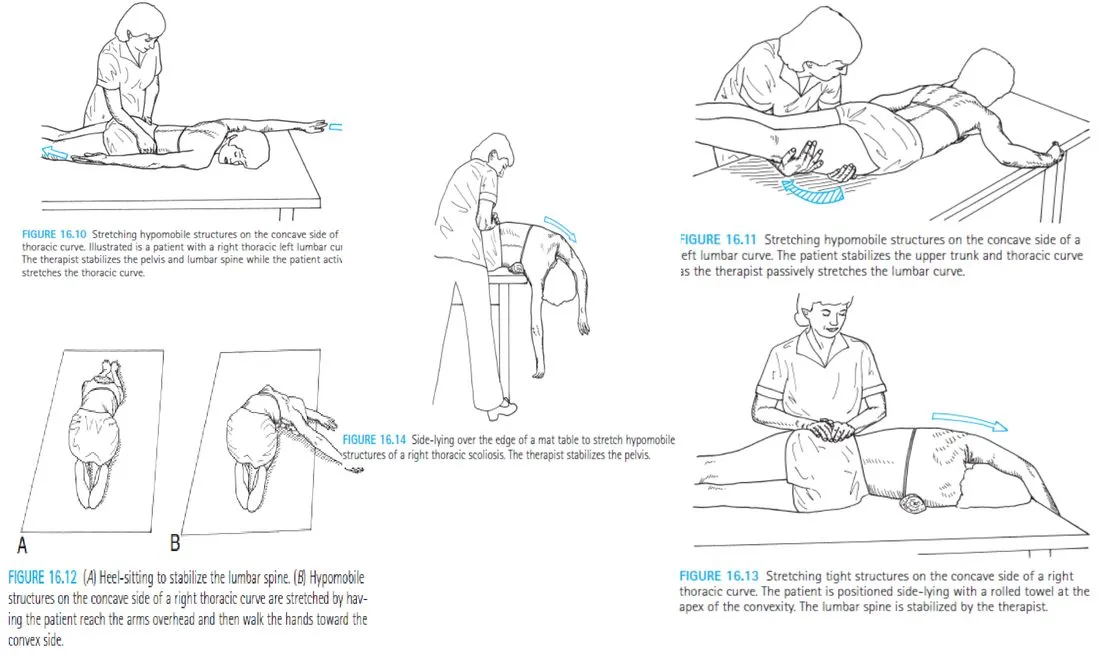
- Techniques to increase lumbar extension (prone press-up, standing) and lateral flexibility (stretching the ConcaveCurving inward, like the inside of a bowl.General meaning, not from the slides side of the curve in various positions).
Part 2 — Core Stability
Objectives
Define Core stabilityThe ability to control the position and motion of the trunk over the pelvis and leg, so force and motion can be produced, transferred and controlled in kinetic chain activities.; the three systems; Global musclesSuperficial muscles with larger mass and longer moment arm, which produce gross trunk motion and force. vs Local musclesMuscles with smaller mass and shorter moment arm, which give segmental stability, coordination and control. muscles; the Thoracolumbar fascia (TLF)A multi-layered fascial system that surrounds the erector spinae, multifidi and quadratus lumborum and supports them when they contract.; CervicalRelating to the neck, the top part of the spine.General meaning, not from the slides muscle control; neural control; effects of limb function; the Valsalva manoeuvreForcefully breathing out against a closed airway, which raises pressure in the chest and abdomen.General meaning, not from the slides.
Definition
There is no universally accepted definition of “core”, “core stability” or which muscles form the core. The working definition:
Core stability: the ability to control the position and motion of the trunk over the pelvis and leg to allow optimum production, transfer and control of force and motion to the terminal SegmentalRelating to a single spinal segment: one vertebra and the structures linked to it.General meaning, not from the slides in integrated Kinetic chainA series of linked body segments, with their joints and muscles, that work together to produce movement.General meaning, not from the slides activities.
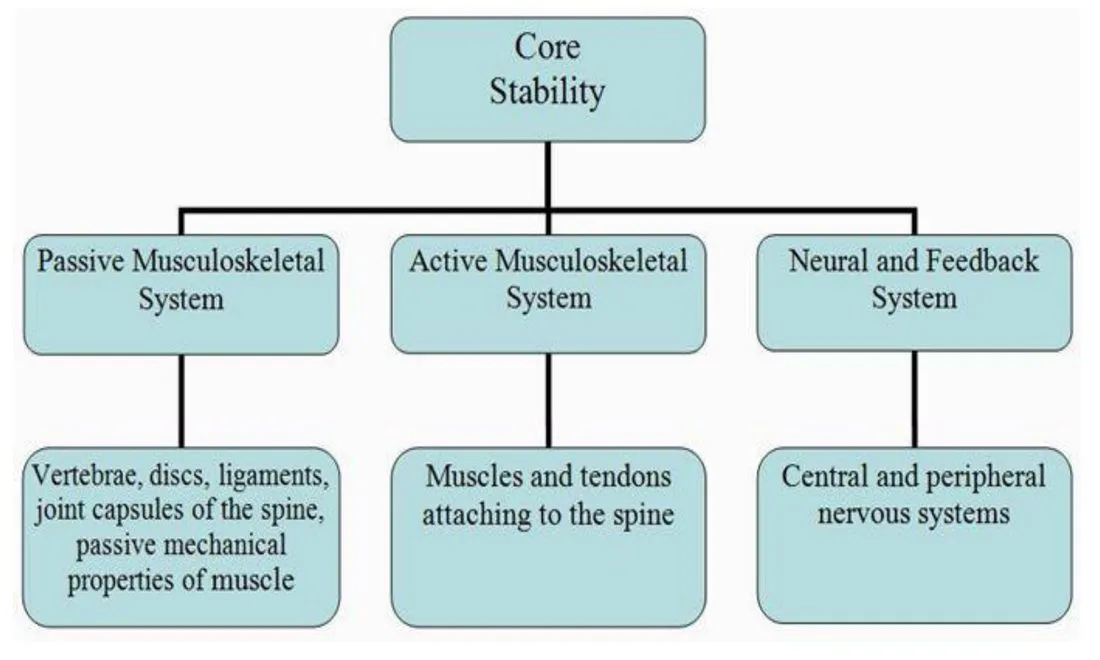
Three major systems of core stability
| System | Made of |
|---|---|
| Passive musculoskeletal systemVertebrae, discs, ligaments, joint capsules and the passive mechanical properties of muscle. | Vertebrae, discs, ligaments, joint capsules, passive mechanical properties of muscle |
| Active musculoskeletal systemThe muscles and tendons attaching to the spine. | Muscles and tendons attaching to the spine |
| Neural and feedback systemThe central and peripheral nervous systems. | Central and peripheral nervous systems |
Bergmark’s muscle classification (1989)
| Global — gross trunk motion | Local — segmental stability | Transfer musclesMuscles that transfer forces and momentum between the trunk and the limbs (axial–appendicular). — transfer forces/momentum |
|---|---|---|
| Larger mass, longer Moment armThe perpendicular distance from the line of a muscle's pull to the joint axis. A longer arm gives more turning force.General meaning, not from the slides → force production | Smaller mass, shorter moment arm → coordination and control | Axial–appendicularLinking the trunk and head (axial skeleton) with the limbs (appendicular skeleton).General meaning, not from the slides |
| LongissimusA long part of the erector spinae muscle group running along the back; thoracis is its upper (chest) part and lumborum its lower (lumbar) part.General meaning, not from the slides | IntertransversariiSmall muscles linking the transverse processes of neighbouring vertebrae.General meaning, not from the slides | Hip flexorsThe muscles at the front of the hip that lift the thigh forward and up.General meaning, not from the slides |
| IliocostalisThe outermost column of the erector spinae muscles, running from the pelvis and ribs up the back.General meaning, not from the slides | InterspinalisSmall muscles linking the spinous processes of neighbouring vertebrae.General meaning, not from the slides | Hip extensorsThe muscles at the back of the hip that move the thigh backward.General meaning, not from the slides |
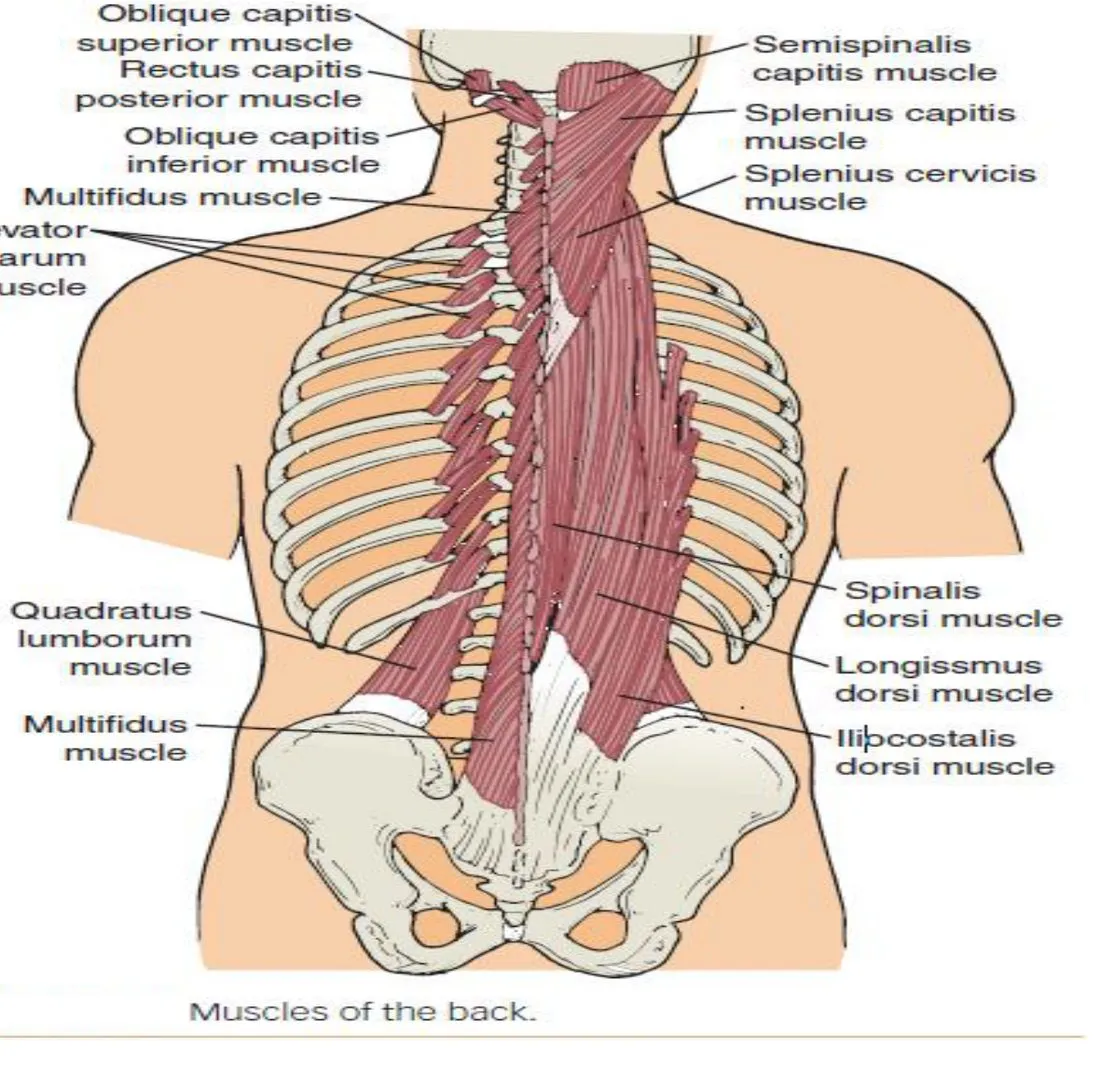
| Quadratus lumborum (QL)A deep muscle of the lower back that runs from the pelvis up to the lowest rib and the lumbar spine.General meaning, not from the slides (lateral fibres) | MultifidusSmall deep muscles along the back of the spine that span a few vertebrae and steady individual segments.General meaning, not from the slides | Hip abductorsThe muscles on the outer hip that lift the leg out to the side.General meaning, not from the slides |
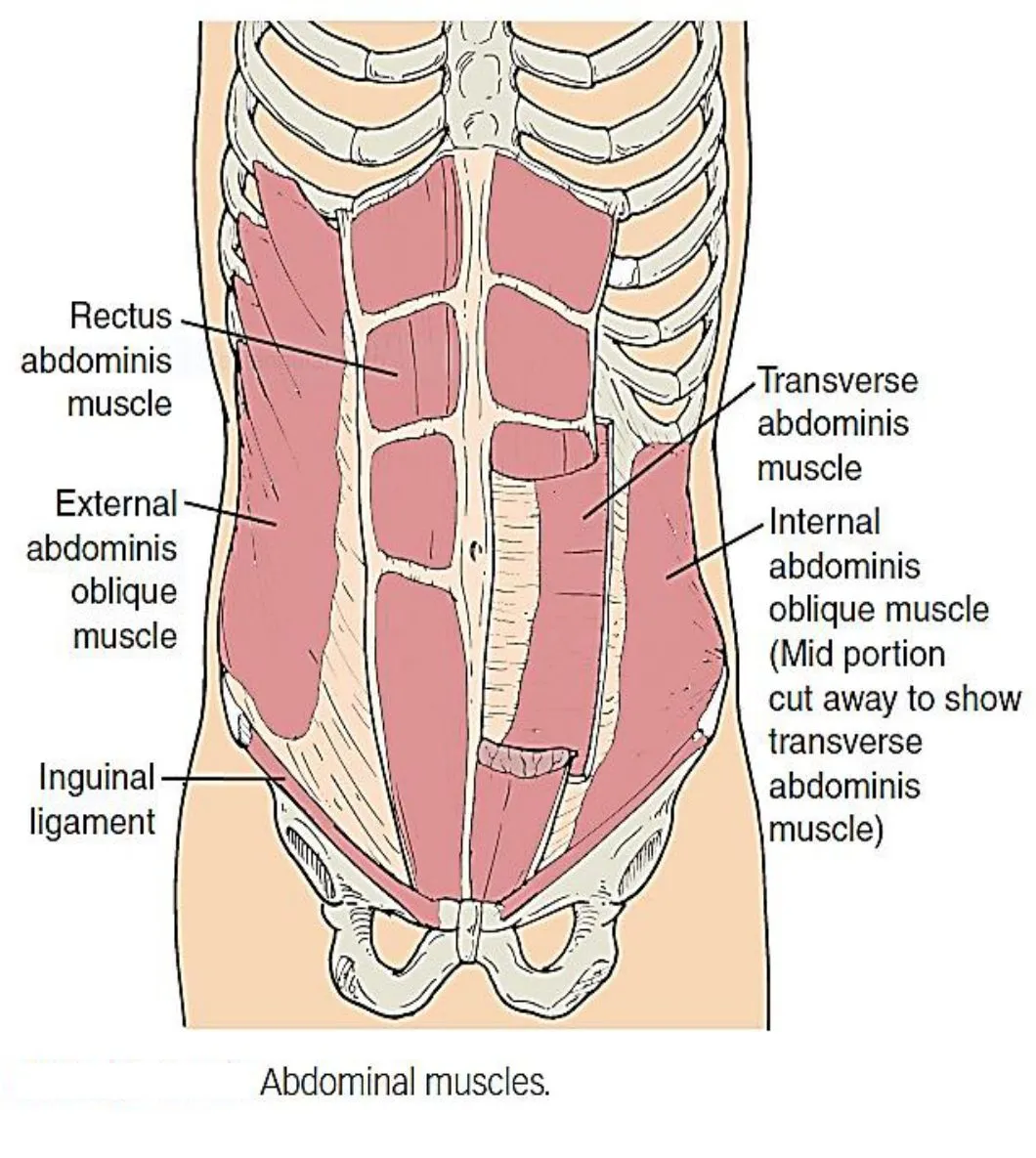
| Rectus abdominisThe paired muscle down the front of the abdomen, the 'six-pack' muscle, that bends the trunk forward.General meaning, not from the slides | Longissimus lumborum | Hip adductorsThe muscles on the inner thigh that pull the leg toward the midline.General meaning, not from the slides |
| External oblique (EO)The outermost abdominal muscle on each side of the trunk, running diagonally; it bends and rotates the trunk.General meaning, not from the slides | Iliocostalis lumborum | Scapular stabilizersThe muscles that hold the shoulder blade steady against the rib cage.General meaning, not from the slides |
| Internal oblique (IO)The abdominal muscle lying under the external oblique; it bends and rotates the trunk.General meaning, not from the slides | Quadratus lumborum (medial fibres) | Muscles acting on the GH jointGlenohumeral joint: the shoulder joint, where the humerus meets the shoulder blade.General meaning, not from the slides joint |
| Transversus abdominis (TrA)The deepest abdominal muscle, wrapping around the trunk like a corset.General meaning, not from the slides | ||
| Internal oblique (insertion into TLF) |
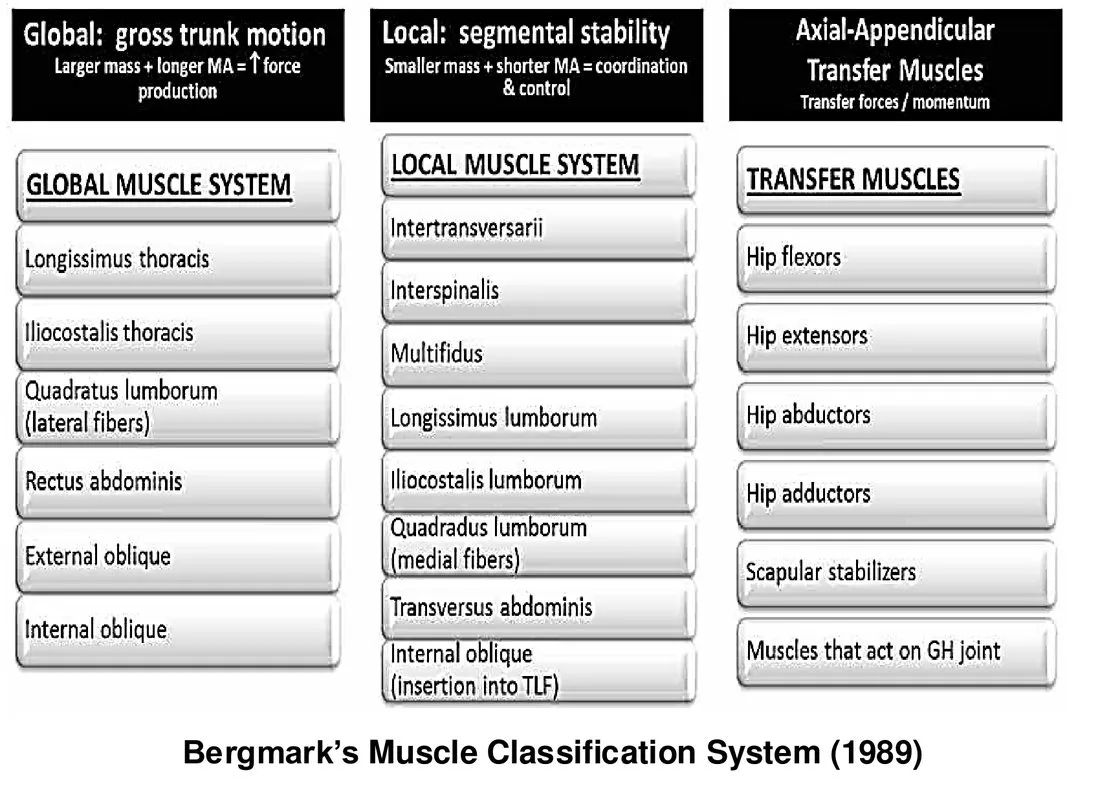
Note how QL and internal oblique appear in both columns: their lateral part is global, their medial/FasciaA sheet of connective tissue that wraps around muscles and other structures.General meaning, not from the slides part is local.
Stabilizing features: global vs deep segmental
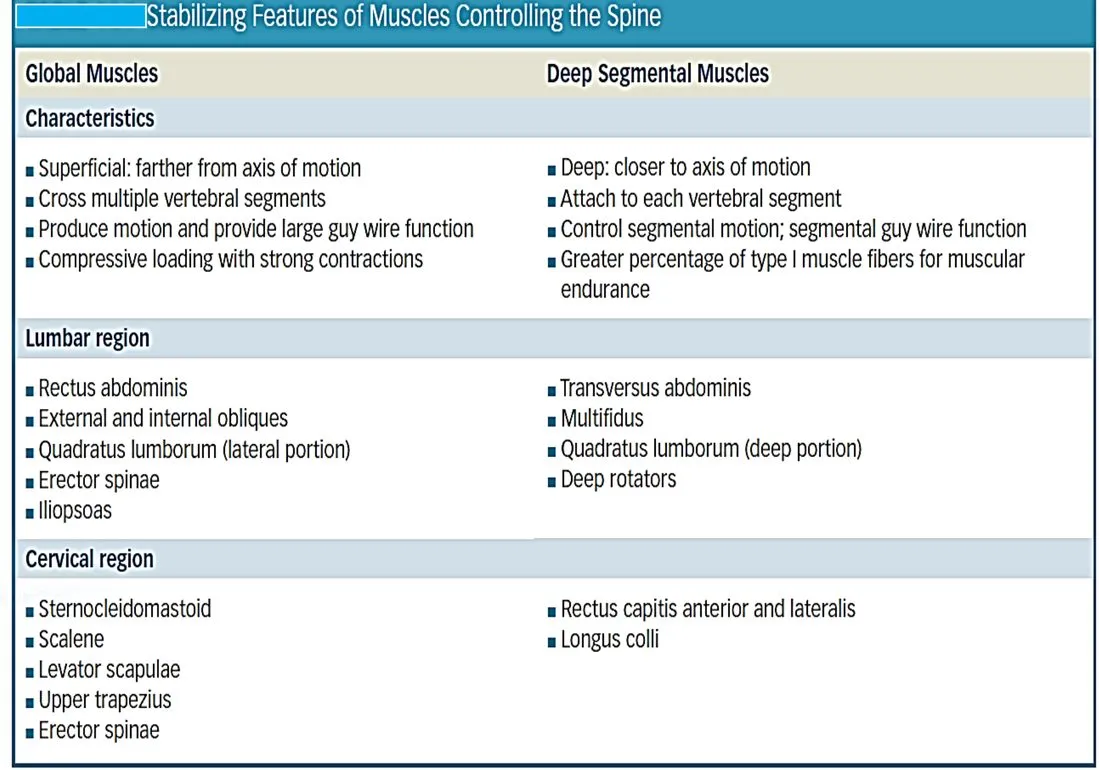
| Global muscles | Deep segmental musclesDeep muscles close to the axis of motion that attach to each vertebral segment and control segmental motion. | |
|---|---|---|
| Position | Superficial, far from the axis of motion | Deep, close to the axis |
| Span | Cross multiple segments | Attach to each vertebral segment |
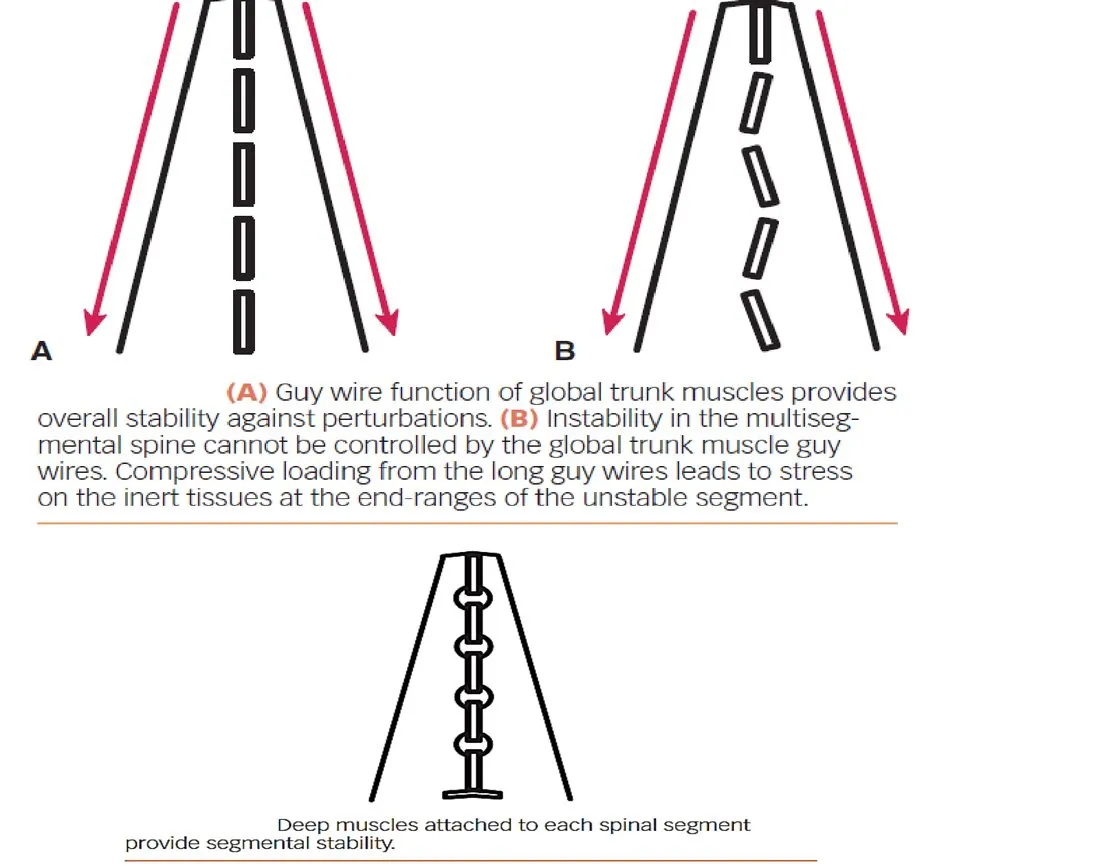
| Function | Produce motion; large Guy wireA tensioned cable that steadies a mast. Global muscles act like the guy wires of a mast, giving overall stability against disturbance. function | Control segmental motion; segmental guy-wire |
| Load | Compressive loading with strong contraction | More Type I fibresSlow-twitch muscle fibres, built for endurance and posture.General meaning, not from the slides fibres → muscular endurance |
| LumbarRelating to the lower back, the part of the spine between the chest and the pelvis.General meaning, not from the slides | Rectus abdominis, external and internal ObliquesThe external and internal oblique abdominal muscles.General meaning, not from the slides, QL (lateral), Erector spinae (ES)The long muscles along each side of the spine that straighten and extend the back.General meaning, not from the slides, IliopsoasThe deep hip flexor muscle running from the lower spine and pelvis to the top of the femur.General meaning, not from the slides | Transversus abdominis, multifidus, QL (deep), Deep rotatorsSmall deep muscles beside the spine that rotate and steady the vertebrae.General meaning, not from the slides |
| Cervical | SCMSternocleidomastoid: the muscle on each side of the neck that turns the head and bends the neck.General meaning, not from the slides, ScalenesThree pairs of muscles at the side of the neck that run from the neck vertebrae to the top two ribs.General meaning, not from the slides, Levator scapulaeA muscle at the side of the neck that lifts the shoulder blade.General meaning, not from the slides, Upper trapeziusThe upper part of the large trapezius muscle, which lifts the shoulder blade and extends the neck.General meaning, not from the slides, erector spinae | Rectus capitis anterior and lateralisTwo small deep muscles at the front and side of the top of the neck that help flex and stabilise the head.General meaning, not from the slides, Longus colliA deep muscle at the front of the neck vertebrae that flexes the neck.General meaning, not from the slides |
Guy-wire figure: the global muscles give overall stability against PerturbationA disturbance or push that knocks the body off its steady position.General meaning, not from the slides like the guy wires of a mast. But they can’t control a multisegmental spine on their own: compression from the long guy wires stresses the Inert tissuesTissues that cannot contract, such as ligaments, joint capsules and discs.General meaning, not from the slides at the End-rangeThe very end of a joint's available movement.General meaning, not from the slides of an unstable segment. Deep muscles attached to each segment provide segmental stability.
Thoracolumbar fascia (TLF)
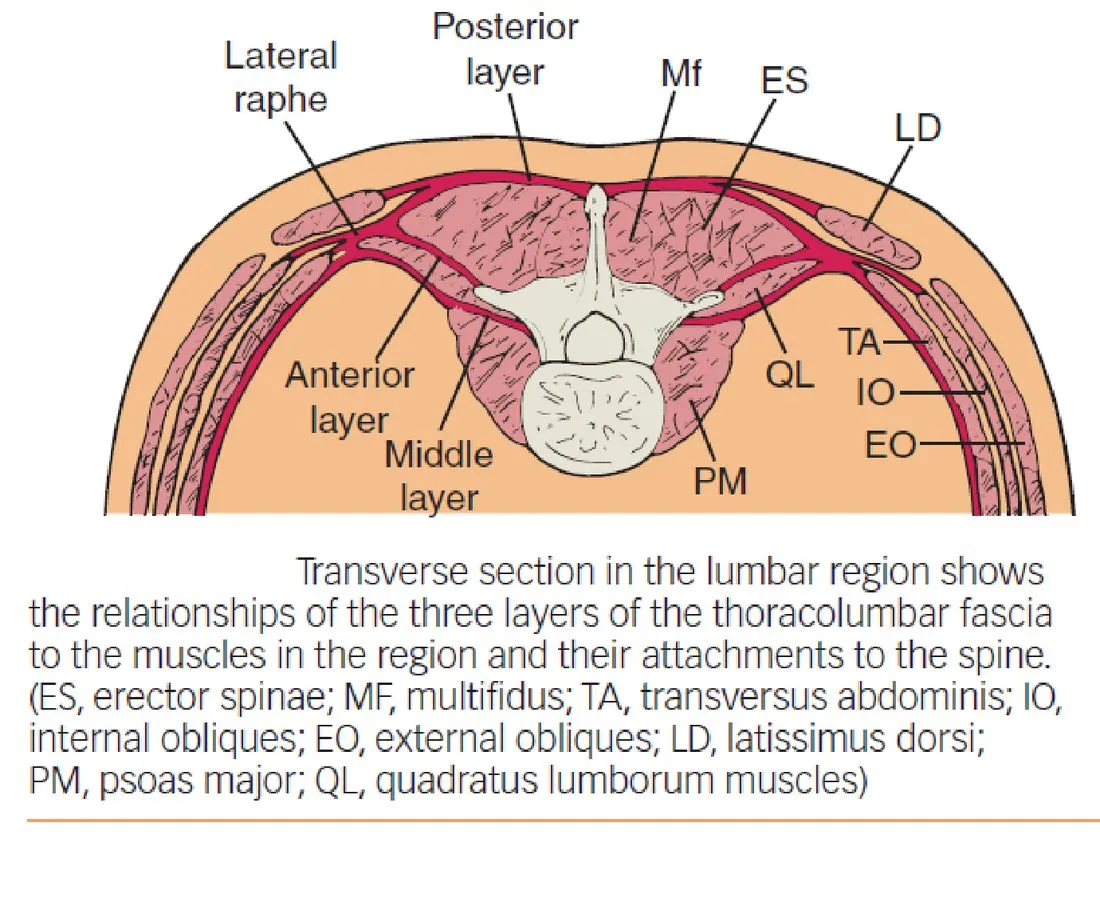
- A multi-layered fascial system that surrounds the erector spinae, multifidi and quadratus lumborum, supporting them when they contract.
- Bigger muscle bulk → more fascial tension → more stability.
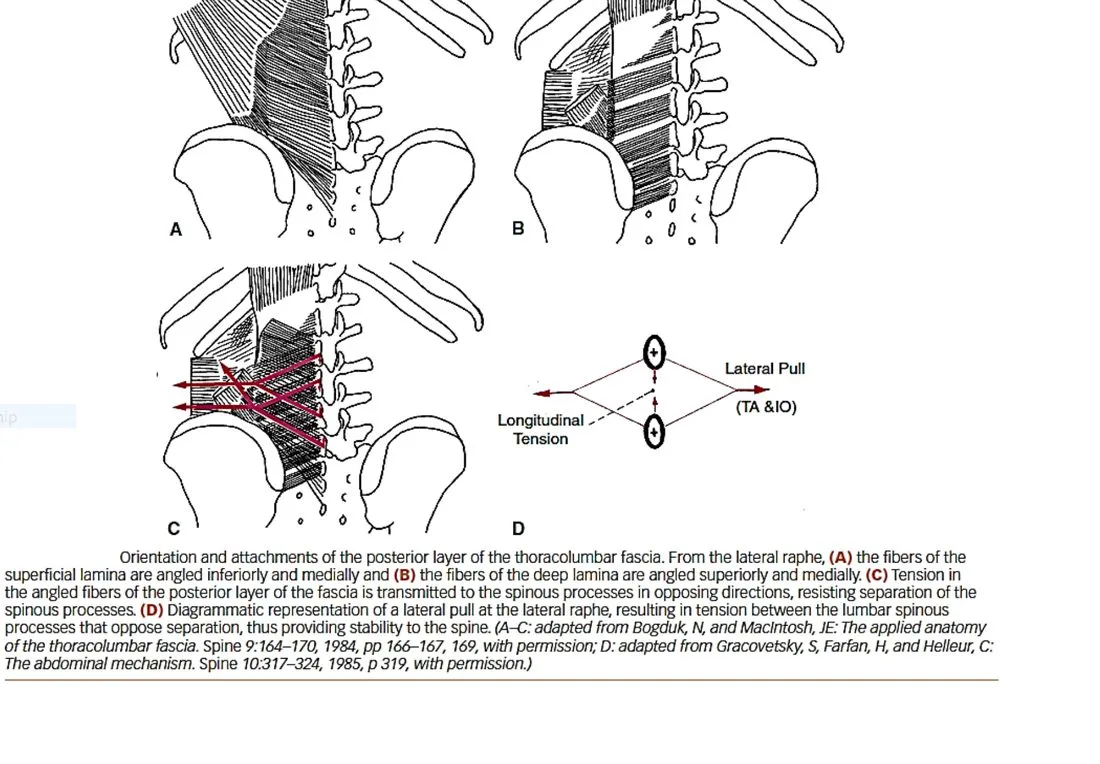
- The Latissimus dorsiThe broad muscle of the back that pulls the arm down and back.General meaning, not from the slides AponeurosisA flat, sheet-like tendon that attaches a broad muscle.General meaning, not from the slides and fibres of Serratus posterior inferiorA thin muscle on the lower back that attaches to the lower ribs.General meaning, not from the slides, internal oblique and transversus abdominis blend at the Lateral rapheThe seam at the side of the back where the layers of the thoracolumbar fascia and abdominal muscles join.General meaning, not from the slides; their contraction tensions the angled fascia and stabilizes the lumbar spine.
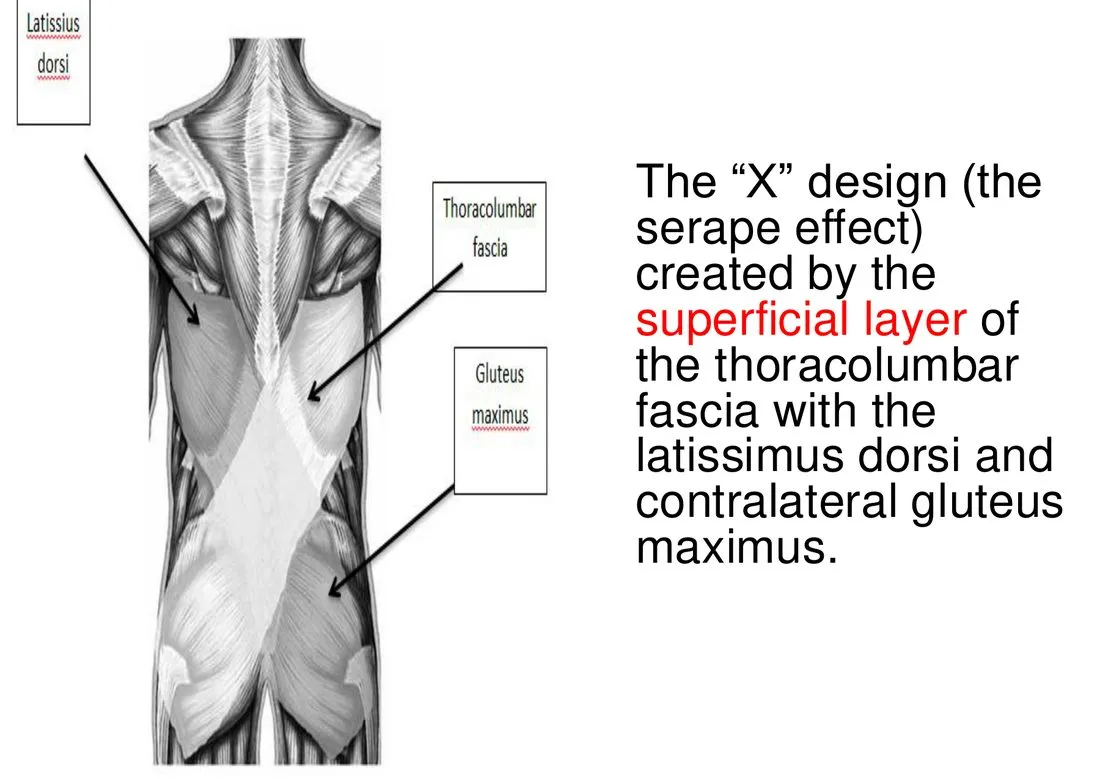
- The “X” design (Serape effectThe 'X' design: the superficial layer of the TLF links the latissimus dorsi with the contralateral gluteus maximus, stabilizing the lumbosacral junction.): the superficial layer of the TLF links the latissimus dorsi with the ContralateralOn the opposite side of the body from the structure being discussed.General meaning, not from the slides Gluteus maximusThe large buttock muscle that extends the hip.General meaning, not from the slides, stabilizing the Lumbosacral junctionThe point where the lumbar spine meets the sacrum.General meaning, not from the slides.
- Transverse section: the TLF has posterior, middle and anterior layers around ES, multifidus and QL, with TA, IO and EO joining at the lateral raphe.
Muscle control in the cervical spine
- The head pivots on the Occipito-atlantal jointsThe joints between the base of the skull (occiput) and the first neck vertebra (atlas).General meaning, not from the slides.
- The head’s centre of gravity is anterior to the joint axis → a Flexion momentA turning force that tends to bend a part forward.General meaning, not from the slides, balanced by the Cervical extensorsThe muscles at the back of the neck that tilt the head and neck backward.General meaning, not from the slides (upper trapezius and cervical erector spinae/SemispinalisA deep back and neck muscle that extends the head and spine.General meaning, not from the slides).
- Tension and fatigue in these and in levator scapulae are felt by most people with Postural syndromeRelating to posture. In McKenzie's system, a syndrome of normal tissues where pain comes from static loading at end-range, not movement, and is never referred. head and neck stress.
- Multifidus has a local stabilizing role in the neck, as in the lumbar spine.
- Jaw position and Masticatory musclesThe chewing muscles of the jaw.General meaning, not from the slides tension depend on the posture of the head on the neck.
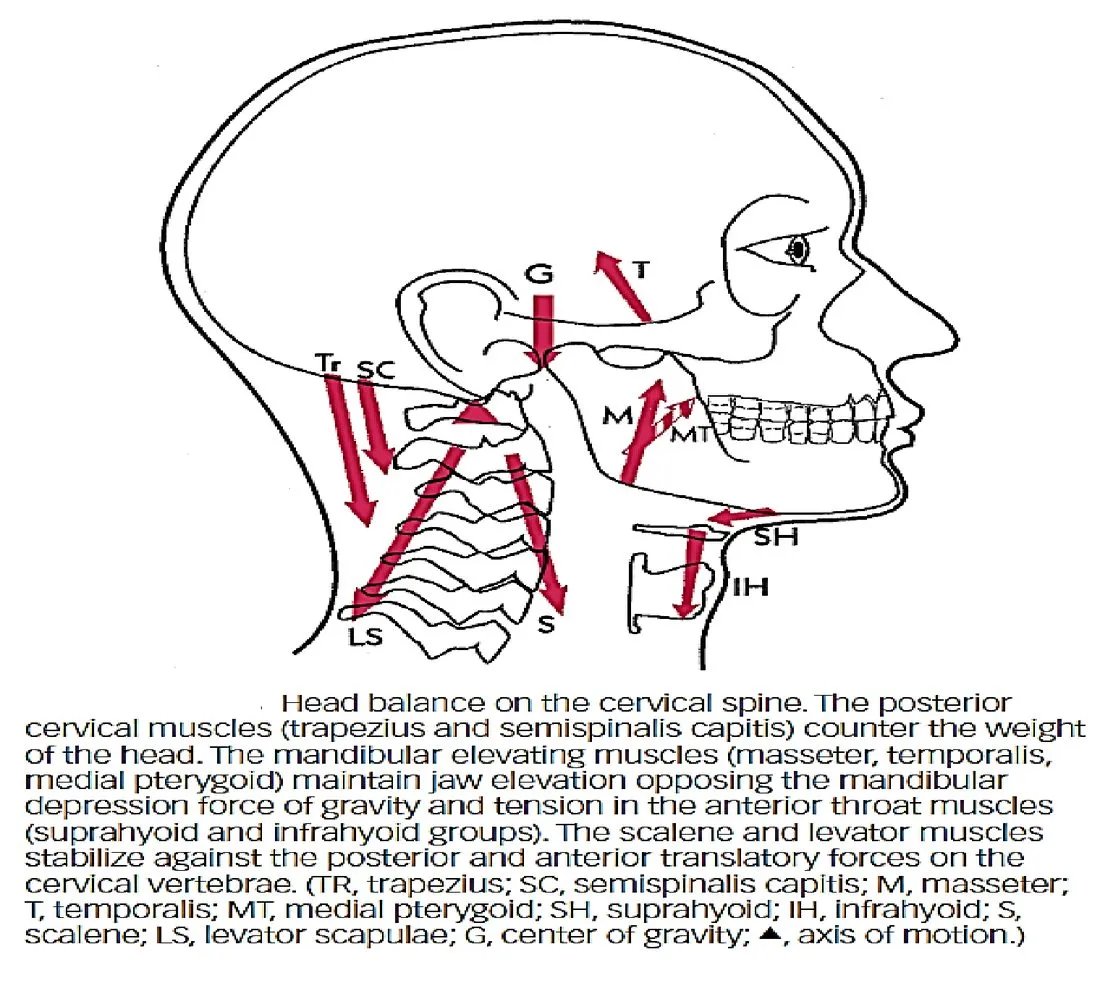
Mandibular elevatorsThe muscles that close the jaw: masseter, temporalis and medial pterygoid.General meaning, not from the slides (MasseterA strong cheek muscle that closes the jaw.General meaning, not from the slides, TemporalisA fan-shaped muscle on the side of the head that closes the jaw.General meaning, not from the slides, Medial pterygoidA muscle on the inner side of the jaw that helps close it.General meaning, not from the slides) keep the jaw partially closed at rest.
Suprahyoid and infrahyoid musclesMuscle groups above (supra-) and below (infra-) the hyoid bone in the neck. They help swallowing and move the jaw and neck.General meaning, not from the slides and infrahyoid groups:
- Help swallowing and balance the jaw against the masticatory muscles; flex the neck when rising from SupineLying face up, on the back.General meaning, not from the slides.
- In Forward head postureA posture in which the head sits forward of the shoulders.General meaning, not from the slides, they and the longus colli become stretched and weak, so the person lifts the head with the SCM.
- In forward head posture the suprahyoids pull the MandibleThe lower jaw bone.General meaning, not from the slides into DepressionMoving a body part downward, such as lowering the jaw.General meaning, not from the slides, which the elevators counteract with sustained contraction to keep the mouth closed.
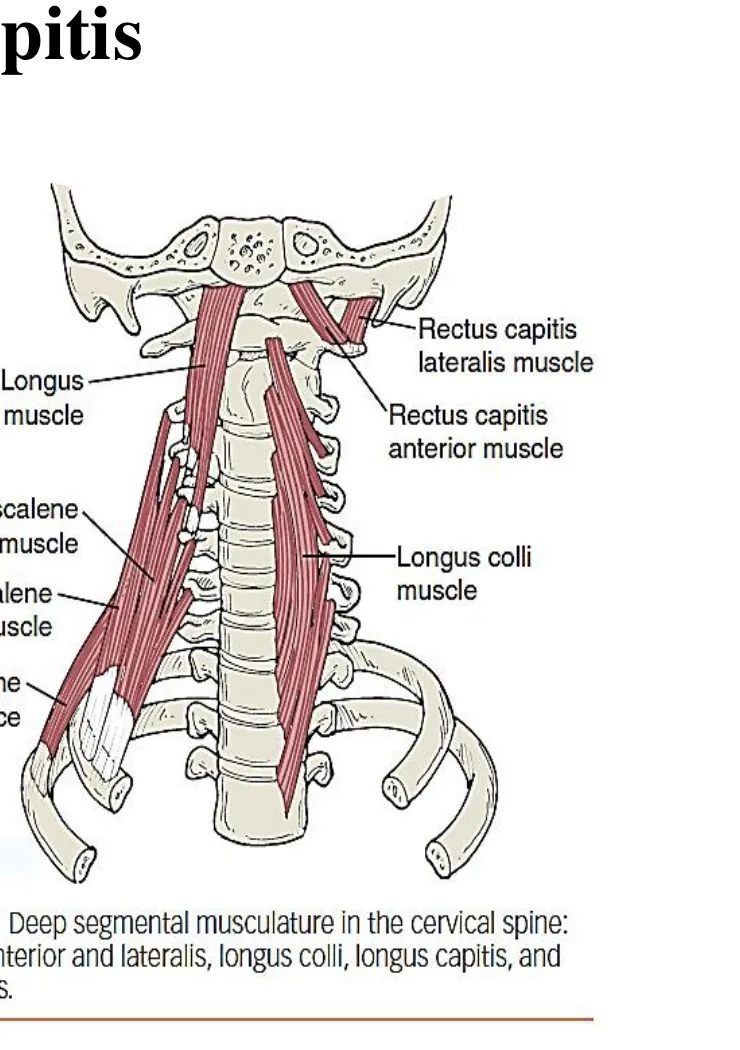
Deep craniocervical flexorsThe deep muscles at the front of the upper neck that flex the head and neck and support the spine.General meaning, not from the slides (rectus capitis anterior and lateralis, longus colli, Longus capitisA deep muscle at the front of the neck that flexes the head.General meaning, not from the slides):
- Segmental attachments; dynamic support of the neck and head.
- Longus colli: important for Axial extensionLengthening the neck upward by drawing the head back (retraction).General meaning, not from the slides (RetractionPulling a part backward, for example drawing the head and chin back over the neck.General meaning, not from the slides); works with the SCM in cervical flexion.
- Without longus colli, the SCM would increase cervical LordosisThe normal inward curve of the lower back or neck. Increased lordosis means the curve is exaggerated.General meaning, not from the slides when trying to flex.
Role of muscle endurance
- Strength matters for large or unpredictable loads (heavy work, sport, falls), but only ~10% of maximum contraction gives stability in usual situations.
- Slightly more is needed in a segment damaged by disc disease or Ligament laxityLooseness of the ligaments, so the joint moves more than normal.General meaning, not from the slides.
- Poor Back extensorsThe muscles along the spine that straighten the back.General meaning, not from the slides endurance is strongly associated with LBPLow back pain.General meaning, not from the slides.
- All back muscles have more type I than Type II fibresFast-twitch muscle fibres, built for quick, forceful movements.General meaning, not from the slides fibres, reflecting their postural/stabilizing role.
Neurological control
- The nervous system coordinates the trunk muscles’ response to expected and unexpected forces, at the right time and by the right amount, by modulating stiffness and movement.
Feed-forward controlThe CNS activates trunk muscles before limb movement to keep the spine stable.:
- The CNSCentral nervous system: the brain and spinal cord.General meaning, not from the slides activates trunk muscles before limb movement to keep the spine stable.
- Anticipatory activation of transversus abdominis and deep multifidus is independent of the direction or speed of the disturbance.
- Superficial trunk muscles vary with the direction of limb movement (their guy-wire role controls the Centre of massThe point at which the body's mass is balanced.General meaning, not from the slides).
- In LBP patients: delayed TrA RecruitmentThe switching on of muscle fibres or muscles to do a task.General meaning, not from the slides in all directions, and delayed recruitment of rectus abdominis, erector spinae and obliques specific to the movement direction.
Effects of limb function on spinal stability
Without spinal stabilization, limb-girdle muscles transmit force ProximalCloser to the trunk or the point of attachment of a limb; proximally means in that direction.General meaning, not from the slides and move the spine, overstressing it. Clinical tips:
- Hip flexion: the AbdominalsThe muscles of the abdominal wall.General meaning, not from the slides stabilize the pelvis and lumbar spine against the iliopsoas pull, preventing increased lordosis and anterior ShearA force that tries to slide one layer over another, for example one vertebra over the next.General meaning, not from the slides.
- Pushing: IntercostalsThe small muscles between the ribs.General meaning, not from the slides and abdominals stabilize the ribs so Pectoralis majorThe large chest muscle that pulls the arm forward and across the body.General meaning, not from the slides and Serratus anteriorA muscle along the side of the rib cage that holds the shoulder blade against the ribs and helps push forward.General meaning, not from the slides can push effectively.
- Lifting and pulling: longus colli stabilizes the neck so the upper trapezius doesn’t cause excessive lordosis.
Localized fatigue and muscle imbalance
- Stabilizer fatigue comes from repetitive activity, heavy exertion or faulty posture, and raises injury risk.
- Prolonged repetitive lifting changes spine–lower limb motion and recruitment patterns, increasing anterior/posterior shear in the lumbar spine.
- Imbalances in flexibility and strength of the hip, shoulder and neck muscles put asymmetrical forces on the spine → faulty posture.
Intra-abdominal pressure (IAP) and the Valsalva manoeuvre
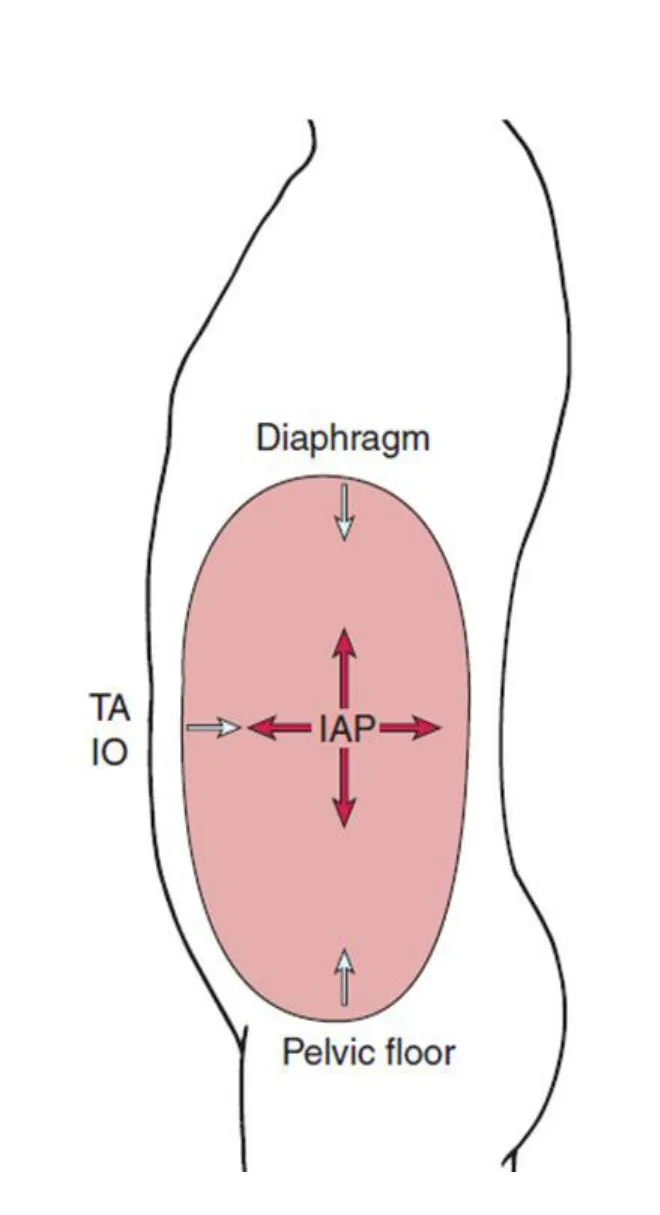
- In the Valsalva manoeuvre, TrA, IO and EO contract and raise Intra-abdominal pressure (IAP)Pressure inside the abdomen. A rise in IAP helps unload the spine and tension the TLF, which contributes to stability..
- TrA alone pushes the abdominal contents up against the DiaphragmThe dome-shaped breathing muscle under the lungs, separating the chest from the abdomen.General meaning, not from the slides, so the diaphragm and Pelvic floorThe muscles that form the base of the pelvis, supporting the organs above.General meaning, not from the slides contract in synchrony with TrA to close the chamber.
- How IAP helps stability:
- Unloads compressive forces on the spine
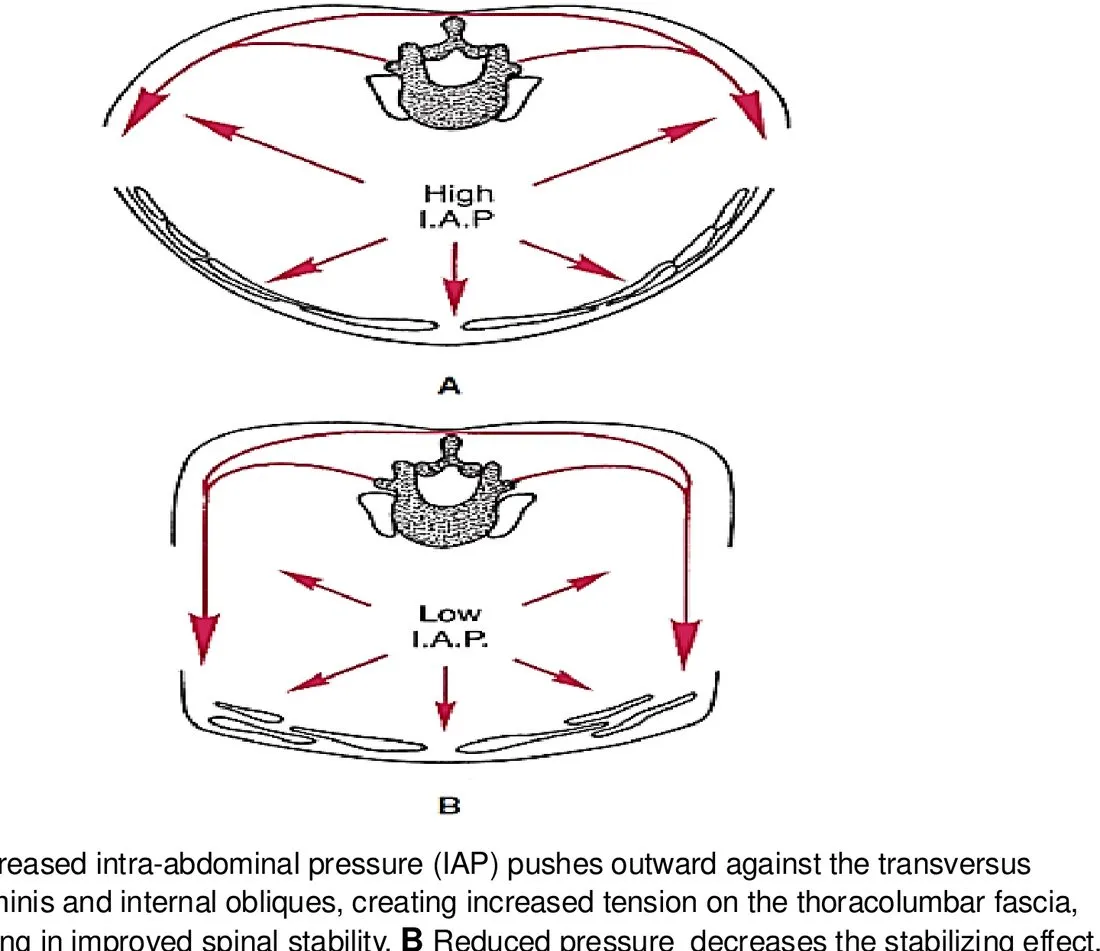
- Pushes out against the abdominals, improving their Length–tension relationshipHow much force a muscle can produce at different lengths.General meaning, not from the slides and tensioning the TLF
- May prevent buckling of the spine
- High IAP → more TLF tension → more stability; low IAP → less.
Valsalva cautions:
- Common when lifting heavy loads, but has cardiovascular risks, so teach patients to exhale while keeping the abdominal contraction.
- Holding the breath while contracting the abdominals delays TrA activation; since TrA is needed for segmental stability, exhaling during exertion reinforces stability.
Impaired posture may be the cause of pain, or the result of a traumatic or pathological event.
Core muscle training (practical)
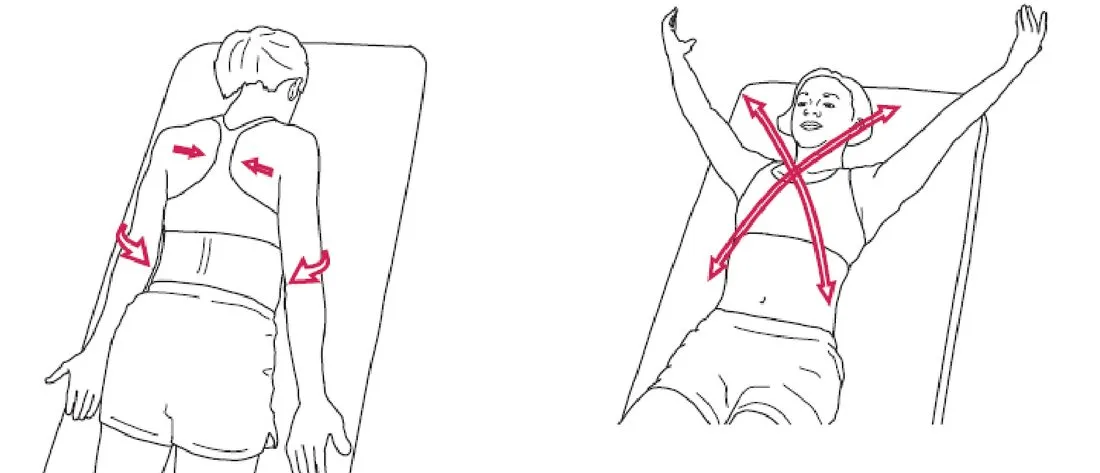
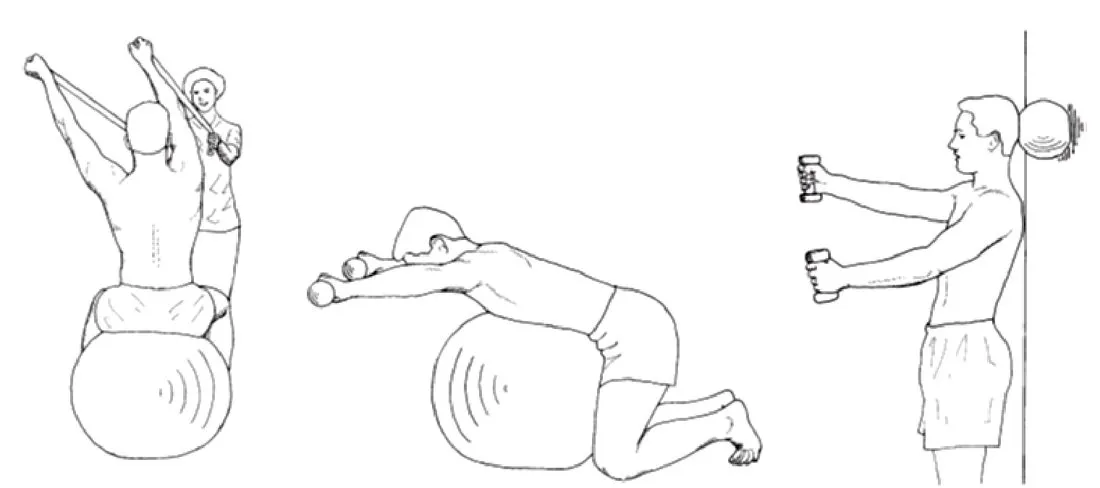
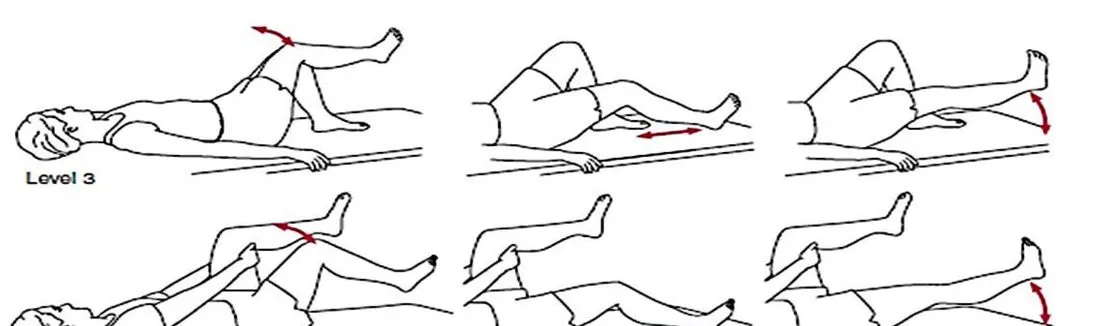
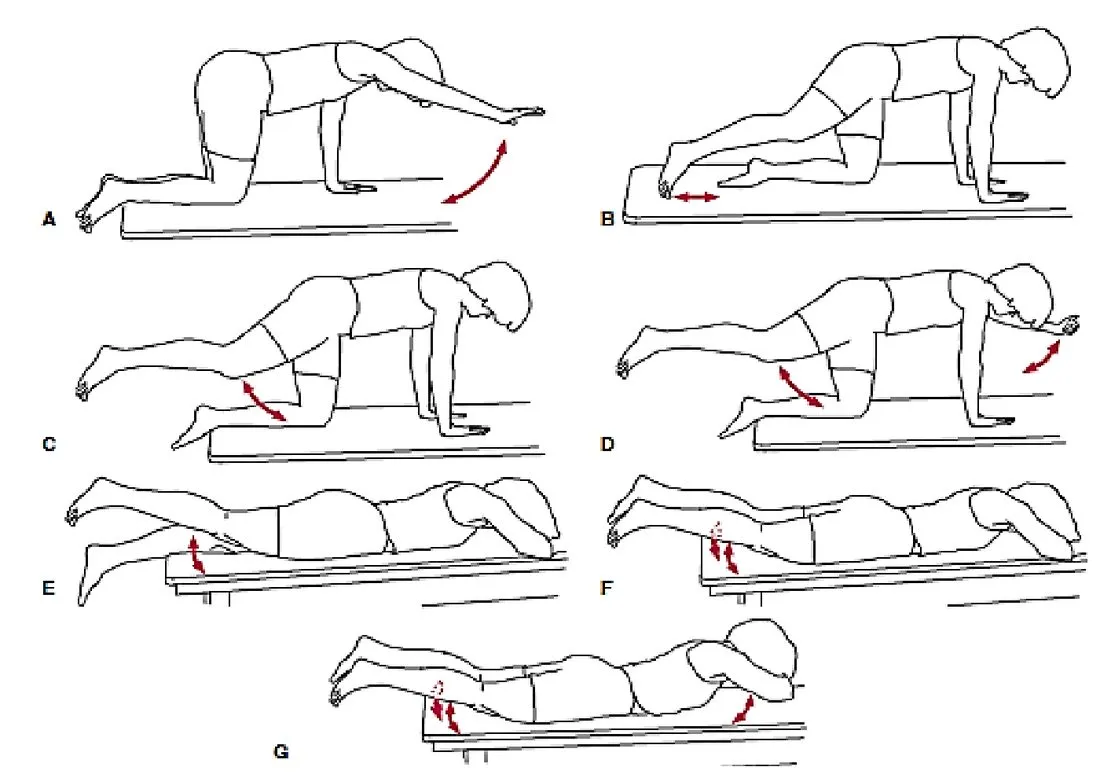
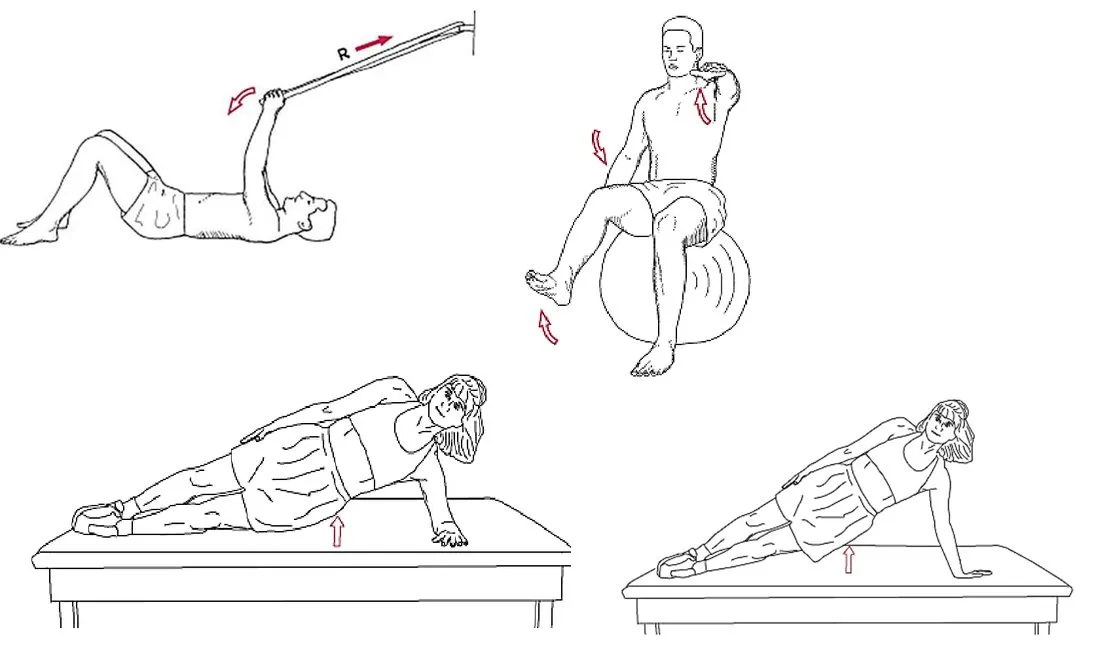
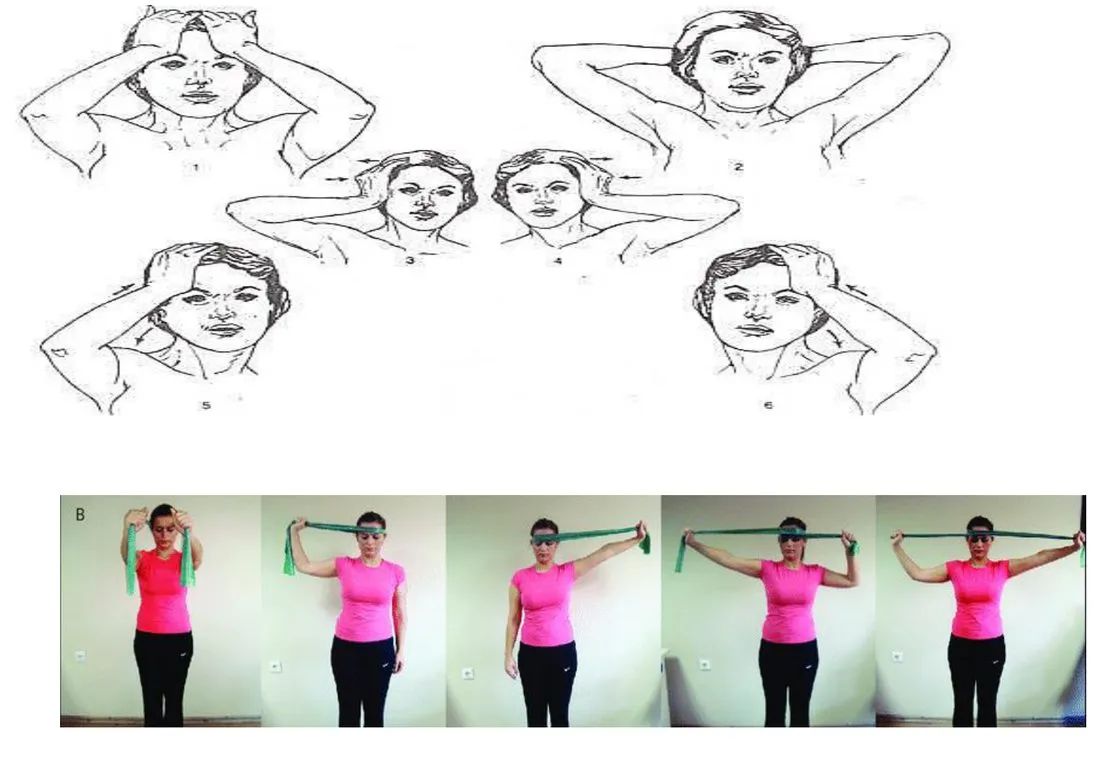
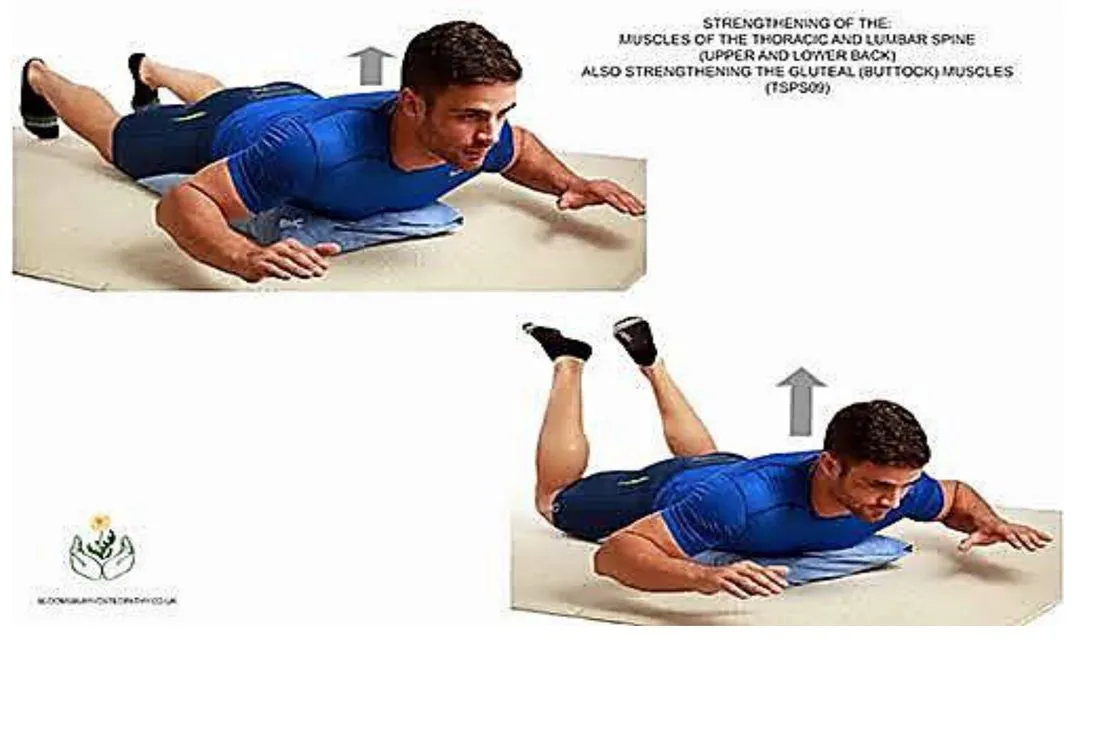
Exercise for muscle performance, endurance and function is built on a base of activating the deep segmental and global stabilizers:
- Deep segmental activation — cervical and lumbar
- Global stabilizationTraining the large, superficial trunk muscles to steady the spine.General meaning, not from the slides — cervical and lumbar
- Stabilization with CardiopulmonaryRelating to the heart and lungs.General meaning, not from the slides endurance
- Stabilization with functional training
- Transitional stabilization exercises
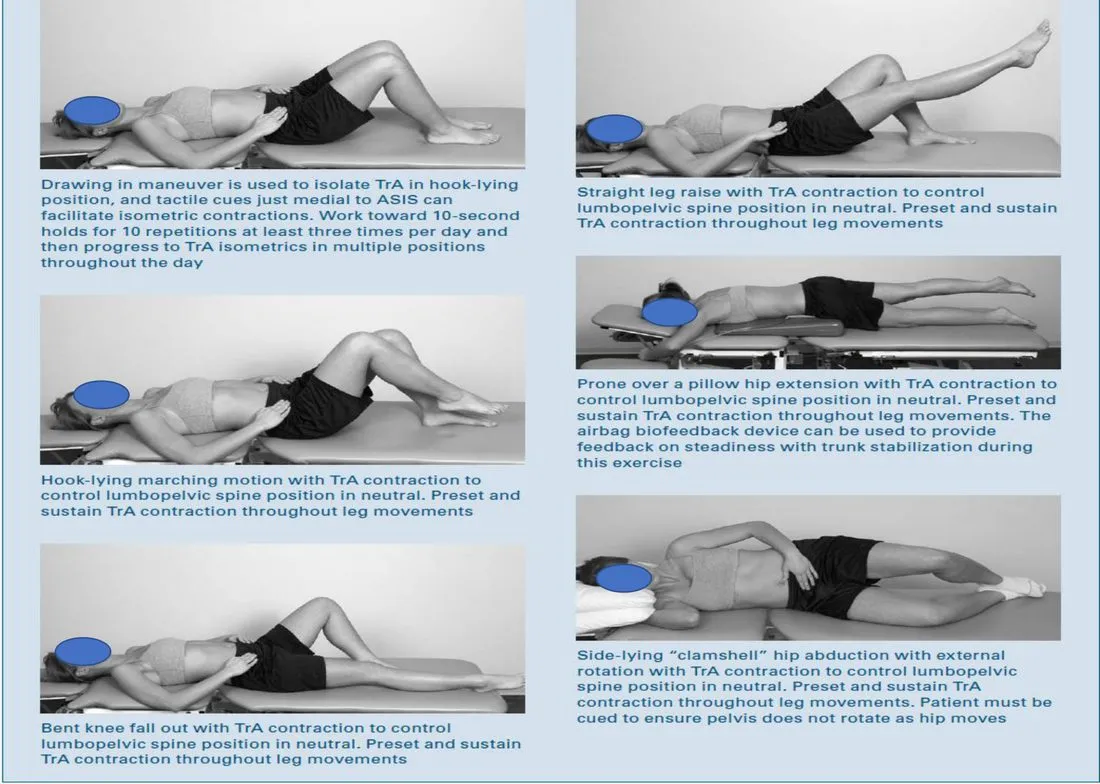
TrA training examples (slide):
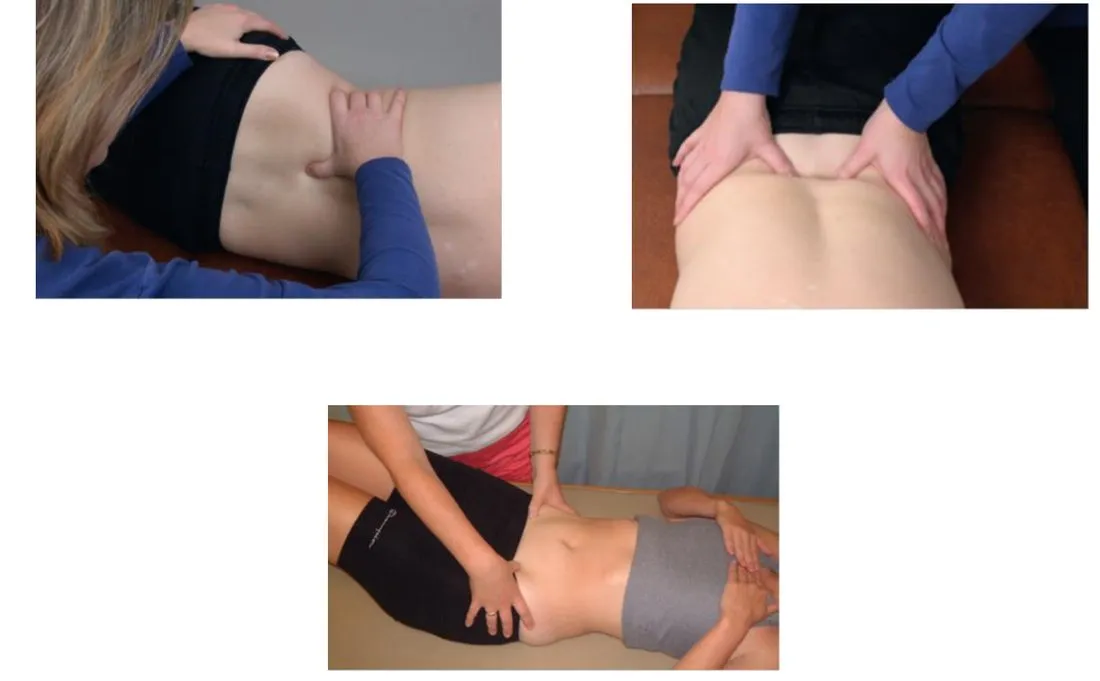
- Drawing-in manoeuvreA TrA exercise in which the lower abdomen is gently drawn in toward the spine.General meaning, not from the slides in Hook-lyingLying on the back with the knees bent and the feet flat.General meaning, not from the slides, Tactile cueA touch used as a prompt to help the patient feel the right muscle working.General meaning, not from the slides just medial to the ASISAnterior superior iliac spine: the bony point at the front of the pelvis.General meaning, not from the slides; work toward 10-second holds × 10 reps, at least 3 times a day, then TrA IsometricA muscle contraction in which the muscle tenses but the joint does not move.General meaning, not from the slides in other positions.
- With TrA TrA pre-setContracting the TrA before the movement begins and holding it during the movement.General meaning, not from the slides and held: Hook-lying marchingFrom hook-lying, lifting one foot at a time off the surface as if marching, while holding the TrA.General meaning, not from the slides, Bent-knee fall-outFrom hook-lying, letting one bent knee fall out to the side and then returning it.General meaning, not from the slides, Straight leg raiseLifting a straightened leg off the surface.General meaning, not from the slides, Prone hip extensionLying face down and lifting the leg backward at the hip.General meaning, not from the slides over a pillow, Side-lying clamshellLying on one side with the knees bent and opening the top knee like a clamshell, without rotating the pelvis.General meaning, not from the slides (pelvis must not rotate).
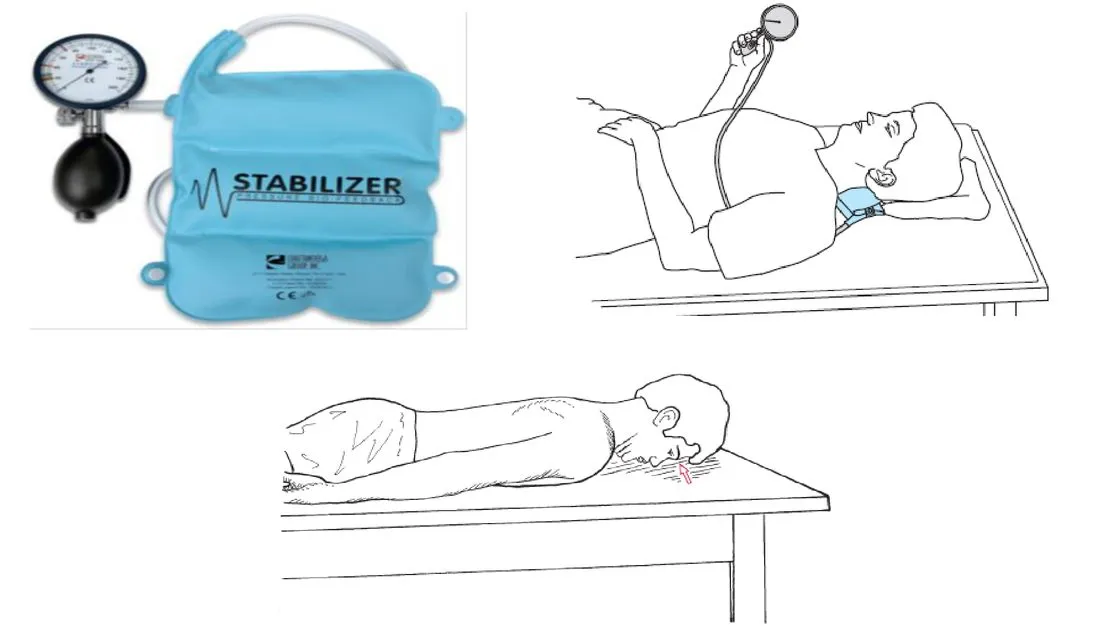
- Pressure biofeedback (Stabilizer)A device with an air-filled pressure cuff and gauge that gives feedback on lumbopelvic steadiness. (Stabilizer™) gives feedback on LumbopelvicRelating to the lumbar spine and the pelvis together.General meaning, not from the slides steadiness.
Part 3 — Spinal Traction
Definition
Spinal tractionTraction forces applied to the cervical and lumbar spine through mechanical systems such as tables, pulleys, cables and weights, to treat neck and back pain. = TractionA pulling force applied to the spine or a limb.General meaning, not from the slides forces applied to the CervicalRelating to the neck, the top part of the spine.General meaning, not from the slides and LumbarRelating to the lower back, the part of the spine between the chest and the pelvis.General meaning, not from the slides spine through mechanical systems: tables, pulleys, cables and weights, to treat neck and back pain.
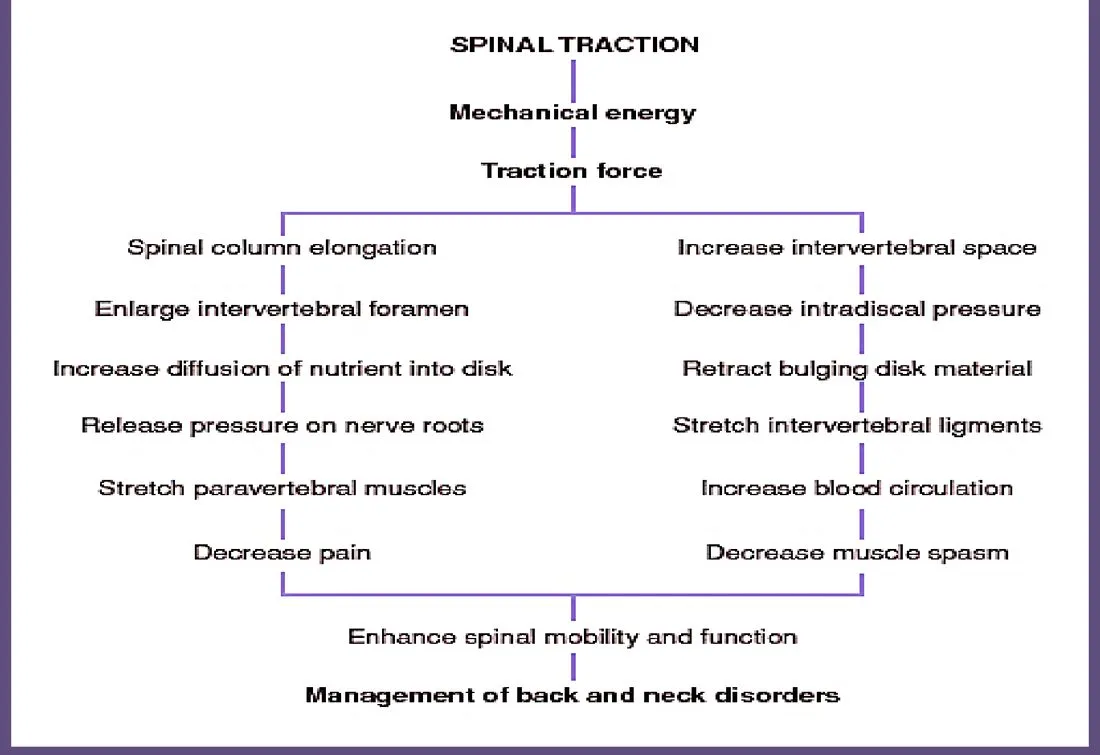
Effects (flowchart)
Mechanical energy → traction force →
- Spinal column elongation · increased intervertebral space
- Enlarged Intervertebral foramenThe opening between two vertebrae where a spinal nerve leaves the spinal canal.General meaning, not from the slides · decreased Intradiscal pressureThe pressure inside the intervertebral disc.General meaning, not from the slides
- Nutrient diffusion into the disc · RetractionPulling a part backward, for example drawing the head and chin back over the neck.General meaning, not from the slides of bulging disc material
- Release of pressure on nerve roots · stretch of intervertebral ligaments
- Stretch of Paravertebral musclesThe muscles that lie alongside the spine.General meaning, not from the slides · increased blood circulation
- Decreased pain · decreased muscle spasm → Enhanced spinal mobility and function
Therapeutic effects and indications
| Cervical | Lumbar |
|---|---|
| ↑ Fluid exchange and nutrient transport in the disc | ↑ Fluid exchange and nutrient transport in the disc |
| ↑ Intervertebral foramen size during traction | Passive traction can reduce intradiscal pressure or make it negative; patient-generated traction may increase it. Pressures return quickly when traction stops |
| ↓ Disc herniationA change in the disc in which disc material bulges beyond its normal edge.General meaning, not from the slides extent (measured immediately after) | Herniated material may shrink in some subjects during traction; usually temporary. A cumulative effect with repeated sessions is possible, but evidence is very limited |
| Affects cervical muscle activity |
N.B. How long any biomechanical or physiological effect lasts is not known.
Types of traction
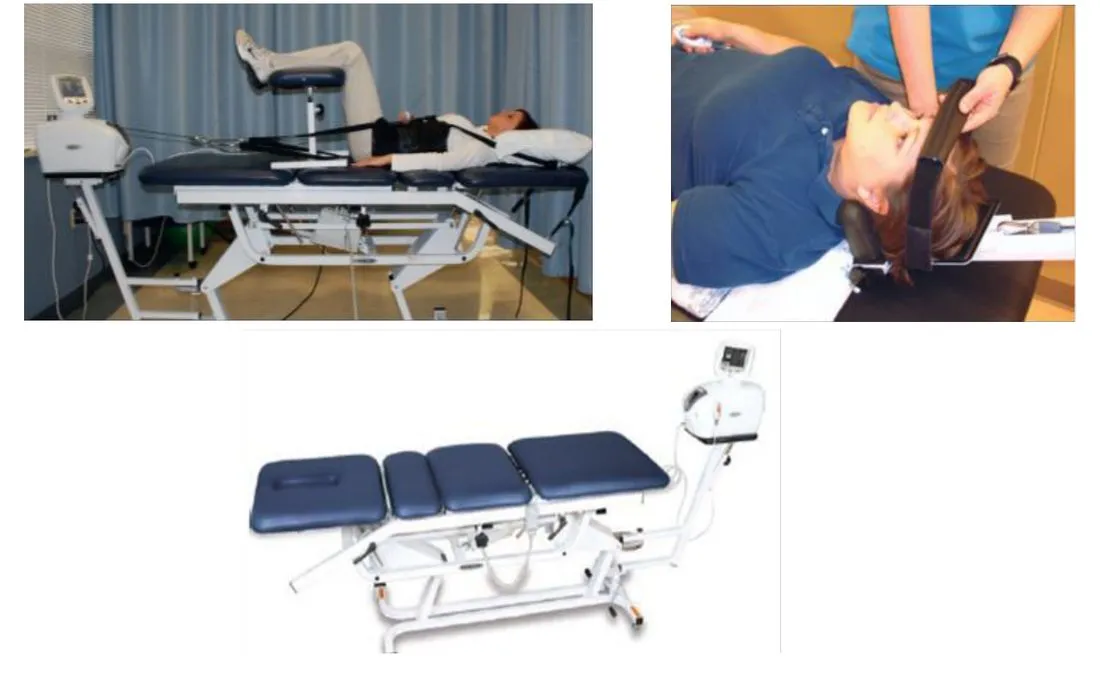
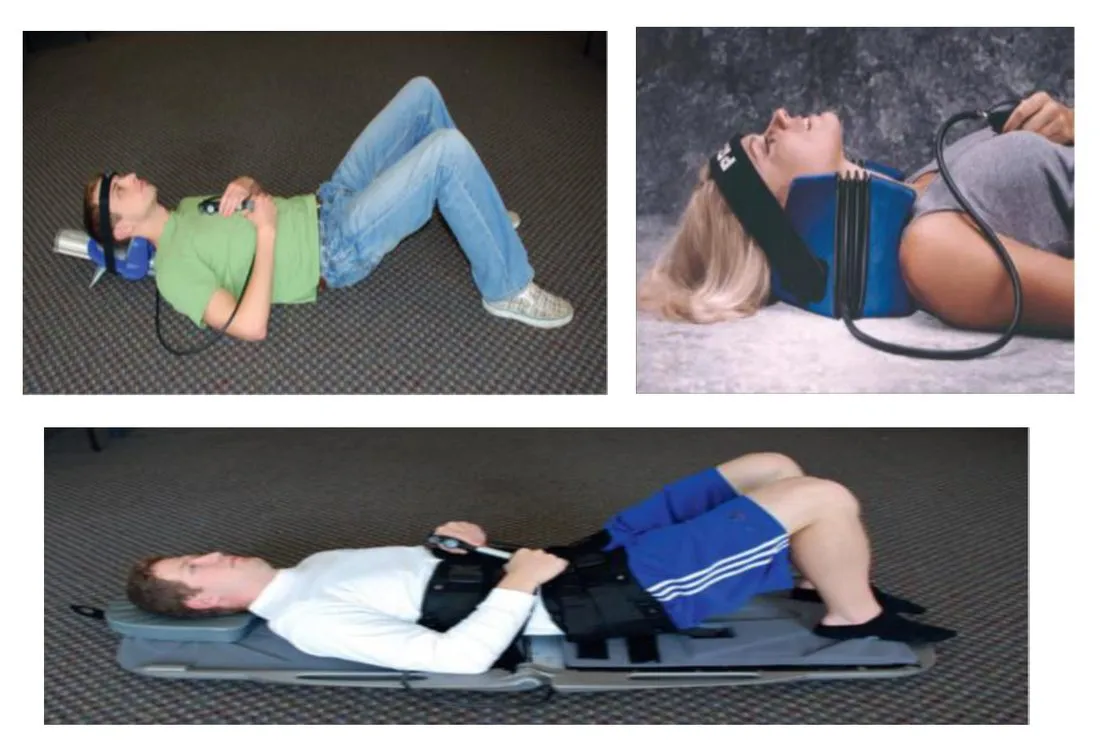
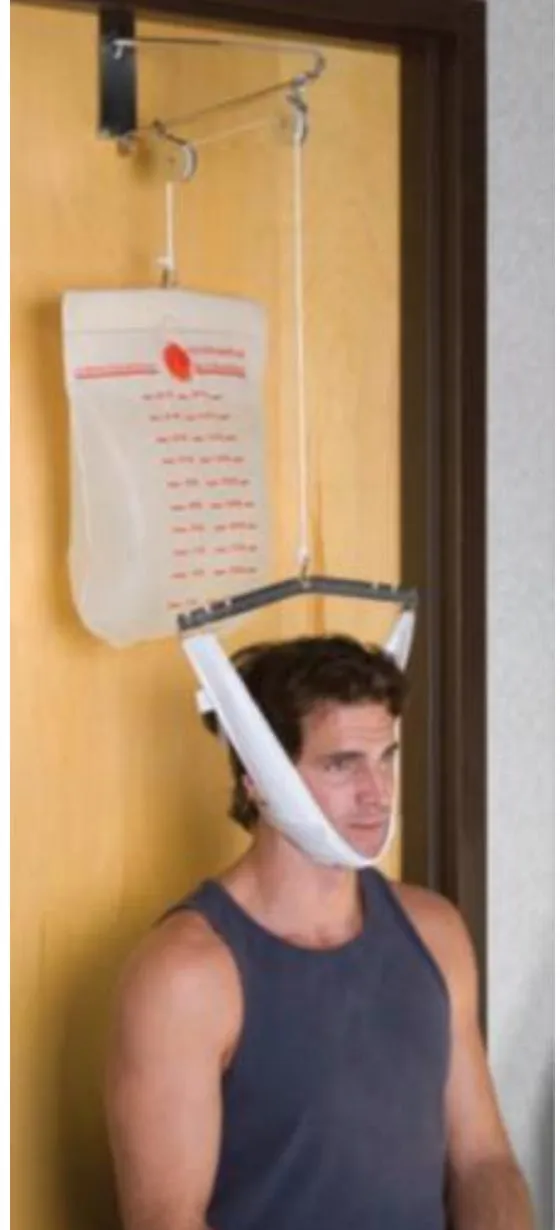
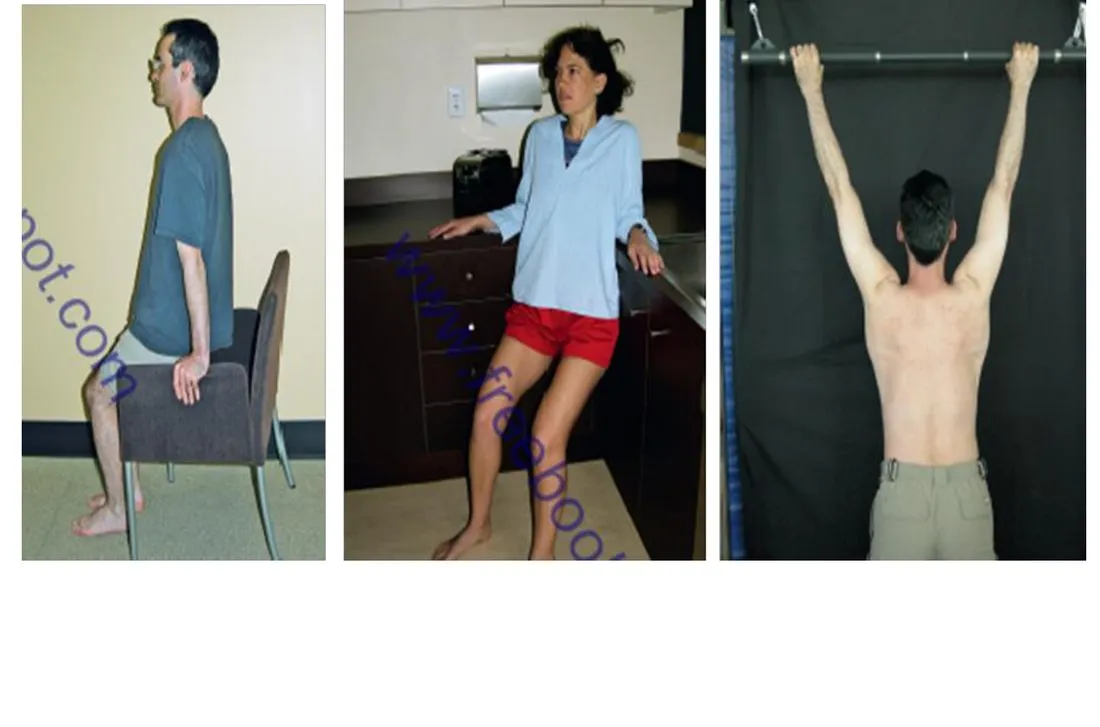
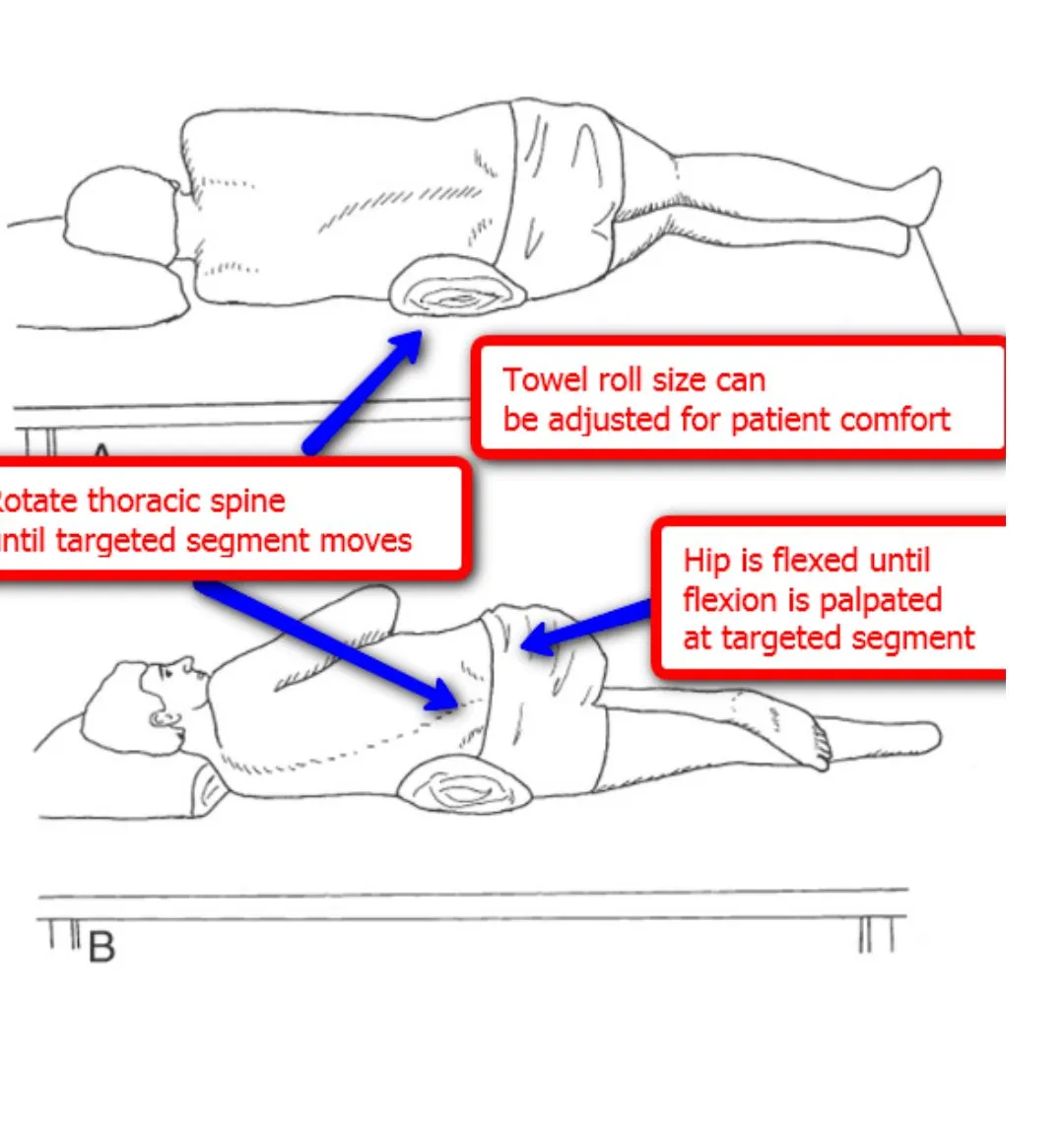
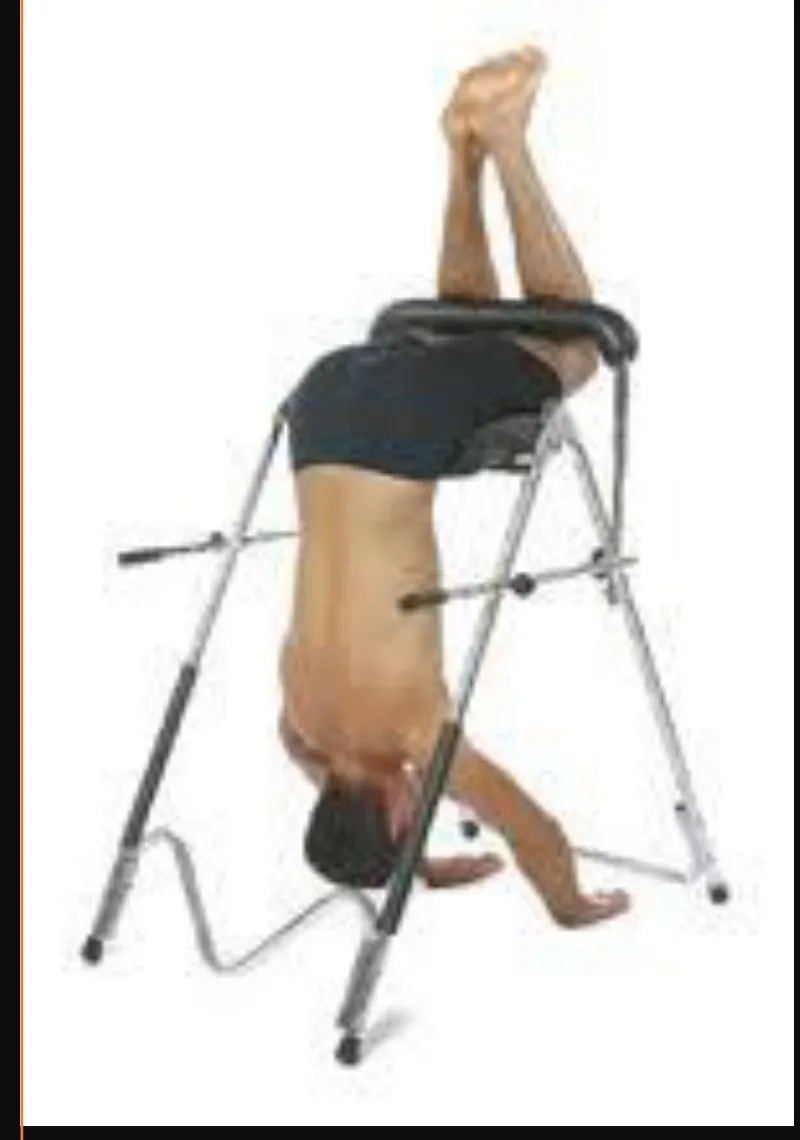
Motorized tractionTraction in which a motor produces the pulling force.General meaning, not from the slides · Pneumatic tractionTraction in which air pressure produces the pulling force.General meaning, not from the slides · Weighted tractionTraction in which weights produce the pulling force.General meaning, not from the slides · Autotractive tractionTraction in which the patient produces the pulling force themselves.General meaning, not from the slides · Positional tractionTraction produced by placing the patient in a position, with supports such as pillows, blocks or sandbags.General meaning, not from the slides · Inverted tractionTraction in which the patient is tilted head-down, so that body weight provides the pull.General meaning, not from the slides · Manual tractionTraction applied by the therapist's hands.General meaning, not from the slides
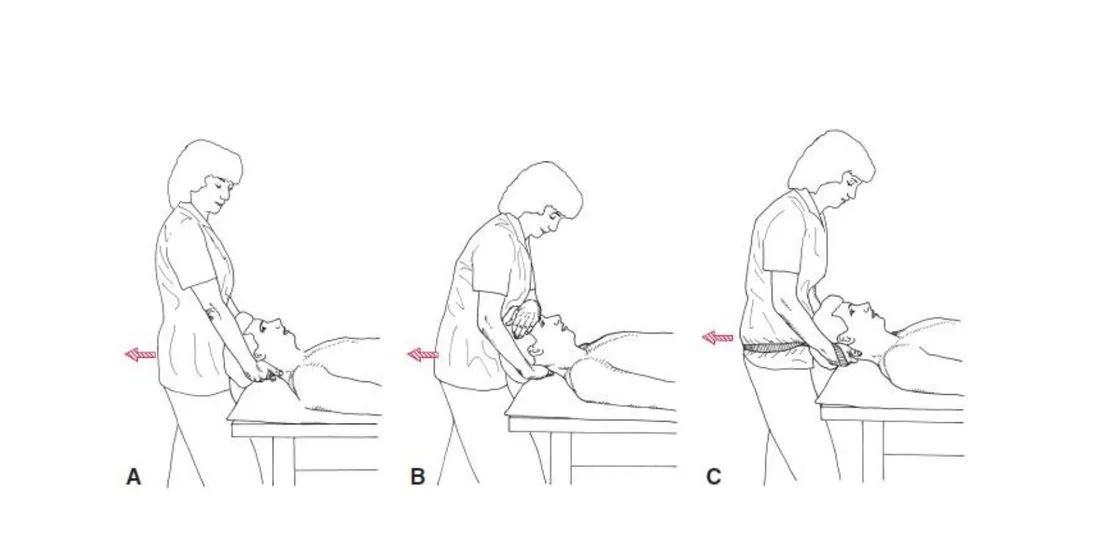
Contraindications (and why)
| Condition | Risk |
|---|---|
| Spinal disease, infection, inflammation, tumour | Further damage |
| Vertebral fracture or DislocationA joint whose bones have been forced out of their normal alignment.General meaning, not from the slides | Spinal cordThe bundle of nerves running down the spinal canal from the brain.General meaning, not from the slides damage from increased mobility |
| Spinal InstabilityA joint or spinal segment that is too loose or slips out of place too easily.General meaning, not from the slides / HypermobilityJoint movement beyond the normal range.General meaning, not from the slides | Cord damage from increased mobility |
| Severe disc herniation | Worsens herniation |
| Vertebral arteryThe artery that runs up the neck through the cervical vertebrae to supply the brain.General meaning, not from the slides DysfunctionImpaired working of a body part. In McKenzie's system, a syndrome of shortened soft tissues with reduced elasticity, painful at end-range under tension, never during movement. | Vascular damage |
| Spinal cord stenosisNarrowing of the spinal canal that squeezes the spinal cord.General meaning, not from the slides | More cord compression |
| OsteoporosisLoss of bone density that leaves bones weak and fragile.General meaning, not from the slides | Vertebral fracture |
| Arthritis and Rheumatoid arthritisA long-term disease in which the immune system inflames the joints.General meaning, not from the slides | Worsens degeneration |
| Aortic aneurysmA bulge in the wall of the aorta, the body's main artery.General meaning, not from the slides | HaemorrhageBleeding.General meaning, not from the slides |
| Abdominal herniaPart of an organ or tissue pushing through a weak spot in the abdominal wall.General meaning, not from the slides | Worsens it |
| Uncontrolled HypertensionHigh blood pressure.General meaning, not from the slides | Worsens it |
| Pregnancy (lumbar only) | Complications |
Precautions
- Pain exacerbation → stop and reassess.
- Previous spinal surgery.
- SpondylolysisA defect in the pars interarticularis, the bridge of bone in the vertebral arch.General meaning, not from the slides and SpondylolisthesisForward displacement of a vertebra over the vertebra below.General meaning, not from the slides → may cause hypermobility; monitor closely.
- Respiratory and hypertensive disorders → watch for distress at first application.
- Dentures → use an Occipital halterA harness for cervical traction that pulls through the back of the head (occiput) only.General meaning, not from the slides only (not Occipitomandibular halterA harness for cervical traction that pulls through both the back of the head and the jaw.General meaning, not from the slides).
- TMJTemporomandibular joint: the jaw joint, in front of the ear.General meaning, not from the slides dysfunction → occipital halter only.
ContraindicationA condition in which a treatment should not be used, because it could cause harm.General meaning, not from the slides vs PrecautionA condition in which a treatment may be used, but only with extra care and close monitoring.General meaning, not from the slides: severe herniation, instability and uncontrolled hypertension are contraindications; spondylolisthesis, previous surgery and controlled hypertensive/respiratory problems are precautions.
Clinical tips
- Cervical traction benefits most: patients > 55 years with positive Cervical distraction testA test in which the examiner gently lifts the patient's head to take pressure off the neck; relief of symptoms is a positive result.General meaning, not from the slides, Nerve tension testsTests that stretch a nerve to see whether they reproduce the patient's symptoms.General meaning, not from the slides, Shoulder abduction testA test in which the patient rests the hand on top of the head; relief of arm symptoms is a positive result.General meaning, not from the slides and PeripheralizationSymptoms moving distally, away from the spine and down the limb..
- Lumbar traction benefits most: patients > 30 years with no Neurological deficitLoss of nerve function, such as weakness, numbness or loss of reflexes.General meaning, not from the slides.
- For acute disc lesions (cervical or lumbar): Sustained tractionA steady pull held for the whole treatment time.General meaning, not from the slides ≤ 10 minutes, Intermittent tractionA pull that is applied and released repeatedly during treatment.General meaning, not from the slides ≤ 15 minutes.