Physical Therapy for Traumatic Conditions of the Upper Extremities
Quiz this lecture (95 questions)This handout (Chapter 4) goes bone by bone down the upper limb. For each injury it gives the Mechanism of injuryHow an injury happened: the force or movement that caused it.General meaning, not from the slides, clinical picture, treatment (Conservative treatmentTreatment without surgery, such as exercise, immobilization or bracing.General meaning, not from the slides vs surgical) and, for most, a phased PTPhysical therapy (physiotherapy): treatment that uses exercise, movement and hands-on techniques to restore movement and function.General meaning, not from the slides rehabilitation protocol.
Reading the protocols: almost every protocol follows the same shape. Phase I (0–2 or 0–6 wk): protect the fracture, keep the free joints moving, IsometricA muscle contraction in which the muscle tenses but the joint does not move.General meaning, not from the slides. Phase II (2–6 or 6–12 wk): active and Active-assisted ROMJoint movement the patient performs with some help from a therapist, a device or the other arm.General meaning, not from the slides ROMRange of motion: how far a joint can move in each direction.General meaning, not from the slides, gentle strengthening. Phase III (6–12 wk): resistance, ProprioceptionThe body's sense of where its joints are and how they are moving.General meaning, not from the slides and CKCClosed kinetic chain: exercise in which the hand or foot is fixed against a surface while the limb moves, so the limb bears weight.General meaning, not from the slides (usually from the end of week 6). After week 12: full ROM, sport/function. Learn the shape once, then learn what’s different for each fracture.
Learning Objectives
- Identify the different upper extremity traumatic injuries.
- Discuss the general management guidelines for each.
1. Fractures of the Clavicle
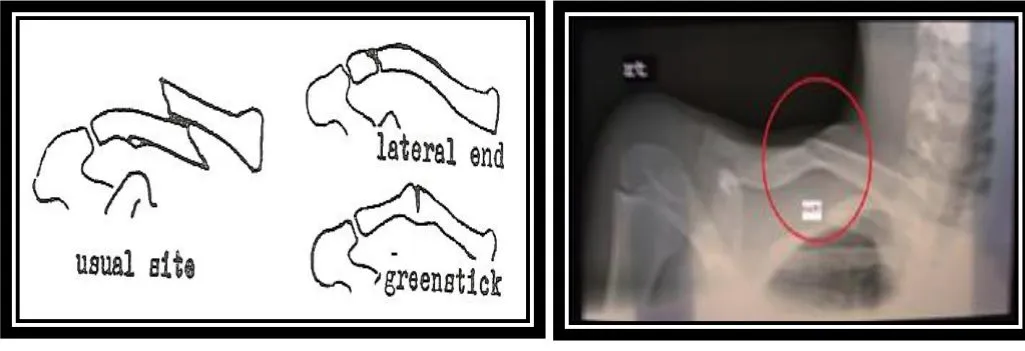
- Trauma: any age; a fall on the side of the shoulder, on the outstretched hand, or a direct blow.
- Site: usually the middle third, at the junction of its two curves.
- Displaced fractureThe broken bone ends have moved out of their normal alignment. Undisplaced or non-displaced means they have not.General meaning, not from the slides: the lateral fragment is pulled downward and medially by gravity; the SternomastoidThe sternocleidomastoid: the muscle on each side of the neck that runs from behind the ear to the breastbone and collarbone.General meaning, not from the slides pulls the medial fragment up; the ends overlap.
- Fracture of the lateral end is rare and usually undisplaced.
Treatment
- ReductionPutting a broken or dislocated bone back into its correct position.General meaning, not from the slides: patient seated on a stool; the surgeon stands behind and braces the shoulders backward.
- Conservative treatmentTreatment without surgery, such as exercise, immobilization or bracing.General meaning, not from the slides (simple stable fractures):
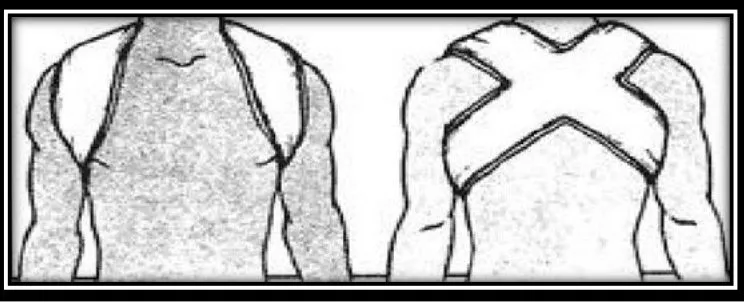
- Figure-of-eight bandageA bandage wound in a figure-of-eight around the shoulders to hold them pulled back.General meaning, not from the slides for 2 weeks, tightened at least every second day, or
- Sling for 3–4 weeks.
- Exercise: fingers and elbow from day 1; shoulder after 2 weeks.
- Operative only for: NeurovascularRelating to both nerves and blood vessels.General meaning, not from the slides injury · severe associated chest injury · open fractures · uncontrolled deformity (cosmetic) · NonunionA fracture that fails to heal together.General meaning, not from the slides.
2. Dislocation of the Shoulder
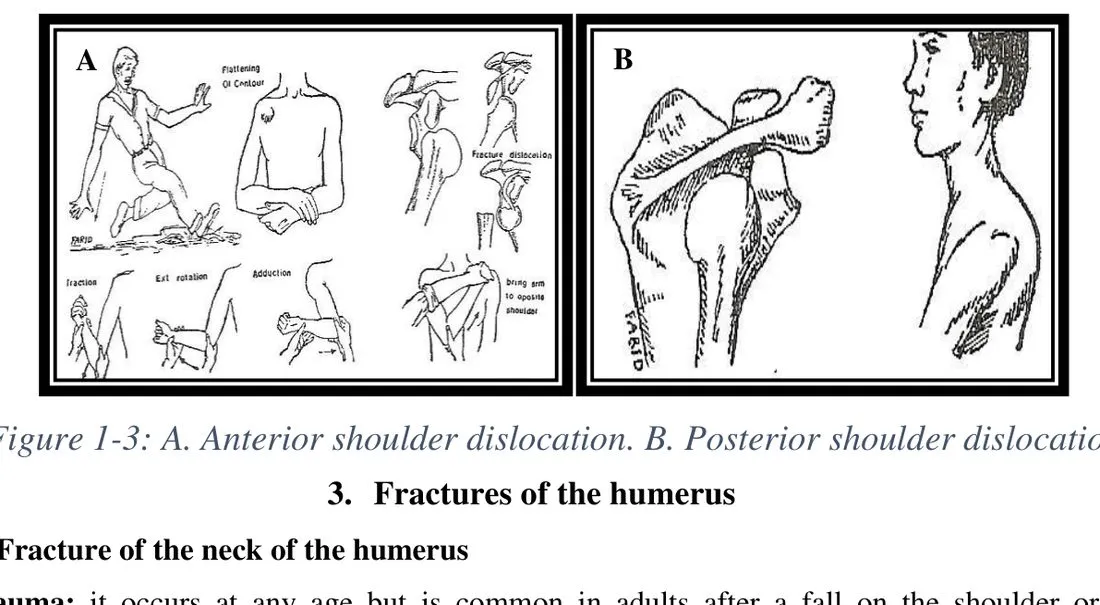
A. Anterior dislocation
- The most common type. Adults, from a fall on the outstretched hand with the arm AbductionMoving a limb away from the midline of the body.General meaning, not from the slides, often with the limb behind the trunk.
- Clinically:
- Severe pain and tenderness.
- Flattened lateral contour of the shoulder; arm held with the elbow away from the trunk.
- Humeral headThe ball-shaped top of the humerus (upper-arm bone) that fits into the shoulder socket.General meaning, not from the slides felt behind the Anterior axillary foldThe front fold of skin and muscle that forms the front wall of the armpit.General meaning, not from the slides, in the Sub-coracoidBelow the coracoid process.General meaning, not from the slides region.
- Painful, limited movement.
- Check for Circumflex (axillary) nerveThe nerve that wraps around the top of the humerus and supplies the deltoid muscle and the skin over the shoulder.General meaning, not from the slides PalsyWeakness or paralysis of a muscle caused by nerve damage.General meaning, not from the slides and other nerve or vascular injury.
- X-ray: to detect associated fractures.
- ReductionPutting a broken or dislocated bone back into its correct position.General meaning, not from the slides techniques: StimsonA shoulder reduction technique in which the patient lies face down with the arm hanging.General meaning, not from the slides, Scapular manipulationA shoulder reduction technique that moves the shoulder blade so the head of the humerus slips back into its socket.General meaning, not from the slides, External rotation (ER)Turning a limb outward, away from the midline of the body.General meaning, not from the slides, MilchA gentle shoulder reduction technique in which the arm is raised overhead and turned outward.General meaning, not from the slides, SpasoA shoulder reduction technique in which the arm is lifted straight up and gently pulled and rotated outward.General meaning, not from the slides, Traction–countertractionA reduction technique in which one person pulls the arm while another pulls in the opposite direction.General meaning, not from the slides.
- ImmobilizationKeeping a body part still, for example with a cast, splint or sling, so that it can heal.General meaning, not from the slides: arm bandaged to the side for 3 weeks (lets the torn Joint capsuleThe sleeve of tough tissue that surrounds a joint.General meaning, not from the slides heal and reduces recurrence).
- Avoid abduction + external rotation for 3 months (the position that DislocationA joint whose bones have been forced out of their normal alignment.General meaning, not from the slides it).
B. Recurrent dislocation
- Young adults, especially athletes and epileptics.
- Repeated dislocation detaches the Glenoid labrumThe ring of fibrous cartilage around the rim of the shoulder socket (glenoid).General meaning, not from the slides and anterior capsule from the anterior GlenoidThe shallow socket of the shoulder blade that receives the head of the humerus.General meaning, not from the slides margin.
- Re-dislocates with increasing ease during everyday tasks (combing hair, reaching up); the patient can often reduce it himself.
- Operation when disability is great.
C. Posterior dislocation
- Less common; athletes and epileptics.
- Clinically: pain and inability to move; shoulder locked in Internal rotation (IR)Turning a limb inward, toward the midline of the body.General meaning, not from the slides; front of the shoulder flattened with a prominent CoracoidA small hook-shaped bony projection from the front of the shoulder blade.General meaning, not from the slides; humeral head felt in the InfraspinousBelow the spine of the shoulder blade, at the back of the shoulder.General meaning, not from the slides region.
- Reduction: gentle prolonged TractionA pulling force applied to a limb.General meaning, not from the slides + external rotation, pushing the head anteriorly.
- FixationHolding a fractured bone in position with plates, screws, pins, wires or a cast.General meaning, not from the slides: Shoulder spicaA cast around the trunk that holds the shoulder and arm in a set position.General meaning, not from the slides in abduction and external rotation for 1 month.
| Anterior | Posterior | |
|---|---|---|
| Frequency | Most common | Less common |
| Head felt | Sub-coracoid | Infraspinous |
| Arm position | Elbow away from trunk | Locked in internal rotation |
| Immobilized | Bandaged to the side, 3 weeks | Thumb spicaA cast or splint that holds the thumb and wrist still.General meaning, not from the slides in abduction + ER, 1 month |
After any shoulder dislocation, PTPhysical therapy (physiotherapy): treatment that uses exercise, movement and hands-on techniques to restore movement and function.General meaning, not from the slides includes: Rhythmic stabilizationA technique of alternating isometric contractions against the therapist's resistance, to train joint stability.General meaning, not from the slides, CKCClosed kinetic chain: exercise in which the hand or foot is fixed against a surface while the limb moves, so the limb bears weight.General meaning, not from the slides exercise, ProprioceptionThe body's sense of where its joints are and how they are moving.General meaning, not from the slides, Sensory-motor trainingTraining that links sensation and movement control, for example with desensitization, mirror therapy and motor imagery.General meaning, not from the slides training and strengthening.
3. Fractures of the Humerus
A. Fracture of the neck of the humerus
- Trauma: any age, common in adults; fall on the shoulder or outstretched hand.
- Clinically: pain, swelling, EcchymosisBruising: discolouration of the skin from bleeding under it.General meaning, not from the slides of the shoulder, painful movement.
- Impacted fractureA fracture with no separation of the broken ends, so no reduction is needed. (no separation): no ReductionPutting a broken or dislocated bone back into its correct position.General meaning, not from the slides needed; arm sling or triangular bandage 2–3 weeks, then shoulder exercises.
- Unimpacted fractureA fracture in which the broken ends are separated; it needs closed or open reduction. (separated): closed or Open reductionRealigning a bone through a surgical opening.General meaning, not from the slides, then sling or surgical FixationHolding a fractured bone in position with plates, screws, pins, wires or a cast.General meaning, not from the slides (Intramedullary nailA metal rod placed inside the hollow centre of a long bone to hold a fracture.General meaning, not from the slides, plate and screws, screws, or even shoulder ArthroplastySurgery that replaces or reshapes a joint.General meaning, not from the slides).
B. Proximal humerus fractures (PHFs)
- One third of all HumerusThe upper-arm bone.General meaning, not from the slides fractures. Only 0.5–3.5% of fractures in children and adolescents; more common in adults (fall on shoulder or hand, car accident).
- Conservative treatmentTreatment without surgery, such as exercise, immobilization or bracing.General meaning, not from the slides: sling 2–3 weeks, then gradual rehab. Indicated for minimally Displaced fractureThe broken bone ends have moved out of their normal alignment. Undisplaced or non-displaced means they have not.General meaning, not from the slides Surgical neckThe narrowing of the humerus just below its rounded head, a common fracture site.General meaning, not from the slides fractures and Greater tuberosityThe bony bump on the upper outer part of the humerus, where rotator cuff muscles attach.General meaning, not from the slides fractures displaced < 5 mm.
- Operative: only for displaced, unstable (high-energy) fractures: PercutaneousDone through the skin.General meaning, not from the slides K-wireKirschner wire: a thin metal pin used to hold bone fragments in place.General meaning, not from the slides PinningHolding bone fragments in place with metal pins.General meaning, not from the slides, retrograde ESINElastic stable intramedullary nailing: flexible rods placed inside the hollow centre of a bone. Retrograde means inserted against the usual direction.General meaning, not from the slides (ESIN), rarely screws.
PT for humerus fractures
Short-term goals:
- Prevent Disuse atrophyWasting of muscle caused by not using it.General meaning, not from the slides
- Maintain ROMRange of motion: how far a joint can move in each direction.General meaning, not from the slides
- Avoid exercises that reproduce the Mechanism of injuryHow an injury happened: the force or movement that caused it.General meaning, not from the slides
- Avoid prolonged ImmobilizationKeeping a body part still, for example with a cast, splint or sling, so that it can heal.General meaning, not from the slides (stiffness). Sequence: early Passive ROMMovement of a joint carried out by someone or something else, with no effort from the patient.General meaning, not from the slides → Active ROMJoint movement the patient performs by their own muscle effort.General meaning, not from the slides → progressive resistance, stretching and strengthening.
Phase I (0–6 weeks), exercises start day 7–10:
- Sling removed during exercise
- Pendulum (Codman) exercisesGentle exercises in which the relaxed arm hangs and swings like a pendulum.General meaning, not from the slides
- Posture correction
- ROM of neck, elbow, wrist, hand
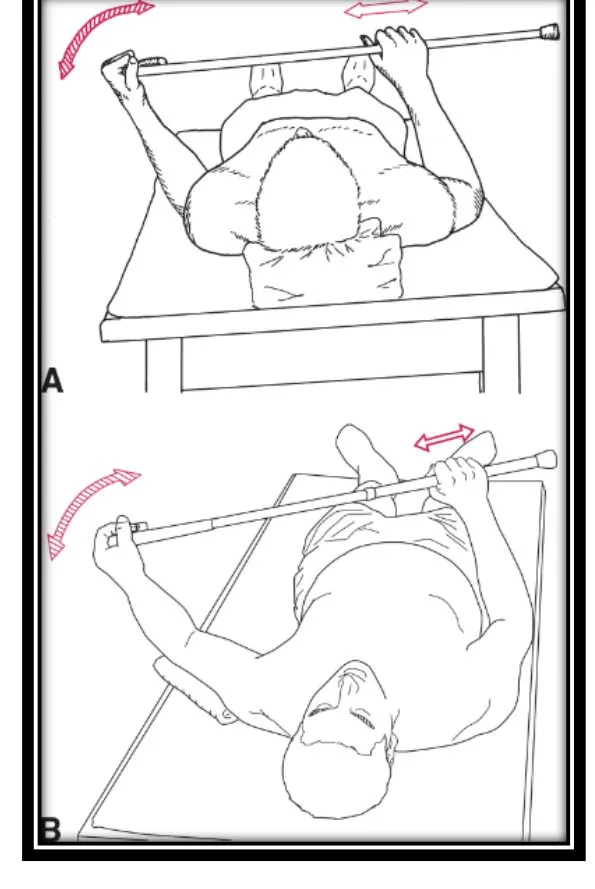
- After week 1: supine External rotation (ER)Turning a limb outward, away from the midline of the body.General meaning, not from the slides with a stick/cane, with about 15–20° AbductionMoving a limb away from the midline of the body.General meaning, not from the slides
- Overhead pulleyA rope-and-pulley set-up that the patient pulls with the good arm to raise the affected arm.General meaning, not from the slides exercises after 3 weeks
- Shoulder IsometricA muscle contraction in which the muscle tenses but the joint does not move.General meaning, not from the slides in week 4
- ProprioceptionThe body's sense of where its joints are and how they are moving.General meaning, not from the slides training
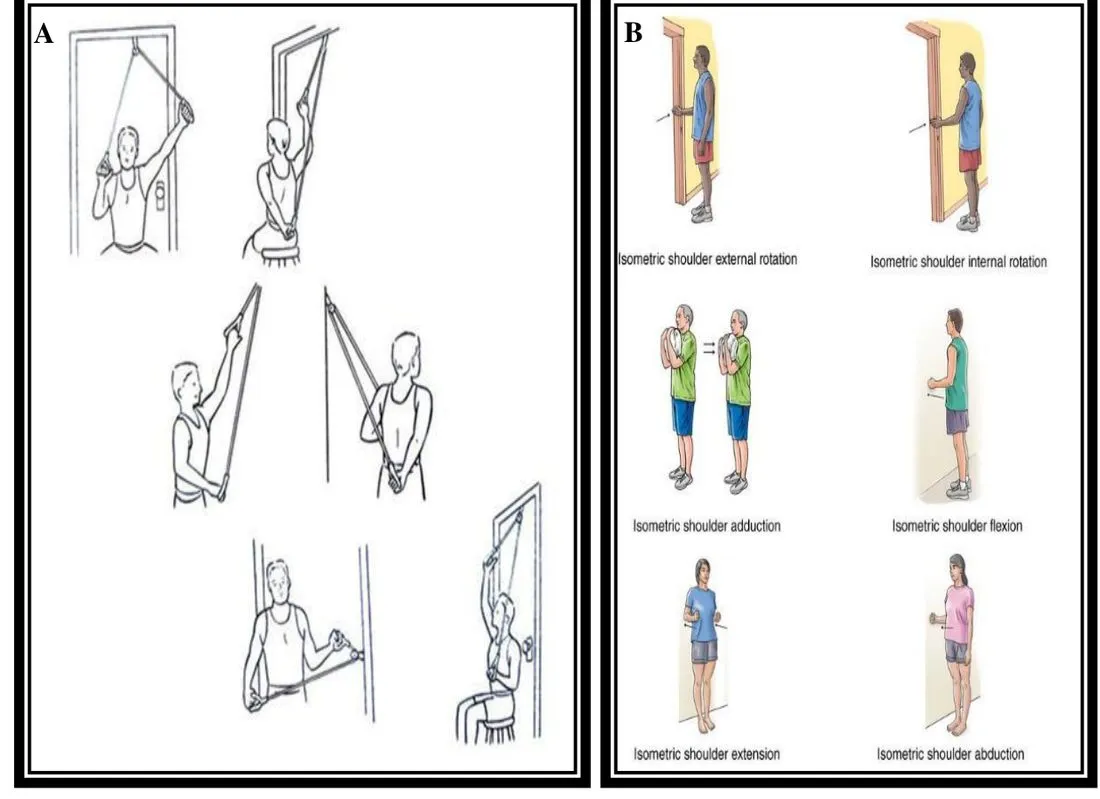
Phase II (6–12 weeks):
- Increase active ROM; progress to resistance and stretching
- Supine active Forward elevationLifting the arm forward and upward in front of the body.General meaning, not from the slides (gravity partly eliminated)
- Then upright forward elevation with a stick, the unaffected arm assisting
- Then active elevation without assistance
- TheraBandA brand of elastic resistance band used for strengthening exercises.General meaning, not from the slides: Internal rotation (IR)Turning a limb inward, toward the midline of the body.General meaning, not from the slides, ER, flexion, extension, abduction — 2–3 sets of 10–15 (up to 20) reps
- Flexibility and stretching in all directions
- Proprioception
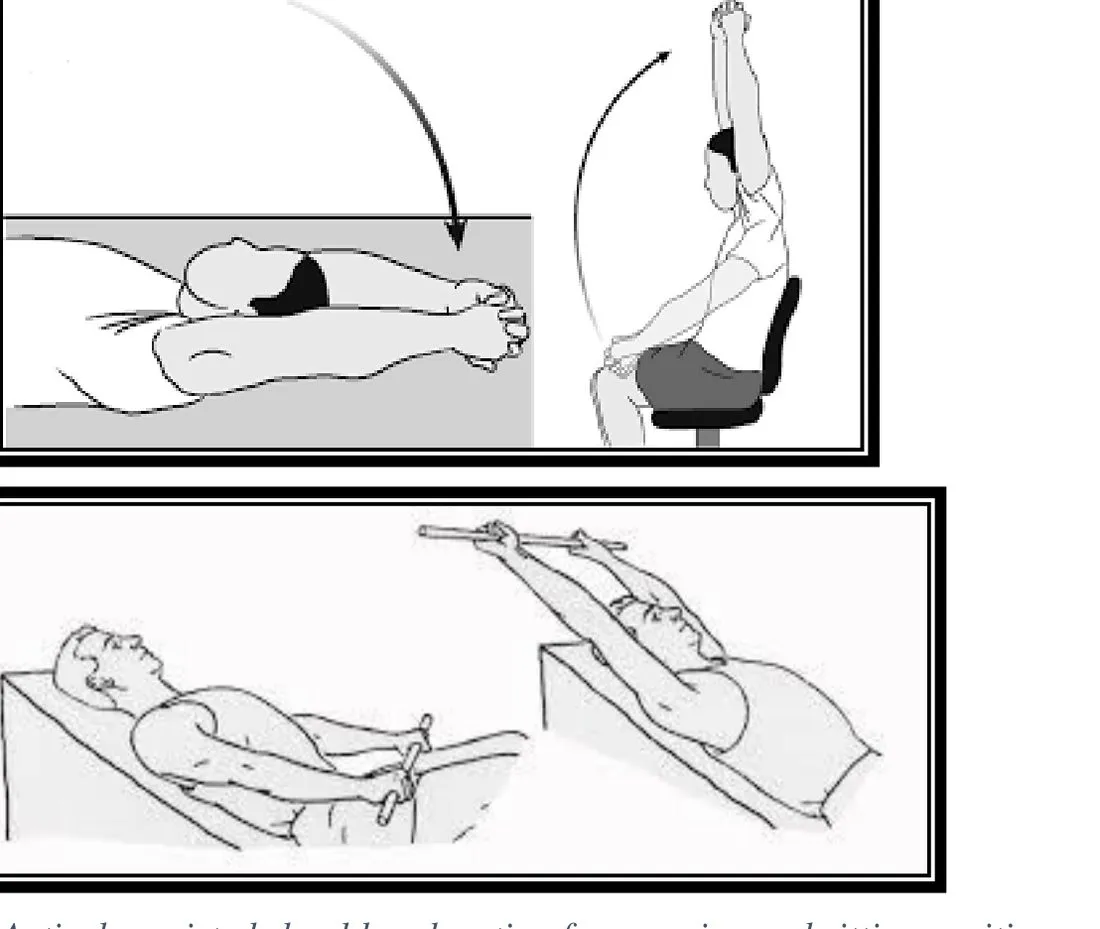
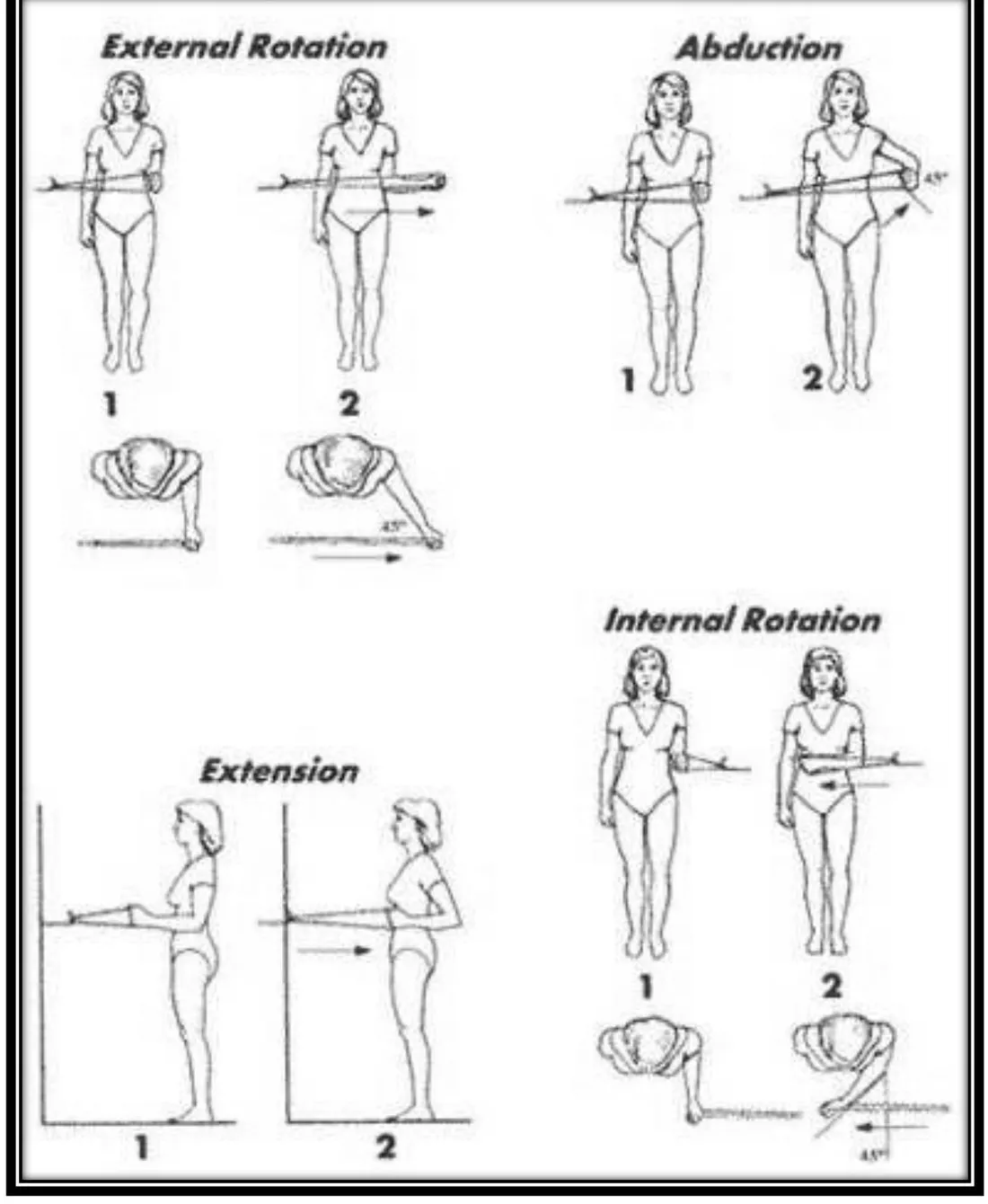
Phase III (after 12 weeks):
- IsotonicExercise in which the muscle works against a steady load while the joint moves, for example with weights or tubing.General meaning, not from the slides: rubber tubing → weights
- Rotator cuffThe group of four shoulder muscles and their tendons that hold the head of the humerus in its socket and rotate the arm.General meaning, not from the slides and ScapularRelating to the scapula (shoulder blade).General meaning, not from the slides strengthening
- Stop the weights if pain persists
- Progress to overhead exercise
- ROM to maximum
- Proprioception and CKCClosed kinetic chain: exercise in which the hand or foot is fixed against a surface while the limb moves, so the limb bears weight.General meaning, not from the slides
- Functional training
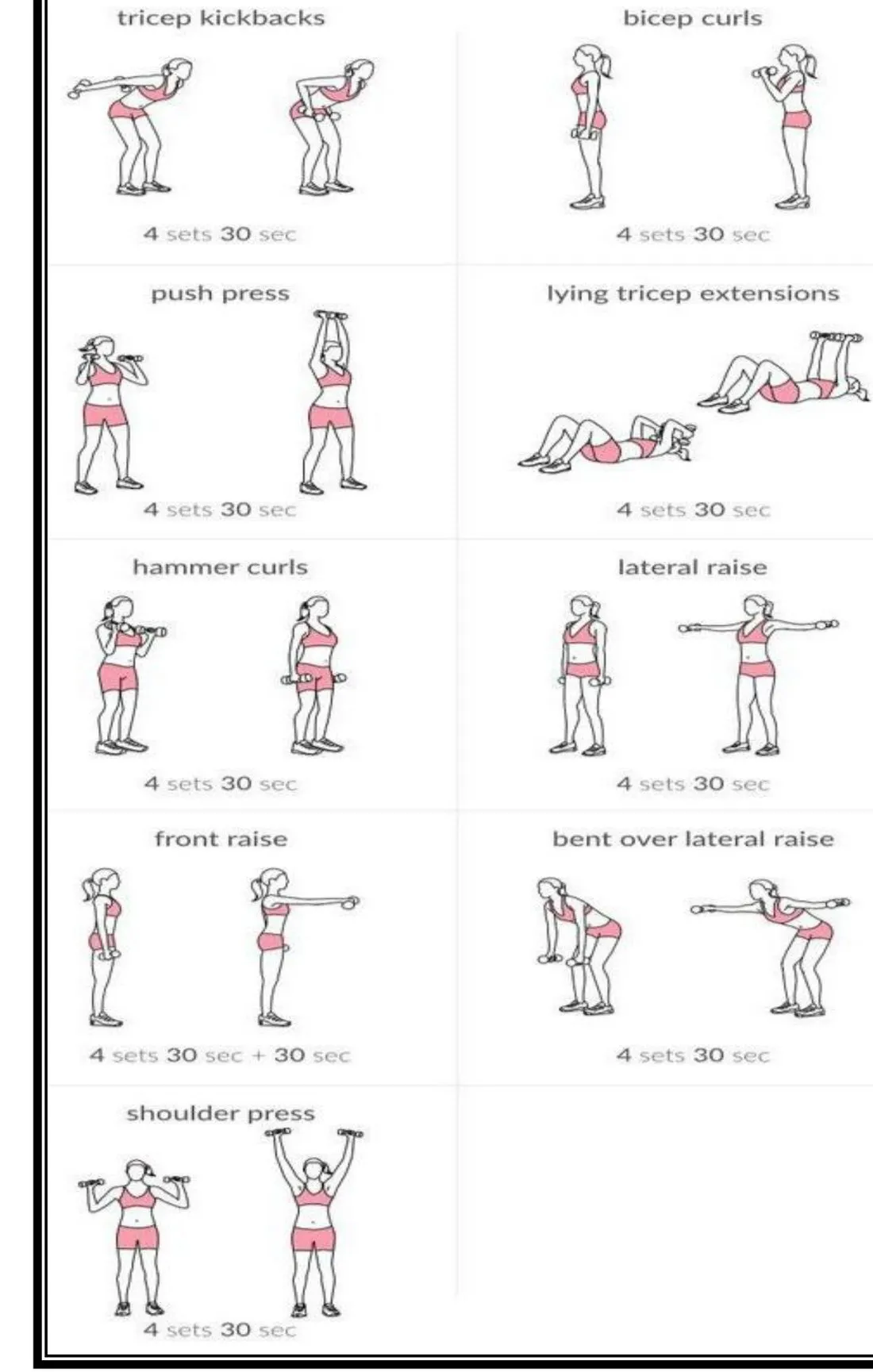
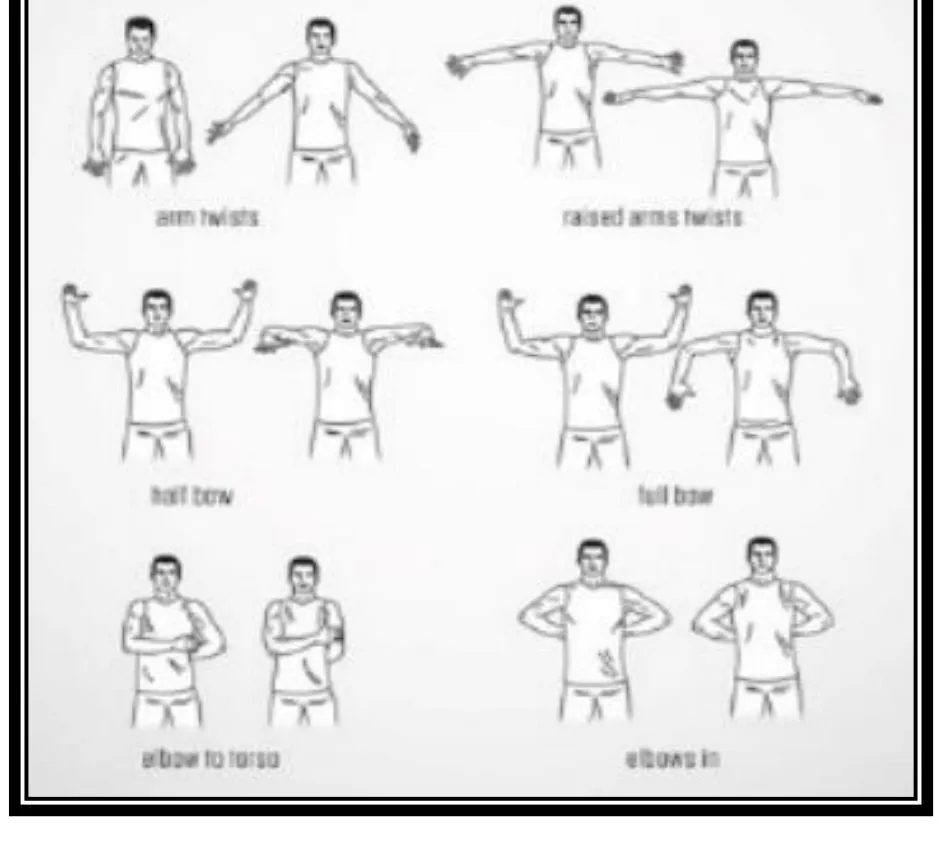
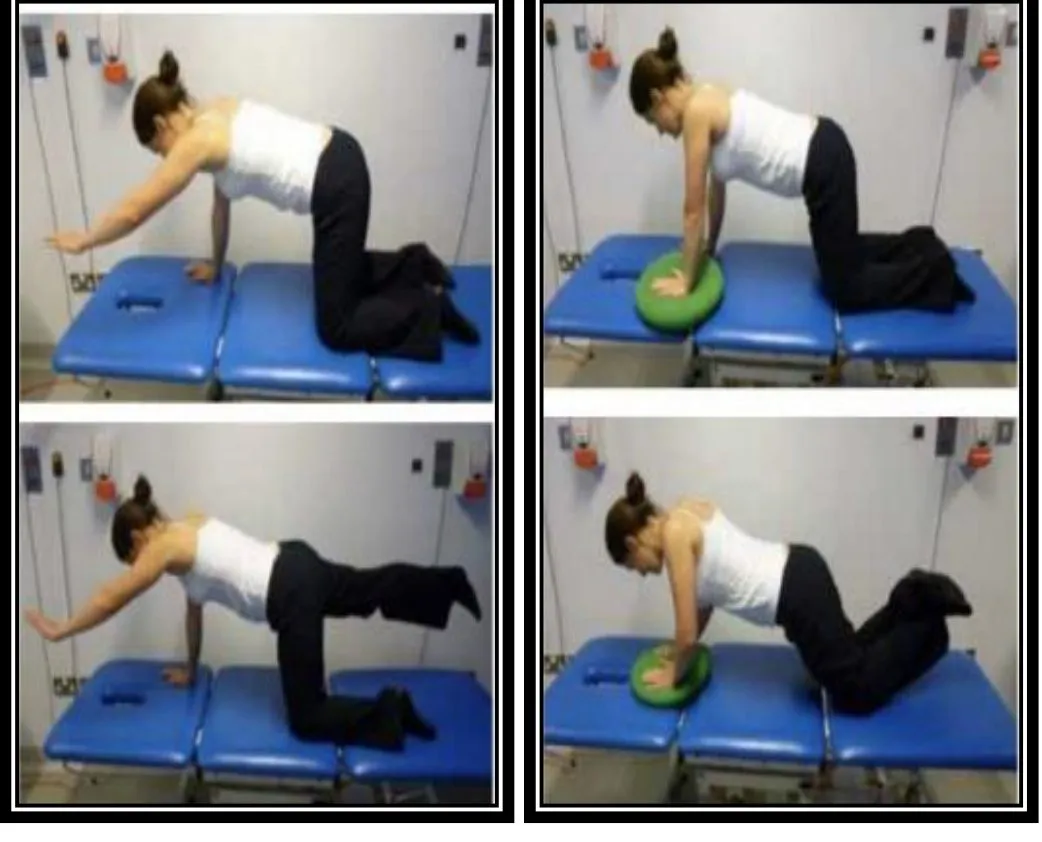
C. Fracture of the shaft of the humerus
- Trauma: direct or indirect, any age. ProximalCloser to the trunk or the point of attachment of a limb.General meaning, not from the slides, middle or DistalFarther from the trunk or the point of attachment of a limb.General meaning, not from the slides third; Transverse fractureA fracture line running straight across the bone.General meaning, not from the slides, Oblique fractureA fracture line running at a slant across the bone.General meaning, not from the slides, ComminutedBroken into more than two pieces.General meaning, not from the slides or double-level.
- Conservative: padded Coaptation splintA padded U-shaped plaster slab placed over the elbow, up the arm and over the shoulder. (coaptation splint) over the elbow, up the arm and over the shoulder; arm bandaged to the side for the first month or until UnionThe broken bone ends healing together.General meaning, not from the slides, which takes 3 months.
- Surgical: displaced or open unstable fractures → ORIFOpen reduction and internal fixation: surgery that realigns the bone and holds it with plates, screws or pins.General meaning, not from the slides with plate and screws.
- Exercise: wrist and fingers from the start; elbow flexors/extensors isometric; shoulder after plaster removal.
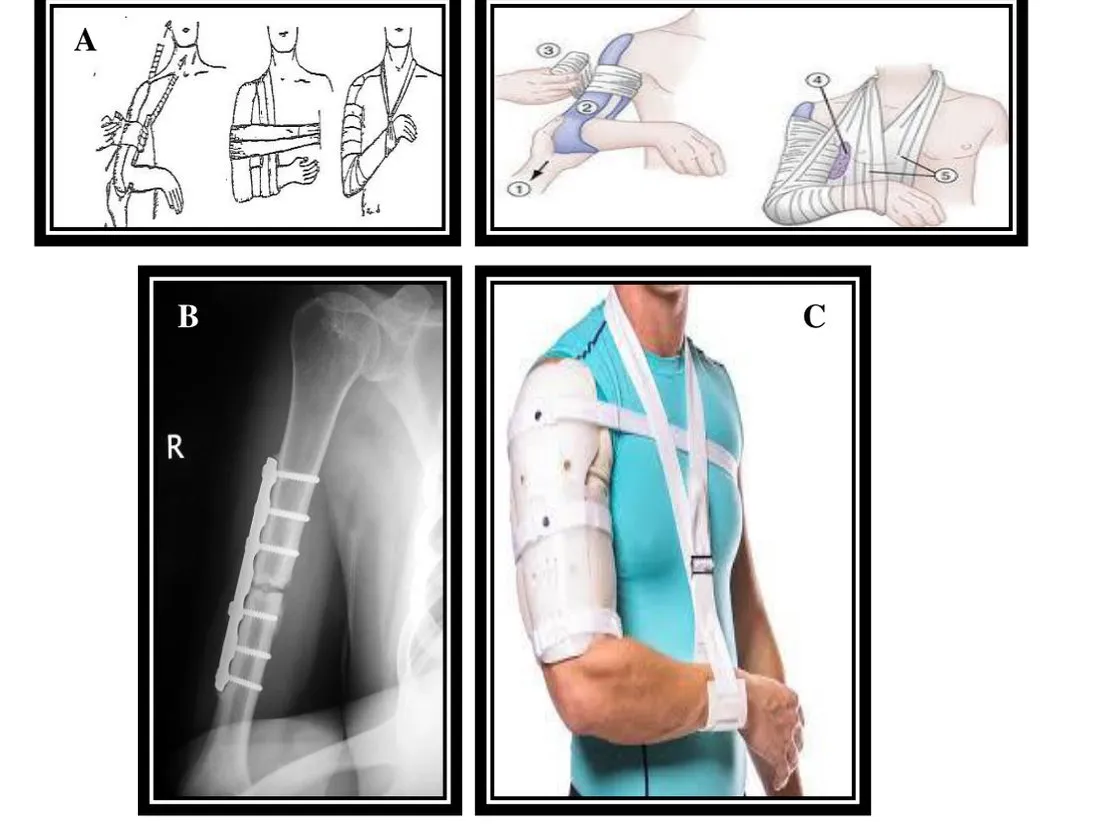
Watch for the Radial nerveThe nerve that runs down the back of the arm and forearm and controls the muscles that straighten the elbow, wrist and fingers.General meaning, not from the slides: the immobilization lecture lists the humeral shaft fracture as the classic radial-nerve injury.
Phase I (0–6 weeks):
- Sling for comfort with coaptation splint
- Switch to a Sarmiento braceA functional brace for the upper arm that allows elbow and shoulder movement while the fracture heals.General meaning, not from the slides at day 10–12
- Discontinue sling at 2 weeks
- ROM of neck, shoulder, elbow, wrist, hand
- Pendulum exercises
- 3–5 times a day, 30 min per session
- Passive self-assisted exercise
Phase II (6–12 weeks): early active, resistive and stretching exercise; TheraBand 3 sets of 10–15; flexibility in all directions.
Phase III (> 12 weeks): tubing → weights; rotator cuff and scapular strengthening; stop weights if pain persists; overhead; ROM to maximum; proprioception.
D. Supracondylar fracture of the humerus
- Trauma: fall on the outstretched hand; children 5–7 years.
- Clinically:
- Pain and swelling around the elbow.
- OlecranonThe bony tip of the elbow, at the upper end of the ulna.General meaning, not from the slides and the two EpicondylesThe bony bumps on each side of the lower end of the humerus, at the elbow.General meaning, not from the slides keep their normal relationship (this is what separates it from elbow DislocationA joint whose bones have been forced out of their normal alignment.General meaning, not from the slides).
- Deformity from the displaced condylar fragment.
- Feel the Radial pulseThe pulse felt at the wrist, on the thumb side.General meaning, not from the slides; check the hand for IschaemiaToo little blood supply to a tissue, so it does not get enough oxygen.General meaning, not from the slides and nerve injury.
- Treatment: CRPPClosed reduction and percutaneous pinning: the bone is realigned without opening the skin and held with pins inserted through the skin.General meaning, not from the slides (CRPP), under General anaesthesiaMedication that puts the patient into a deep sleep for surgery.General meaning, not from the slides, done urgently to take pressure off the Brachial vesselsThe artery and veins of the upper arm, running down in front of the elbow.General meaning, not from the slides. Then a Posterior slabA plaster slab applied along the back of the limb.General meaning, not from the slides from AxillaThe armpit.General meaning, not from the slides to knuckles with the elbow in 20–40° flexion for 3 weeks.
- Open reduction with pinning only if there is Median nerveThe nerve that runs down the middle of the forearm into the hand and supplies the thumb side of the palm.General meaning, not from the slides or vascular injury.
- After the splint: active elbow flexion only. No massage or passive movement.
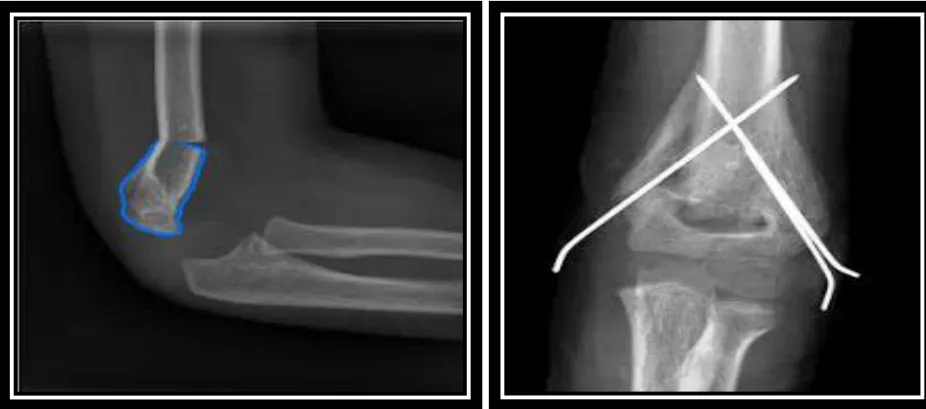
Volkmann’s ischaemic contracture
- A serious complication of Supracondylar fractureA break just above the condyles at the lower end of the humerus, near the elbow.General meaning, not from the slides: brachial artery compression → ischaemia of the forearm muscles, especially the deep flexors (FDP / FPLFlexor digitorum profundus and flexor pollicis longus: the deep forearm muscles that bend the fingers and the thumb.General meaning, not from the slides, FPL).
- Leads to progressive damage and FibrosisThickening and scarring of tissue.General meaning, not from the slides.
- Needs early PTPhysical therapy (physiotherapy): treatment that uses exercise, movement and hands-on techniques to restore movement and function.General meaning, not from the slides: splinting and active and passive ROM.
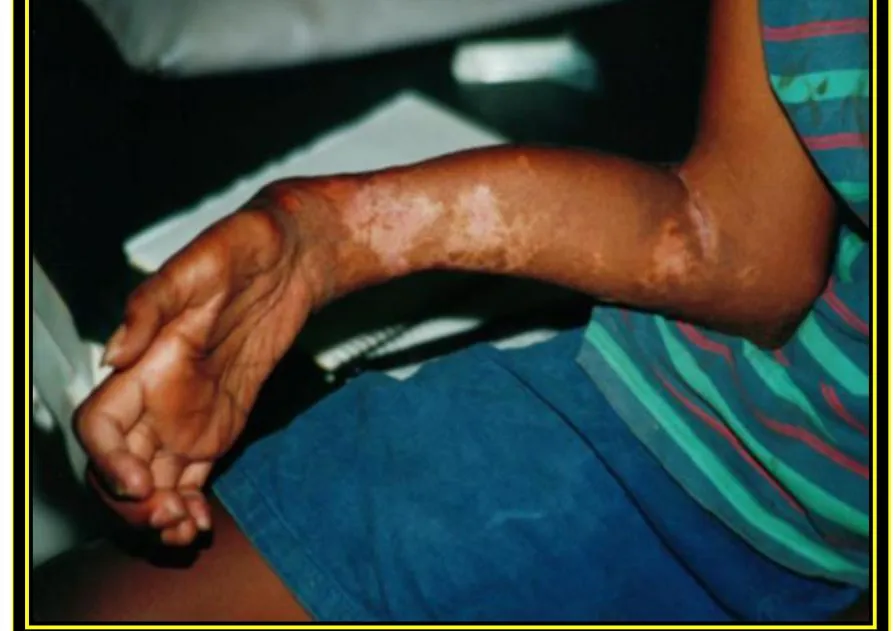
4. Dislocation of the Elbow
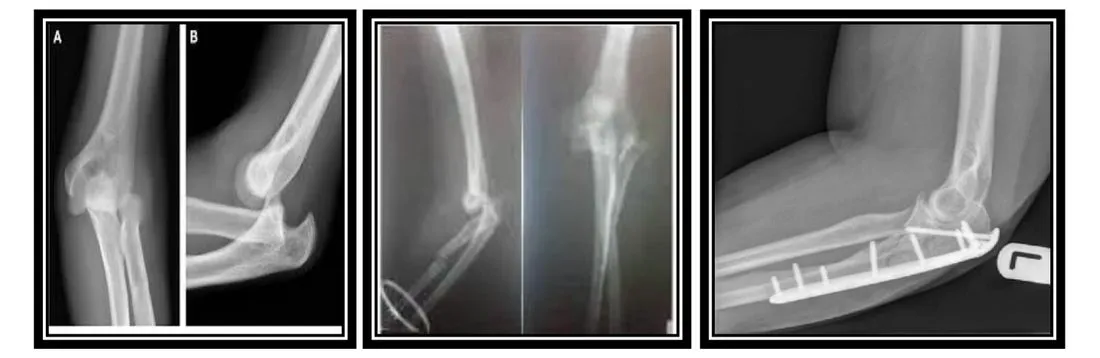
- Trauma: fall on the outstretched hand. RadiusThe forearm bone on the thumb side.General meaning, not from the slides and UlnaThe forearm bone on the little-finger side.General meaning, not from the slides Displaced fractureThe broken bone ends have moved out of their normal alignment. Undisplaced or non-displaced means they have not.General meaning, not from the slides PosterolaterallyToward the back and the outer side.General meaning, not from the slides; the Joint capsuleThe sleeve of tough tissue that surrounds a joint.General meaning, not from the slides is usually torn.
- Clinically: severe pain; elbow held at 140° of extension; OlecranonThe bony tip of the elbow, at the upper end of the ulna.General meaning, not from the slides prominent and raised above the line joining the EpicondylesThe bony bumps on each side of the lower end of the humerus, at the elbow.General meaning, not from the slides (the normal triangle is lost); lower end of the HumerusThe upper-arm bone.General meaning, not from the slides prominent in the Cubital fossaThe hollow at the front of the elbow.General meaning, not from the slides.
- Conservative treatmentTreatment without surgery, such as exercise, immobilization or bracing.General meaning, not from the slides: Closed reductionRealigning a bone by manipulation, without cutting the skin.General meaning, not from the slides by TractionA pulling force applied to a limb.General meaning, not from the slides along the forearm → Long-arm castA cast that runs from the hand up past the elbow to the upper arm.General meaning, not from the slides at 90° flexion for 3 weeks.
- Surgical: unstable fracture or complex DislocationA joint whose bones have been forced out of their normal alignment.General meaning, not from the slides → internal FixationHolding a fractured bone in position with plates, screws, pins, wires or a cast.General meaning, not from the slides.
| Supracondylar fractureA break just above the condyles at the lower end of the humerus, near the elbow.General meaning, not from the slides | Elbow dislocation | |
|---|---|---|
| Olecranon–epicondyle relationship | Normal | Disturbed (olecranon raised) |
| Typical patient | Child 5–7 | Fall on outstretched hand |
| Fixation | SlabA strip of plaster applied along part of a limb as a splint, without wrapping completely around it.General meaning, not from the slides 20–40° flexion, 3 weeks | Cast 90° flexion, 3 weeks |
PTPhysical therapy (physiotherapy): treatment that uses exercise, movement and hands-on techniques to restore movement and function.General meaning, not from the slides for simple elbow dislocation
- Phase I (0–1 week): splinted at 90° flexion for 5–10 days.
- Phase II (2–6 weeks):
- Splint removed; Active ROMJoint movement the patient performs by their own muscle effort.General meaning, not from the slides as tolerated
- Sling or splint for comfort early on
- Extension increased gradually over weeks 3–6; a Hinged braceA brace with a hinge that allows controlled movement at the elbow.General meaning, not from the slides may block some extension. Avoid forced Passive ROMMovement of a joint carried out by someone or something else, with no effort from the patient.General meaning, not from the slides. Gradual strengthening (start IsometricA muscle contraction in which the muscle tenses but the joint does not move.General meaning, not from the slides) of the elbow and whole upper limb; posture correction
- ProprioceptionThe body's sense of where its joints are and how they are moving.General meaning, not from the slides
- Phase III (6–12 weeks): continue; proprioception and CKCClosed kinetic chain: exercise in which the hand or foot is fixed against a surface while the limb moves, so the limb bears weight.General meaning, not from the slides from the end of week 6.
- After 12 weeks: full ROMRange of motion: how far a joint can move in each direction.General meaning, not from the slides, proprioception and CKC, functional/sport training.
5. Fracture of the Radial Head and Neck
- Trauma: ValgusBent outward: the part beyond a joint angles away from the midline of the body.General meaning, not from the slides loading with the elbow extended (fall on the outstretched hand).
- Clinically: pain, swelling, tenderness over the Radial headThe disc-shaped top of the radius, which meets the humerus at the elbow.General meaning, not from the slides; painful, limited Pronation / supinationPronation turns the forearm so the palm faces down; supination turns it so the palm faces up.General meaning, not from the slides and elbow movement.
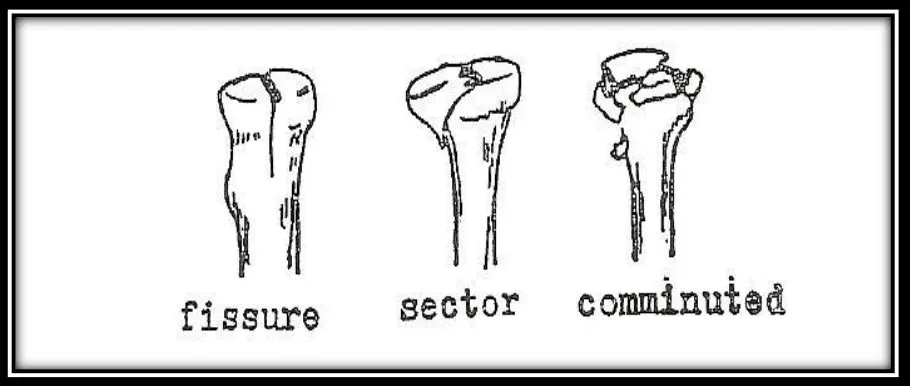
- Conservative treatmentTreatment without surgery, such as exercise, immobilization or bracing.General meaning, not from the slides: FissureA fine crack in a bone.General meaning, not from the slides or mildly Displaced fractureThe broken bone ends have moved out of their normal alignment. Undisplaced or non-displaced means they have not.General meaning, not from the slides → rest in a sling or SlabA strip of plaster applied along part of a limb as a splint, without wrapping completely around it.General meaning, not from the slides for 10 days, then active exercise.
- Surgical: displaced sector or ComminutedBroken into more than two pieces.General meaning, not from the slides → ORIFOpen reduction and internal fixation: surgery that realigns the bone and holds it with plates, screws or pins.General meaning, not from the slides (mini-fragment screws, K-wireKirschner wire: a thin metal pin used to hold bone fragments in place.General meaning, not from the slides, mini T-plate); ExcisionSurgical removal.General meaning, not from the slides of the head may be indicated.
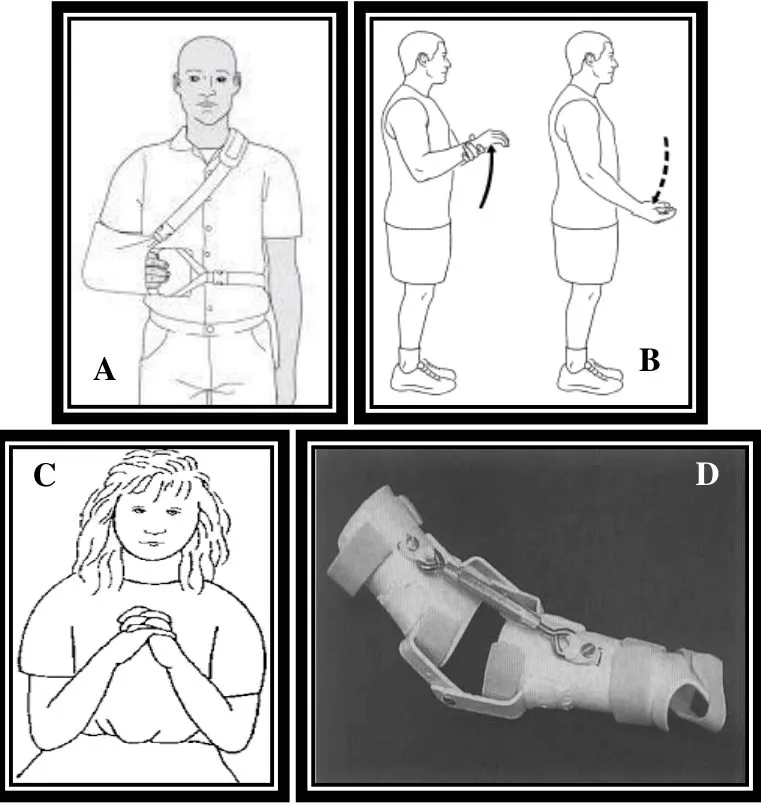
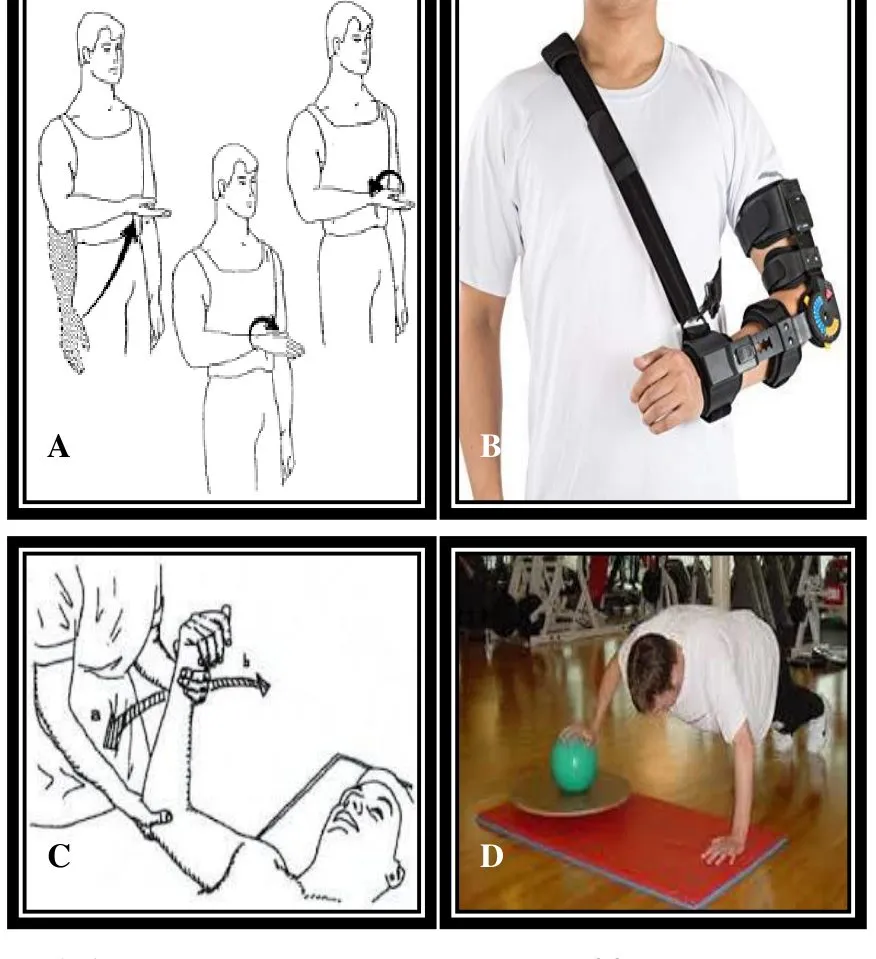
PTPhysical therapy (physiotherapy): treatment that uses exercise, movement and hands-on techniques to restore movement and function.General meaning, not from the slides after radial head ORIF
-
Phase I (0–2 weeks):
- Splint 1–2 weeks
- Sling for comfort
- Avoid Coronal planeThe vertical plane that divides the body into a front half and a back half.General meaning, not from the slides (VarusBent inward: the part beyond a joint angles toward the midline of the body.General meaning, not from the slides/valgus) stress: ROMRange of motion: how far a joint can move in each direction.General meaning, not from the slides with the arm close to the body, no flexion in pronation
- Gentle Active-assisted ROMJoint movement the patient performs with some help from a therapist, a device or the other arm.General meaning, not from the slides elbow flexion–extension at the end of week 2
- Keep shoulder, wrist and finger ROM and upper limb strength
-
Phase II (2–6 weeks):
-
SuturesStitches that close a surgical wound.General meaning, not from the slides out at 2 weeks
-
Active and active-assisted supination/pronation; elbow IsometricA muscle contraction in which the muscle tenses but the joint does not move.General meaning, not from the slides
-
Muscle energy technique (MET)A technique based on autogenic and reciprocal inhibition, safer and usually better than passive stretching for ROM. (MET): based on Autogenic inhibitionA muscle relaxing itself after a sustained contraction.General meaning, not from the slides and Reciprocal inhibitionWhen one muscle contracts, the opposing muscle is signalled to relax.General meaning, not from the slides; safer and usually better than passive stretching for ROM. Given as Post-isometric relaxationThe drop in muscle tension that follows a brief isometric contraction.General meaning, not from the slides and/or reciprocal inhibition: 7–10 s hold × 5–10 reps, then a gentle passive stretch, with only 20% resistance to the isometric contraction
-
Full elbow flexion–extension by the end of week 6
-
-
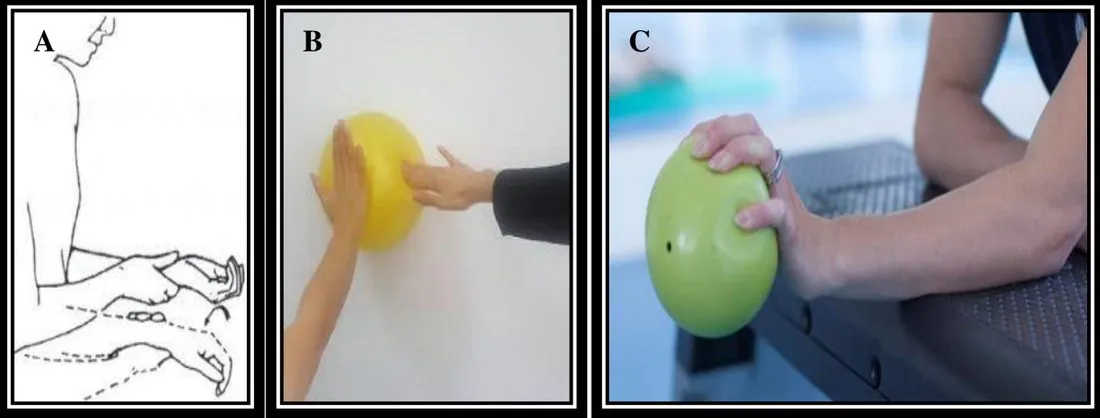
Phase III (6–12 weeks): ProprioceptionThe body's sense of where its joints are and how they are moving.General meaning, not from the slides and CKCClosed kinetic chain: exercise in which the hand or foot is fixed against a surface while the limb moves, so the limb bears weight.General meaning, not from the slides from the end of week 6; full Active ROMJoint movement the patient performs by their own muscle effort.General meaning, not from the slides including pro/supination, and full strength, by week 8.
-
After 12 weeks: full ROM, CKC, function/sport.
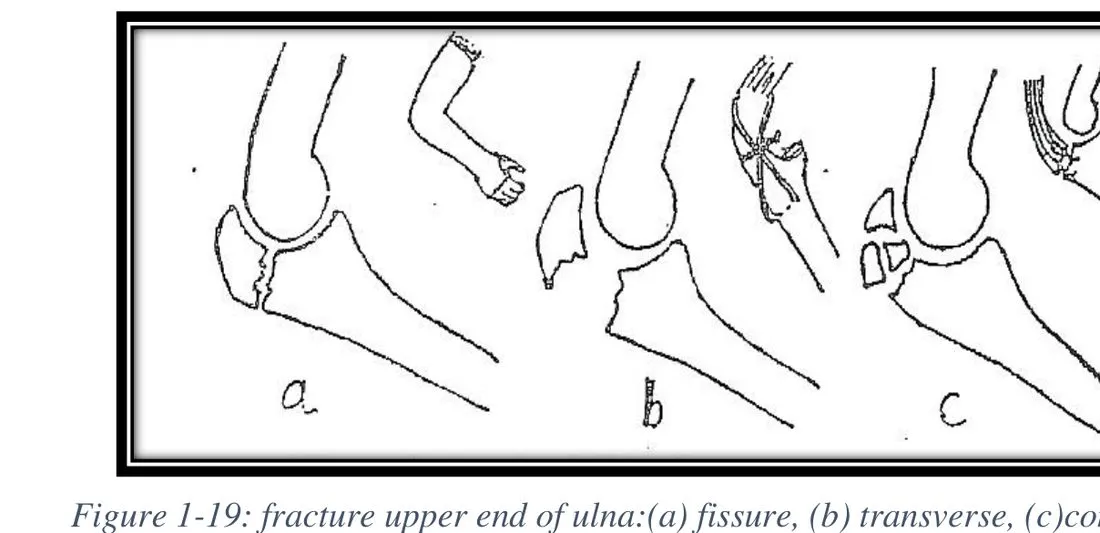
6. Fracture of the Olecranon (upper end of the ulna)
- Extra- or Intra-articularInside a joint.General meaning, not from the slides, Displaced fractureThe broken bone ends have moved out of their normal alignment. Undisplaced or non-displaced means they have not.General meaning, not from the slides or not; may come with CoronoidThe hook-shaped projection of the ulna at the elbow, which sits in front of the humerus.General meaning, not from the slides fractures or elbow fracture-DislocationA joint whose bones have been forced out of their normal alignment.General meaning, not from the slides.
- Causes: direct blow (most common); fall on the outstretched hand with the elbow flexed; high-energy trauma (with Radial headThe disc-shaped top of the radius, which meets the humerus at the elbow.General meaning, not from the slides fracture or dislocation); violent TricepsThe muscle at the back of the upper arm that straightens the elbow.General meaning, not from the slides contraction → Transverse fractureA fracture line running straight across the bone.General meaning, not from the slides fracture.
- Types (figure): FissureA fine crack in a bone.General meaning, not from the slides, transverse, ComminutedBroken into more than two pieces.General meaning, not from the slides.
- Conservative treatmentTreatment without surgery, such as exercise, immobilization or bracing.General meaning, not from the slides: non-displaced → splint or cast at 90° flexion for 4–6 weeks.
- Surgical:
- K-wireKirschner wire: a thin metal pin used to hold bone fragments in place.General meaning, not from the slides (Tension bandA fixation method that uses pins and a wire loop to hold a fracture together.General meaning, not from the slides): most common, for simple displaced and comminuted fractures; allows early Active ROMJoint movement the patient performs by their own muscle effort.General meaning, not from the slides.
- Plate for severely comminuted fractures.
- ExcisionSurgical removal.General meaning, not from the slides with Triceps advancementSurgery that moves the triceps tendon and re-attaches it further along the bone.General meaning, not from the slides in the elderly with severe comminution.
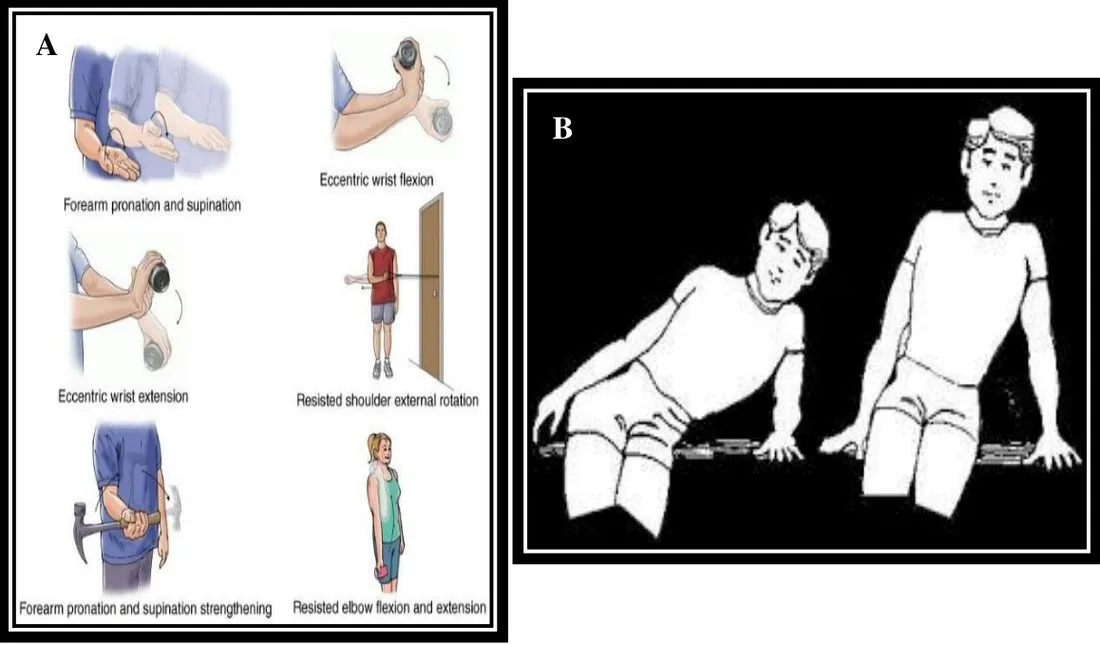
PTPhysical therapy (physiotherapy): treatment that uses exercise, movement and hands-on techniques to restore movement and function.General meaning, not from the slides after OlecranonThe bony tip of the elbow, at the upper end of the ulna.General meaning, not from the slides FixationHolding a fractured bone in position with plates, screws, pins, wires or a cast.General meaning, not from the slides
- Phase I (0–2 weeks): Posterior slabA plaster slab applied along the back of the limb.General meaning, not from the slides 1–2 weeks; gentle active and Active-assisted ROMJoint movement the patient performs with some help from a therapist, a device or the other arm.General meaning, not from the slides ROMRange of motion: how far a joint can move in each direction.General meaning, not from the slides after removal. Highly comminuted fractures → longer splinting, delayed motion.
- Phase II (2–6 weeks): SuturesStitches that close a surgical wound.General meaning, not from the slides out at 2 weeks; gentle active elbow ROM; NO resistance around the elbow (the triceps pulls on the fracture); keep shoulder, wrist and finger ROM; strengthen shoulder, wrist and grip.
- Phase III (6–12 weeks), once UnionThe broken bone ends healing together.General meaning, not from the slides is confirmed: regain full ROM; gentle progressive resistance; ProprioceptionThe body's sense of where its joints are and how they are moving.General meaning, not from the slides and CKCClosed kinetic chain: exercise in which the hand or foot is fixed against a surface while the limb moves, so the limb bears weight.General meaning, not from the slides (Weight bearingPutting body weight through a limb or joint.General meaning, not from the slides).
- After 12 weeks: full ROM, CKC, function/sport.
N.B. Elbow injuries are the most common PediatricRelating to children.General meaning, not from the slides injuries: 28.4% of all pediatric fractures. They’re often followed by stiffness or ContractureA lasting shortening of muscle or soft tissue that limits how far a joint can move.General meaning, not from the slides (Joint capsuleThe sleeve of tough tissue that surrounds a joint.General meaning, not from the slides and Peri-articularAround a joint.General meaning, not from the slides FibrosisThickening and scarring of tissue.General meaning, not from the slides), so early MobilizationGentle movement of a joint or soft tissue to improve how freely it moves.General meaning, not from the slides is encouraged.
7. Forearm Injuries
A. Shaft of the radius and ulna
- Trauma: direct or indirect; upper, middle or lower third.
- Conservative treatmentTreatment without surgery, such as exercise, immobilization or bracing.General meaning, not from the slides: needs perfect Anatomical reductionPutting the bone fragments back exactly in their original position.General meaning, not from the slides. Long (above-elbow) cast, elbow at 90°, forearm neutral, arm elevated, for 4 weeks → Short-arm castA cast that runs from the hand up to just below the elbow.General meaning, not from the slides or Functional braceA brace that supports a healing fracture while allowing free active movement of the limb.General meaning, not from the slides for 2 weeks. Total 6–8 weeks.
- Surgical: ORIFOpen reduction and internal fixation: surgery that realigns the bone and holds it with plates, screws or pins.General meaning, not from the slides with plate and screws (severe Displaced fractureThe broken bone ends have moved out of their normal alignment. Undisplaced or non-displaced means they have not.General meaning, not from the slides or failed conservative care); External fixationHolding bone fragments steady with pins connected to a frame outside the body.General meaning, not from the slides possible.
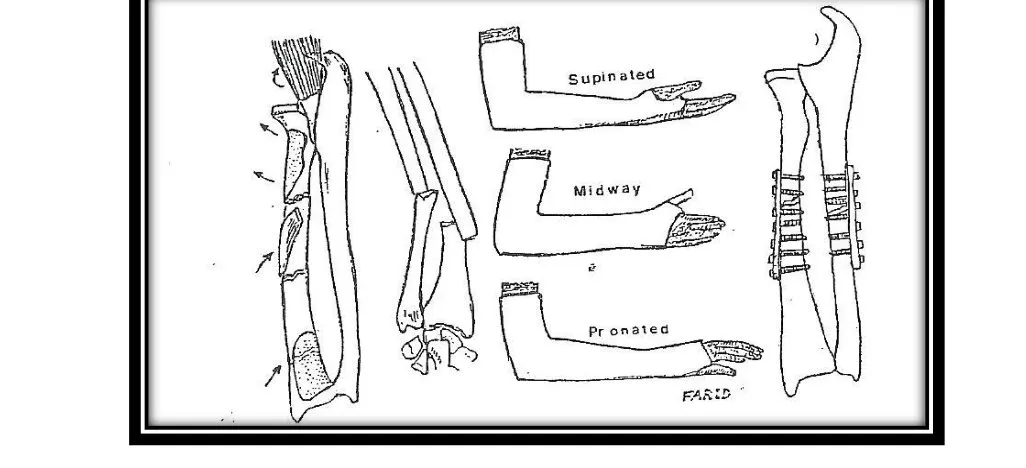
PTPhysical therapy (physiotherapy): treatment that uses exercise, movement and hands-on techniques to restore movement and function.General meaning, not from the slides after forearm shaft FixationHolding a fractured bone in position with plates, screws, pins, wires or a cast.General meaning, not from the slides
- Phase I (0–2 weeks): splint, protect incisions; SuturesStitches that close a surgical wound.General meaning, not from the slides out at 2 weeks; elevation for OedemaSwelling caused by fluid collecting in the tissues.General meaning, not from the slides; finger ROMRange of motion: how far a joint can move in each direction.General meaning, not from the slides and grip are essential; shoulder mobility and strength; ProprioceptionThe body's sense of where its joints are and how they are moving.General meaning, not from the slides; posture.
- Phase II (2–6 weeks): active and Active-assisted ROMJoint movement the patient performs with some help from a therapist, a device or the other arm.General meaning, not from the slides ROM of elbow, forearm and wrist; gentle strengthening.
- Phase III (6–12 weeks): increase ROM; lifting and twisting only once UnionThe broken bone ends healing together.General meaning, not from the slides is achieved; proprioception and CKCClosed kinetic chain: exercise in which the hand or foot is fixed against a surface while the limb moves, so the limb bears weight.General meaning, not from the slides from the end of week 8 (not 6 as for the elbow).
- After 12 weeks (phase IV): full ROM, CKC, function/sport.
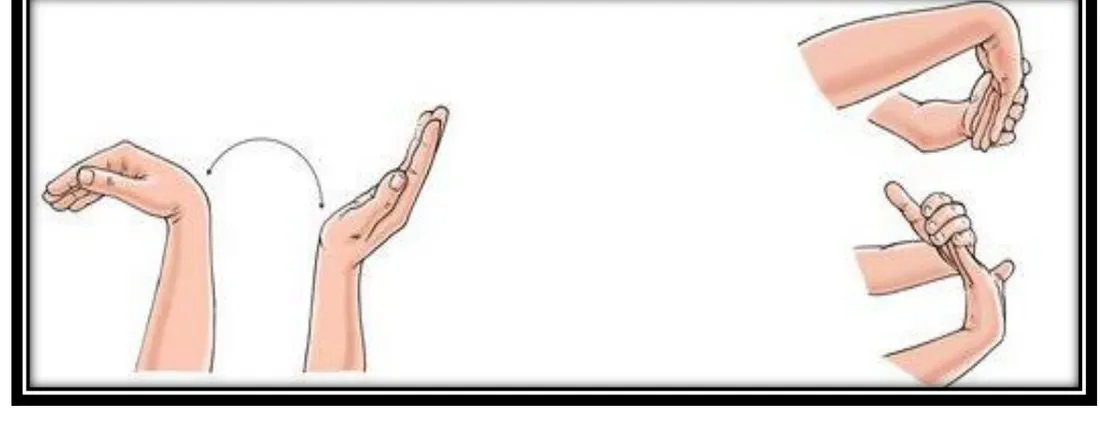
B. Monteggia fracture-dislocation
- UlnaThe forearm bone on the little-finger side.General meaning, not from the slides fractured near the junction of the upper and middle thirds (AngulationThe angle at which a bone or limb bends away from a straight line.General meaning, not from the slides), RadiusThe forearm bone on the thumb side.General meaning, not from the slides intact → DislocationA joint whose bones have been forced out of their normal alignment.General meaning, not from the slides of the superior (ProximalCloser to the trunk or the point of attachment of a limb.General meaning, not from the slides) Radio-ulnar jointA joint between the radius and ulna: the superior (proximal) one is at the elbow, the inferior (distal) one is at the wrist.General meaning, not from the slides.
- Open reductionRealigning a bone through a surgical opening.General meaning, not from the slides if ManipulationHands-on movement of a joint or bone by the clinician.General meaning, not from the slides fails.
C. Galeazzi fracture-dislocation
- Radius fractured in the DistalFarther from the trunk or the point of attachment of a limb.General meaning, not from the slides third → inferior (distal) radio-ulnar dislocation.
- Best treated by ORIF because it tends to re-dislocate.
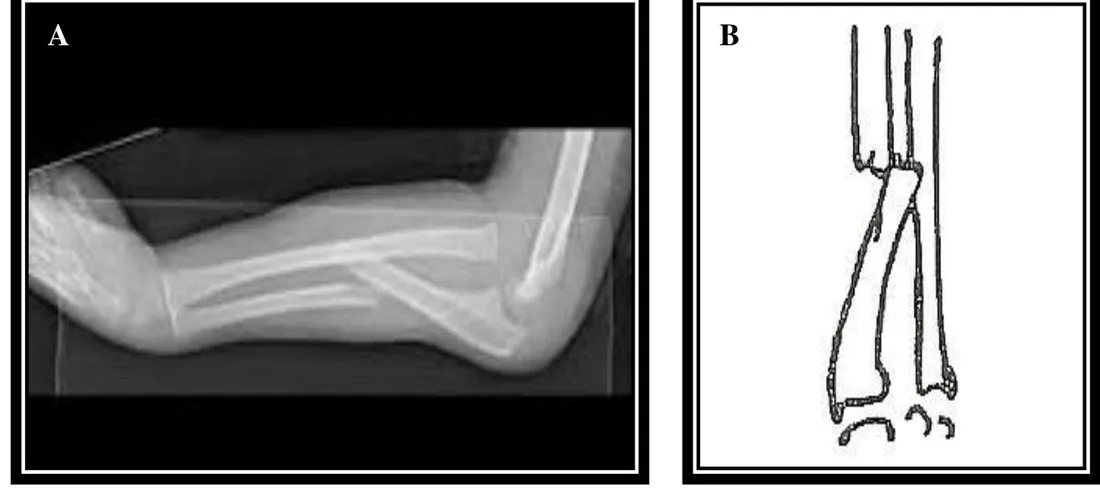
| Bone broken | Joint dislocated | |
|---|---|---|
| Monteggia fracture-dislocationThe ulna is fractured near the junction of its upper and middle thirds with the radius intact, causing dislocation of the superior radio-ulnar joint. | Ulna (upper/middle third) | Superior radio-ulnar |
| Galeazzi fracture-dislocationThe radius is fractured in its distal third, causing dislocation of the inferior radio-ulnar joint. | Radius (distal third) | Inferior radio-ulnar |
Memory hook: “MU-GR” — Monteggia = Ulna, Galeazzi = Radius. The dislocation is at the opposite end from the fracture.
8. Fractures of the Distal Radius
A. Colles’ fracture
- Trauma: fall on the outstretched hand; fracture within 1 inch of the lower end of the RadiusThe forearm bone on the thumb side.General meaning, not from the slides.
- DistalFarther from the trunk or the point of attachment of a limb.General meaning, not from the slides fragment Displaced fractureThe broken bone ends have moved out of their normal alignment. Undisplaced or non-displaced means they have not.General meaning, not from the slides upward, backward (DorsalToward the back; for the hand, the back of the hand.General meaning, not from the slides) and radially; inferior Radio-ulnar jointA joint between the radius and ulna: the superior (proximal) one is at the elbow, the inferior (distal) one is at the wrist.General meaning, not from the slides SubluxationA partial dislocation, where the joint surfaces are shifted but still touch.General meaning, not from the slides possible; Ulnar styloidThe bony point at the wrist end of the ulna, on the little-finger side.General meaning, not from the slides may break.
- Clinically: the Dinner-fork deformityThe characteristic wrist deformity of Colles' fracture, named for its shape like a dinner fork.; pain at the distal radius; the Radial styloidThe bony point at the wrist end of the radius, on the thumb side.General meaning, not from the slides rises to the level of the ulnar styloid.
- Conservative treatmentTreatment without surgery, such as exercise, immobilization or bracing.General meaning, not from the slides: Short-arm castA cast that runs from the hand up to just below the elbow.General meaning, not from the slides with the forearm Pronation / supinationPronation turns the forearm so the palm faces down; supination turns it so the palm faces up.General meaning, not from the slides and Radial/ulnar deviationTilting the wrist toward the thumb side (radial) or the little-finger side (ulnar).General meaning, not from the slides; heals in 6–8 weeks.
- Surgical: Closed reductionRealigning a bone by manipulation, without cutting the skin.General meaning, not from the slides and PercutaneousDone through the skin.General meaning, not from the slides PinningHolding bone fragments in place with metal pins.General meaning, not from the slides; ORIFOpen reduction and internal fixation: surgery that realigns the bone and holds it with plates, screws or pins.General meaning, not from the slides with plate and screws for severe displacement; External fixationHolding bone fragments steady with pins connected to a frame outside the body.General meaning, not from the slides possible.
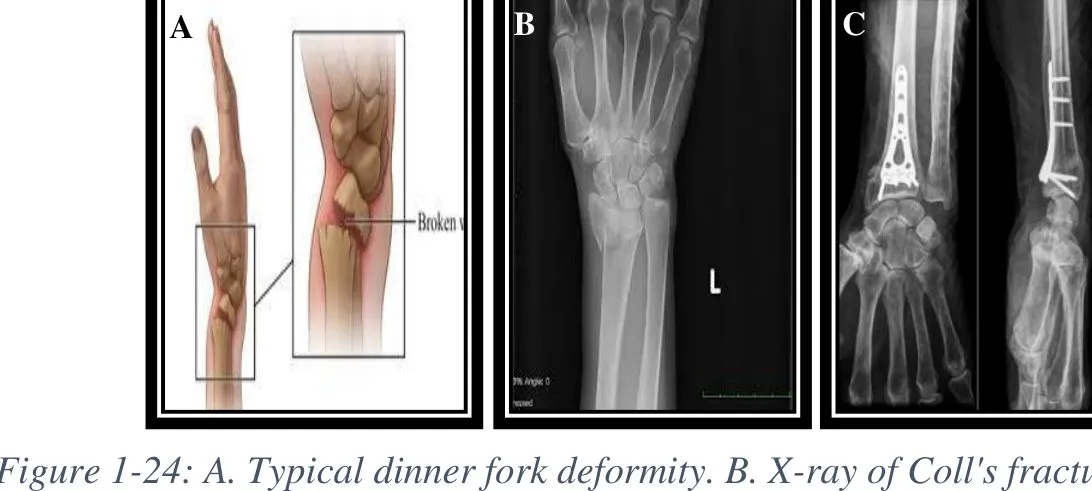
PTPhysical therapy (physiotherapy): treatment that uses exercise, movement and hands-on techniques to restore movement and function.General meaning, not from the slides for Colles' fractureA fracture within 1 inch of the lower end of the radius, with the distal fragment displaced upward, backward (dorsally) and radially.
- Day 1 → week 1: Active ROMJoint movement the patient performs by their own muscle effort.General meaning, not from the slides of the non-splinted joints (fingers, shoulder) from day 1. No pronation/supination, no wrist ROMRange of motion: how far a joint can move in each direction.General meaning, not from the slides. IsometricA muscle contraction in which the muscle tenses but the joint does not move.General meaning, not from the slides within the cast for the fingers; shoulder strengthening; posture; ProprioceptionThe body's sense of where its joints are and how they are moving.General meaning, not from the slides; function with the uninvolved limb.
- Weeks 2–4: continue active ROM of free joints, strengthening and general conditioning.
- Weeks 4–6: start active wrist ROM (if the splint is off or the fracture was fixed): gentle pronation/supination and radial/ulnar deviation; gentle grip (ball squeezing, finger AdductionMoving a limb toward the midline of the body.General meaning, not from the slides against resistance).
- Weeks 6–12: Tendon glidingExercises that slide the tendons smoothly through their sheaths so they do not stick.General meaning, not from the slides if needed; advance ROM; functional tasks from week 6 (combing, brushing); proprioception and CKCClosed kinetic chain: exercise in which the hand or foot is fixed against a surface while the limb moves, so the limb bears weight.General meaning, not from the slides from the end of week 6.
- After 12 weeks: full ROM, CKC, function/sport.
B. Smith fracture (reversed Colles’)
- Fall on the dorsum of the hand; distal fragment displaced forward (VolarToward the palm side of the hand or wrist.General meaning, not from the slides).
- ManipulationHands-on movement of a joint or bone by the clinician.General meaning, not from the slides, then Long-arm castA cast that runs from the hand up past the elbow to the upper arm.General meaning, not from the slides for 6–8 weeks.
| Colles’ | Smith fractureReversed Colles' fracture: a fall onto the back of the hand displaces the distal fragment forward (volarly). | |
|---|---|---|
| Fall onto | Outstretched hand (palm) | Back of the hand |
| Distal fragment | Backward (dorsal), up, radial | Forward (volar) |
| Cast | Below-elbow, pronation + ulnar deviation | Above-elbow, 6–8 weeks |
9. Fracture of the Scaphoid
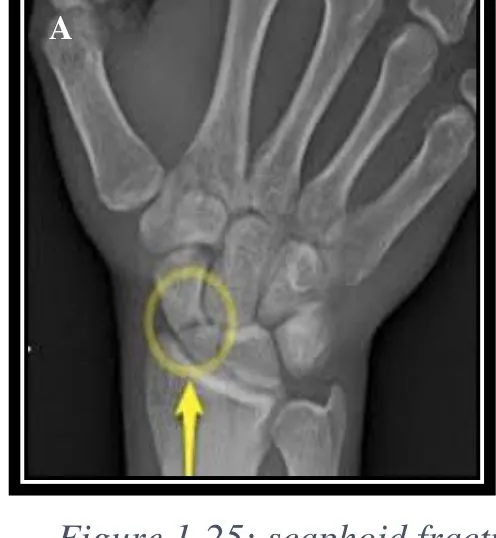
- Trauma: fall on the outstretched hand.
- Clinically: pain and swelling on the radial side of the wrist; tenderness in the Anatomical snuffboxThe small hollow on the thumb side of the back of the wrist.General meaning, not from the slides; wrist movement slightly painful and limited.
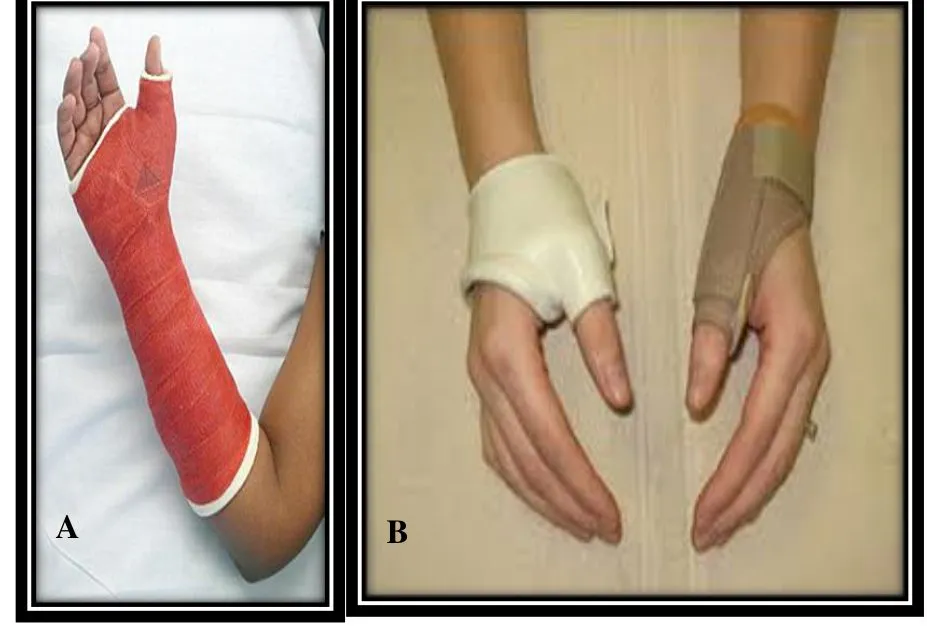
Conservative treatmentTreatment without surgery, such as exercise, immobilization or bracing.General meaning, not from the slides
- ProximalCloser to the trunk or the point of attachment of a limb.General meaning, not from the slides third: long-arm Thumb spicaA cast or splint that holds the thumb and wrist still.General meaning, not from the slides for 6 weeks (forearm rotation limited; wrist in slight flexion and slight Radial/ulnar deviationTilting the wrist toward the thumb side (radial) or the little-finger side (ulnar).General meaning, not from the slides) → short-arm thumb spica for another 6 weeks (weeks 6–12). Not healed on X-ray → 3 more weeks.
- Waist (middle) and DistalFarther from the trunk or the point of attachment of a limb.General meaning, not from the slides third: short-arm cast is enough.
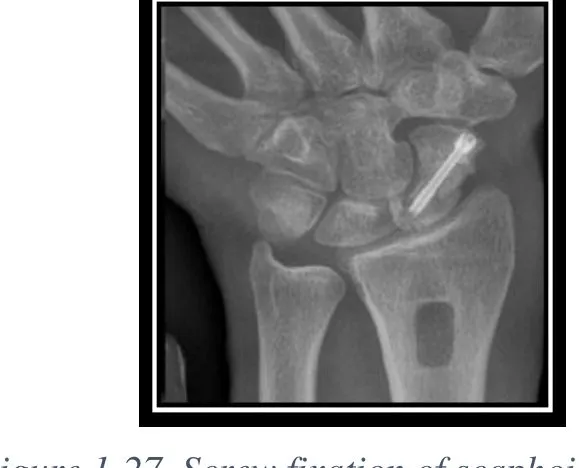
- If the fracture displaces or the line widens → screw FixationHolding a fractured bone in position with plates, screws, pins, wires or a cast.General meaning, not from the slides.
Surgical indications
- Displaced fractureThe broken bone ends have moved out of their normal alignment. Undisplaced or non-displaced means they have not.General meaning, not from the slides, but the effects of long ImmobilizationKeeping a body part still, for example with a cast, splint or sling, so that it can heal.General meaning, not from the slides (wrist stiffness, ThenarThe fleshy pad at the base of the thumb.General meaning, not from the slides AtrophyWasting away, or shrinking in size, of a tissue such as muscle.General meaning, not from the slides, delayed return to work or sport) would be intolerable.
- Previously unrecognized or untreated fractures.
- Displaced fractures, NonunionA fracture that fails to heal together.General meaning, not from the slides or OsteonecrosisDeath of bone tissue because its blood supply is lost.General meaning, not from the slides.
- PercutaneousDone through the skin.General meaning, not from the slides screw fixation for nondisplaced or minimally displaced fractures: UnionThe broken bone ends healing together.General meaning, not from the slides ~5 weeks earlier and return to sport/work ~7 weeks earlier than casting. Marked displacement → ORIFOpen reduction and internal fixation: surgery that realigns the bone and holds it with plates, screws or pins.General meaning, not from the slides.
Time to union by site
| Site | Union |
|---|---|
| Distal third | 6–8 weeks |
| Middle third | 8–12 weeks |
| Proximal third | 12–24 weeks |
Why the proximal pole is slowest: not stated in the handout, but this is the classic retrograde blood supply of the ScaphoidOne of the small wrist bones, on the thumb side.General meaning, not from the slides, which is also why the proximal third risks osteonecrosis.
PTPhysical therapy (physiotherapy): treatment that uses exercise, movement and hands-on techniques to restore movement and function.General meaning, not from the slides for conservative scaphoid treatment
- Weeks 0–6: active shoulder ROMRange of motion: how far a joint can move in each direction.General meaning, not from the slides; active MCP jointMetacarpophalangeal joint: the knuckle joint where a finger or thumb meets the hand bone.General meaning, not from the slides/PIP jointProximal interphalangeal joint: the middle joint of a finger.General meaning, not from the slides/DIP jointDistal interphalangeal joint: the joint nearest the fingertip.General meaning, not from the slides of fingers 2–5; posture; shoulder and elbow strengthening; maintain hand posture and skin creases; prevent ContractureA lasting shortening of muscle or soft tissue that limits how far a joint can move.General meaning, not from the slides.
- Weeks 6–12: continue; start active elbow flexion/extension and Pronation / supinationPronation turns the forearm so the palm faces down; supination turns it so the palm faces up.General meaning, not from the slides. At 12 weeks: CTComputed tomography: a scan that uses X-rays to make detailed cross-section pictures of the body.General meaning, not from the slides if X-rays are doubtful; not united → continue short spica.
- Weeks 12–14: remove the spica; active/gentle Active-assisted ROMJoint movement the patient performs with some help from a therapist, a device or the other arm.General meaning, not from the slides wrist flexion/extension and radial/ulnar deviation, thumb MCP/IP jointInterphalangeal joint: a joint between two finger or thumb bones.General meaning, not from the slides ROM; grip and thenar strengthening; ProprioceptionThe body's sense of where its joints are and how they are moving.General meaning, not from the slides and CKCClosed kinetic chain: exercise in which the hand or foot is fixed against a surface while the limb moves, so the limb bears weight.General meaning, not from the slides from the end of week 12.
- Weeks 14–18: discontinue all splinting; progress all ROM; strengthening; stretch tight structures and Tendon glidingExercises that slide the tendons smoothly through their sheaths so they do not stick.General meaning, not from the slides; by the end: full ROM, strength and flexibility; function.
10. Metacarpal Fractures
- Common, especially in contact sports; direct blow or fall onto the hand.
- 4th and 5th MetacarpalOne of the five long bones in the palm of the hand.General meaning, not from the slides are the most common.
- Neck fractures are the majority. Base fractures are less common, but Bennett's fractureAn intra-articular fracture of the base of the 1st metacarpal (thumb); the most common fracture of that site. (Intra-articularInside a joint.General meaning, not from the slides) is the most common fracture of the base of the 1st metacarpal (thumb).
- Clinically: pain and limited movement; swelling and EcchymosisBruising: discolouration of the skin from bleeding under it.General meaning, not from the slides; knuckle asymmetry, finger misalignment; any AngulationThe angle at which a bone or limb bends away from a straight line.General meaning, not from the slides can give a Pseudo-claw deformityA false claw-like finger posture that any angulation of the fracture can produce..
- Conservative treatmentTreatment without surgery, such as exercise, immobilization or bracing.General meaning, not from the slides: Closed reductionRealigning a bone by manipulation, without cutting the skin.General meaning, not from the slides + radial or ulnar Gutter castA cast moulded as a trough along one side of the forearm and hand.General meaning, not from the slides, or Functional braceA brace that supports a healing fracture while allowing free active movement of the limb.General meaning, not from the slides (3-point pressure), which is often better since it allows free active motion. Stable fractures heal in 3–4 weeks, then removable splints for controlled motion.
- Multiple metacarpal fractures: cast all fingers or a Posterior slabA plaster slab applied along the back of the limb.General meaning, not from the slides with MCP jointMetacarpophalangeal joint: the knuckle joint where a finger or thumb meets the hand bone.General meaning, not from the slides joints flexed 50–70°, wrist neutral, IP jointInterphalangeal joint: a joint between two finger or thumb bones.General meaning, not from the slides joints extended, for 4–6 weeks.
- Surgical: unstable or intra-articular → ORIFOpen reduction and internal fixation: surgery that realigns the bone and holds it with plates, screws or pins.General meaning, not from the slides (most stable, early rehab). PercutaneousDone through the skin.General meaning, not from the slides FixationHolding a fractured bone in position with plates, screws, pins, wires or a cast.General meaning, not from the slides is reliable, with better ROMRange of motion: how far a joint can move in each direction.General meaning, not from the slides and fewer complications than ORIF with wiring or miniplates.
11. Phalangeal Fractures
- Common in contact sports; ProximalCloser to the trunk or the point of attachment of a limb.General meaning, not from the slides, middle or DistalFarther from the trunk or the point of attachment of a limb.General meaning, not from the slides; intra- or Extra-articularOutside a joint.General meaning, not from the slides; stable or unstable.
- Stable: Impacted fractureA fracture with no separation of the broken ends, so no reduction is needed., little or no Displaced fractureThe broken bone ends have moved out of their normal alignment. Undisplaced or non-displaced means they have not.General meaning, not from the slides, usually isolated Transverse fractureA fracture line running straight across the bone.General meaning, not from the slides.
- Unstable: ComminutedBroken into more than two pieces.General meaning, not from the slides, displaced, Oblique fractureA fracture line running at a slant across the bone.General meaning, not from the slides or Spiral fractureA fracture line that winds around the bone, usually from a twisting force.General meaning, not from the slides, or multiple fractures in one DigitA finger or toe.General meaning, not from the slides.
- UnionThe broken bone ends healing together.General meaning, not from the slides 3–6 weeks, but RadiologicalSeen on X-ray or other imaging.General meaning, not from the slides healing can take 10–12 weeks.
- ImmobilizationKeeping a body part still, for example with a cast, splint or sling, so that it can heal.General meaning, not from the slides MCP jointMetacarpophalangeal joint: the knuckle joint where a finger or thumb meets the hand bone.General meaning, not from the slides and IP jointInterphalangeal joint: a joint between two finger or thumb bones.General meaning, not from the slides joints for > 3–4 weeks → residual stiffness, so early ROMRange of motion: how far a joint can move in each direction.General meaning, not from the slides is recommended.
Conservative treatmentTreatment without surgery, such as exercise, immobilization or bracing.General meaning, not from the slides
- Buddy tapingTaping an injured finger to the neighbouring finger, which allows early ROM. (stable fractures): tape to the neighbouring digit; allows early ROM.
- Closed reductionRealigning a bone by manipulation, without cutting the skin.General meaning, not from the slides + cast/splint (stable after ReductionPutting a broken or dislocated bone back into its correct position.General meaning, not from the slides), usually with buddy taping.
- Proximal phalanxThe finger bone closest to the hand.General meaning, not from the slides position: wrist 30° extension, MCP 60–90° flexion, IP 5–10° flexion.
- DorsalToward the back; for the hand, the back of the hand.General meaning, not from the slides PIP jointProximal interphalangeal joint: the middle joint of a finger.General meaning, not from the slides fracture-DislocationA joint whose bones have been forced out of their normal alignment.General meaning, not from the slides: Extension-block dorsal splintA splint on the back of the finger that stops it straightening past a set point.General meaning, not from the slides after reduction.
Surgical
- CRPPClosed reduction and percutaneous pinning: the bone is realigned without opening the skin and held with pins inserted through the skin.General meaning, not from the slides for displaced transverse fractures unstable after reduction; pins out at 4–6 weeks, then a splint for 2 more weeks.
- ORIFOpen reduction and internal fixation: surgery that realigns the bone and holds it with plates, screws or pins.General meaning, not from the slides for comminuted articular or highly unstable fractures.
- External fixationHolding bone fragments steady with pins connected to a frame outside the body.General meaning, not from the slides for severe open or comminuted fractures.
PT for metacarpal and phalangeal fractures
- Day 1 → week 1: NO Passive ROMMovement of a joint carried out by someone or something else, with no effort from the patient.General meaning, not from the slides to the affected digit; Active ROMJoint movement the patient performs by their own muscle effort.General meaning, not from the slides of non-splinted digits and free joints (elbow, shoulder); IsometricA muscle contraction in which the muscle tenses but the joint does not move.General meaning, not from the slides within the cast; elbow/shoulder strengthening; posture; ProprioceptionThe body's sense of where its joints are and how they are moving.General meaning, not from the slides; function with the other limb.
- Weeks 2–4: still no passive ROM of the affected digit; continue as above.
- Weeks 4–6: active ROM of the involved digits; wrist Pronation / supinationPronation turns the forearm so the palm faces down; supination turns it so the palm faces up.General meaning, not from the slides and deviations; gentle grip strengthening; night hand-based Thermoplastic splintA splint made of plastic that softens with heat so it can be moulded to the limb.General meaning, not from the slides from cast removal to the 6-week follow-up (keeps the functional position).
- Weeks 6–12: advance ROM; functional tasks from week 6; proprioception and CKCClosed kinetic chain: exercise in which the hand or foot is fixed against a surface while the limb moves, so the limb bears weight.General meaning, not from the slides from week 6.
- After 12 weeks: full ROM, CKC, function/sport.
Greer’s principles of splinting/casting in hand fractures — REDUCE
| Letter | Principle |
|---|---|
| R | Reduction and FixationHolding a fractured bone in position with plates, screws, pins, wires or a cast.General meaning, not from the slides |
| E | Eliminate contractures with proper positioning |
| D | Don’t immobilize > 3 weeks (some fractures need 6–8 weeks) |
| U | Uninvolved joints are not splinted in stable fractures |
| C | Creases of the skin must not be obstructed |
| E | Early active Tendon glidingExercises that slide the tendons smoothly through their sheaths so they do not stick.General meaning, not from the slides |
- The hand tolerates OedemaSwelling caused by fluid collecting in the tissues.General meaning, not from the slides poorly → RICERest, Ice, Compression, Elevation: a first-aid routine used to control swelling.General meaning, not from the slides for oedema control.
N.B. For hand fractures, early PTPhysical therapy (physiotherapy): treatment that uses exercise, movement and hands-on techniques to restore movement and function.General meaning, not from the slides, a home programme and Occupational therapyTreatment that helps people regain the skills for daily activities and work.General meaning, not from the slides improve function, plus Sensory-motor trainingTraining that links sensation and movement control, for example with desensitization, mirror therapy and motor imagery.General meaning, not from the slides training: DesensitizationGradual exposure of a hypersensitive area to touch so it becomes less sensitive.General meaning, not from the slides, Mirror therapyUsing the mirror reflection of the healthy limb to retrain the brain's perception of the affected limb.General meaning, not from the slides, Cross-educationContralateral strengthening: training one limb to build strength in the opposite one. (ContralateralOn the opposite side of the body from the structure being discussed.General meaning, not from the slides strengthening) and Motor imageryMentally rehearsing a movement without actually doing it.General meaning, not from the slides. Longer immobilization and fear of movement worsen outcomes.