Physical Therapy for Low Back Pain (I)
Quiz this lecture (78 questions)Dr. Eman Abdullah Kamel’s lecture covers LumbarRelating to the lower back, the part of the spine between the chest and the pelvis.General meaning, not from the slides anatomy and how posture loads the disc, the types and course of Low back pain (LBP)Pain and discomfort below the costal margin and above the inferior gluteal folds, with or without leg pain. (LBP), the common lumbar disorders (Lumbar spondylosisDegenerative changes in the vertebral bone, discs and facet joints; also called spinal osteoarthritis., SpondylolysisA defect in the pars interarticularis, the bridge of bone in the vertebral arch., SpondylolisthesisForward displacement of the vertebra above over the vertebra below., RetrolisthesisBackward displacement of the vertebra above on the one below., Lumbarization of S1The S1 segment becomes mobile, behaving like a lumbar vertebra., SacralizationL5 is fused to the sacrum or ilium., Disc lesionDamage to an intervertebral disc, such as a bulge or herniation.General meaning, not from the slides, StenosisNarrowing of the spinal canal or nerve-root canals.), how to assess the lumbar spine, and the rehabilitation programme for each condition.
Learning Objectives
- Recognize the effect of body posture on Intradiscal pressureThe pressure inside the intervertebral disc.General meaning, not from the slides.
- Recognize the common LumbarRelating to the lower back, the part of the spine between the chest and the pelvis.General meaning, not from the slides spine disorders.
- Identify the clinical picture of the common lumbar spine disorders.
- Recognize the basic physical therapy interventions for these disorders.
Lumbar Anatomy and Pathomechanics
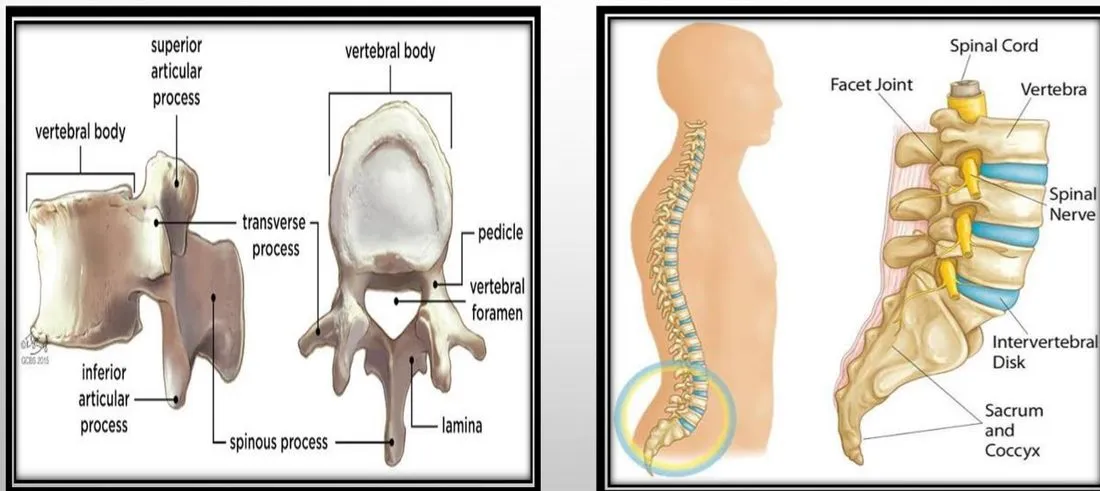
Intervertebral disc
- Consists of the Annulus fibrosusThe outer rings (lamellae) of the intervertebral disc. (outer rings, LamellaeThe thin layered rings that make up the annulus fibrosus.General meaning, not from the slides) and the Nucleus pulposusThe soft, jelly-like centre of the intervertebral disc. (centre).
- Carries substantial loads from gravity and muscle forces.
- It is the major anterior load-bearing element in Axial compressionA force pressing along the length of the spine.General meaning, not from the slides and flexion.
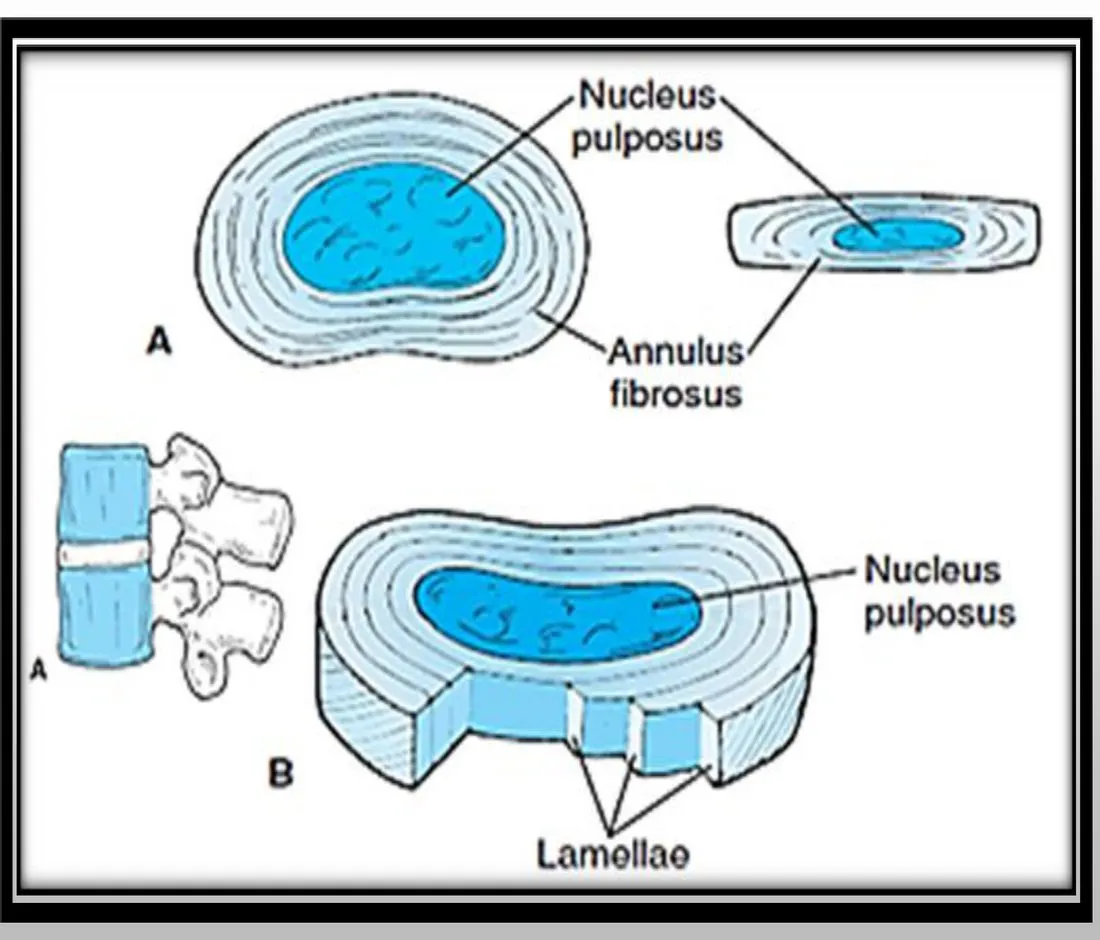
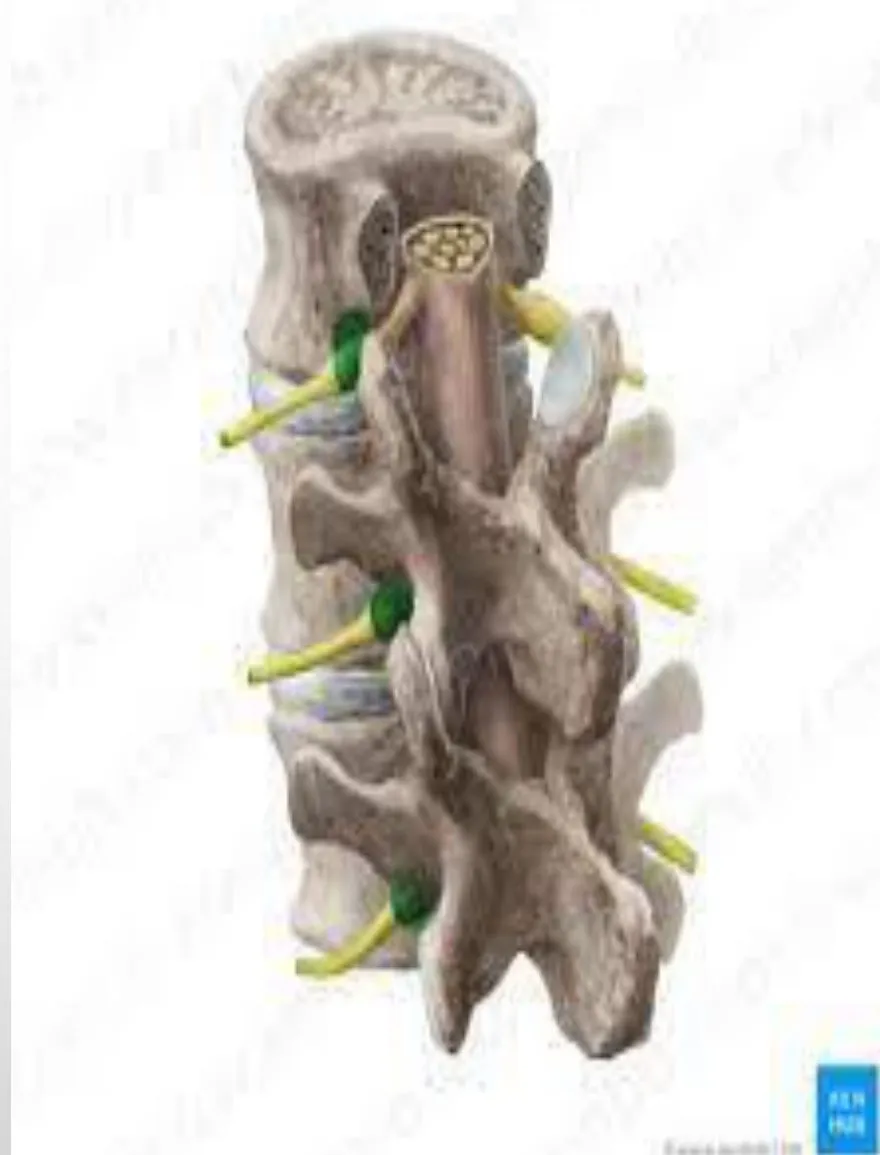
Intervertebral foramina
The openings where the spinal nerves leave, between each segment in the posterior pillar.
| Boundary | Structure |
|---|---|
| Anterior | Intervertebral discThe cushion between two vertebrae, made of a tough outer ring (annulus fibrosus) around a soft centre (nucleus pulposus). |
| Posterior | Facet jointA small paired joint at the back of each vertebra that guides and limits spinal movement.General meaning, not from the slides |
| Superior / inferior | PedicleThe short bony stalk that joins the back part of a vertebra to its main body.General meaning, not from the slides of the VertebraOne of the bones that stack to form the spine.General meaning, not from the slides above and below |
Size changes with movement:
- Larger with forward bending and ContralateralOn the opposite side of the body from the structure being discussed.General meaning, not from the slides Side bendingBending the trunk sideways, to the left or right.General meaning, not from the slides.
- Smaller with extension and IpsilateralOn the same side of the body as the structure being discussed.General meaning, not from the slides side bending.
Why it matters later: extension and side-bending toward the painful side narrow the Intervertebral foraminaThe openings, between each spinal segment, where the spinal nerves leave., which squeezes the Nerve rootThe part of a spinal nerve where it leaves the spinal cord, before it branches.General meaning, not from the slides more.
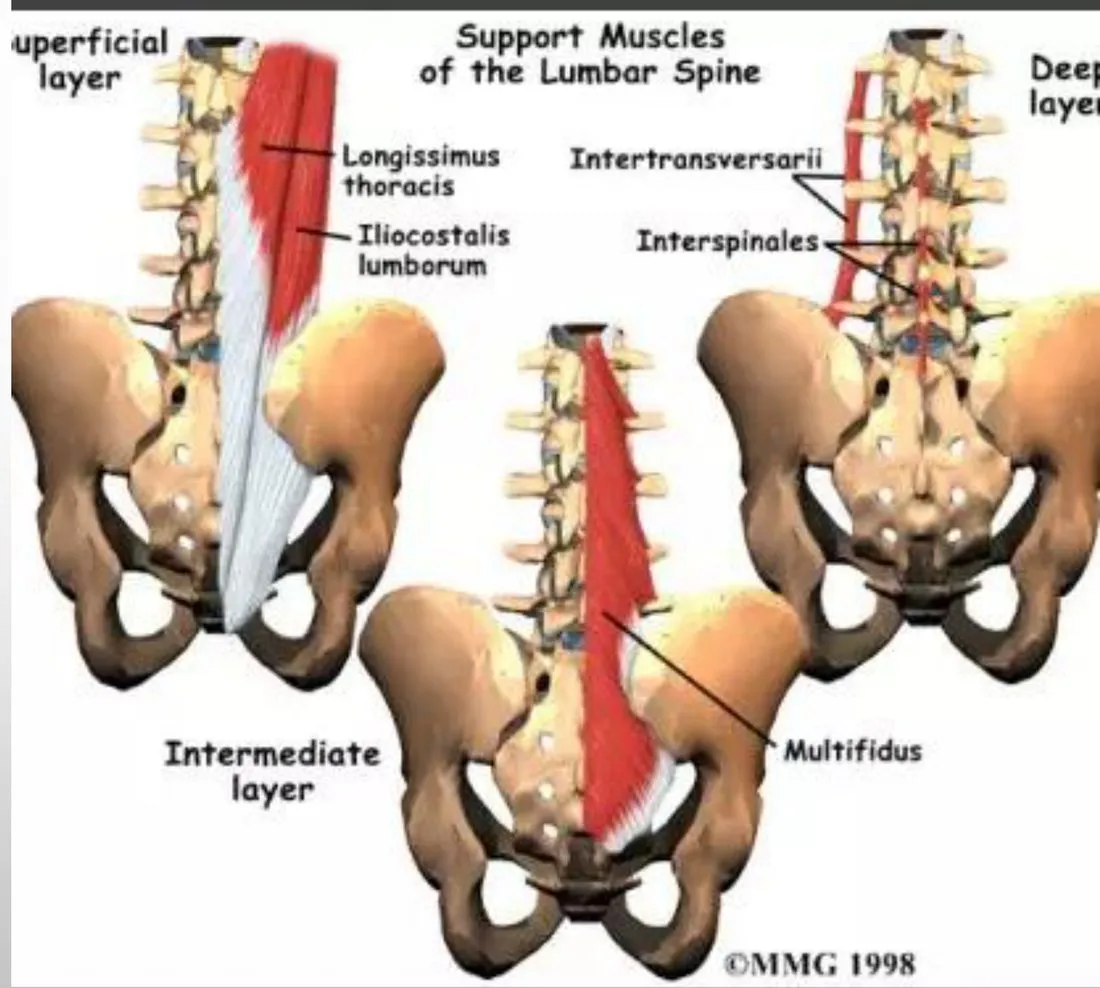
Muscles
There are three layers:
- Deep layer.
- Intermediate layer: these act as position sensors in the spinal Spinal proprioceptionThe body's sense of where its joints are and how they are moving.General meaning, not from the slides system rather than as torque generators, so they are important in the control of posture.
- Superficial layer: contraction of the long Erector spinaeThe long muscles along each side of the spine that straighten and extend the back.General meaning, not from the slides balances the opposing activity of the abdominal muscles.
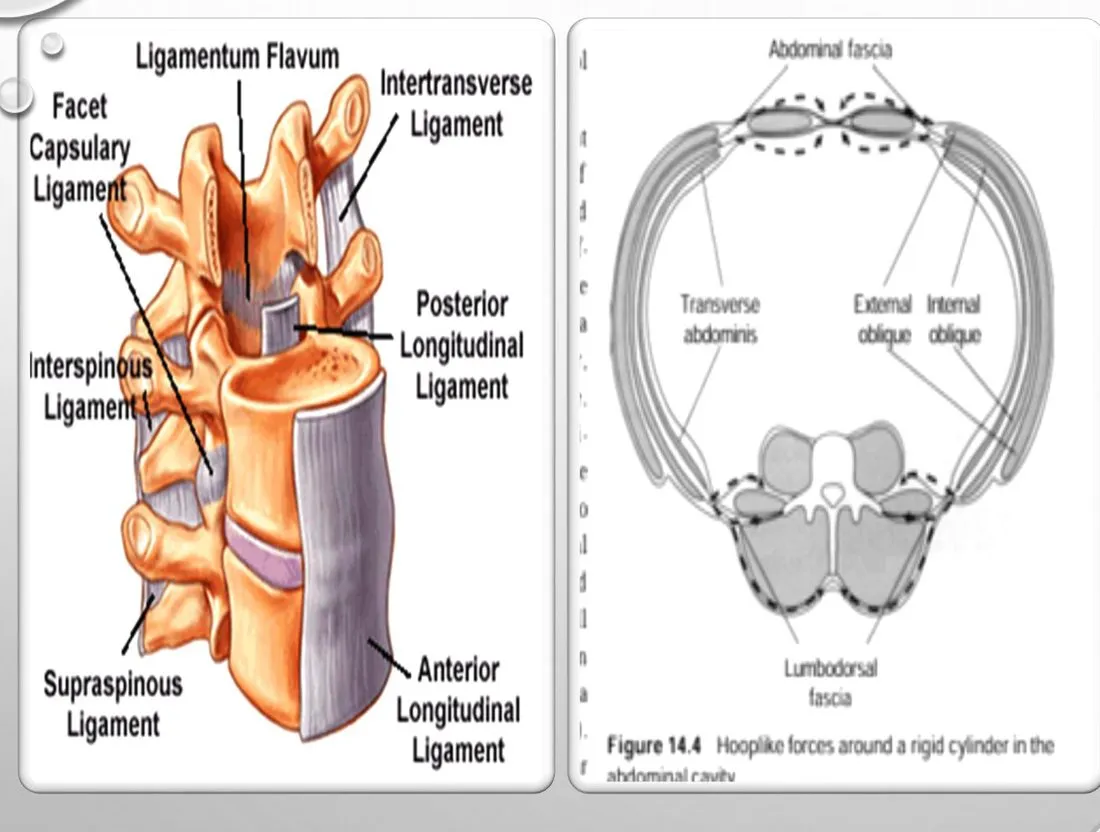
Intra-abdominal pressure (IAP)Pressure inside the abdomen. A rise in IAP contributes to spinal stability and is produced by contraction of the abdominal muscles, pelvic floor and diaphragm. (IAP): there is increasing evidence that a rise in IAP contributes to spinal stability. It is produced by contraction of the abdominal muscles, Pelvic floorThe muscles that form the base of the pelvis, supporting the organs above.General meaning, not from the slides and DiaphragmThe dome-shaped breathing muscle under the lungs, separating the chest from the abdomen.General meaning, not from the slides.
Fascia and ligaments
- Both superficial and deep FasciaA sheet of connective tissue that wraps around muscles and other structures.General meaning, not from the slides are present in the back. Muscle contraction stiffens and stabilises the LumbarRelating to the lower back, the part of the spine between the chest and the pelvis.General meaning, not from the slides spine through the Thoracolumbar fasciaA strong sheet of fascia across the lower back. Muscle contraction stiffens and stabilises the lumbar spine through it..
- The spinal ligaments are key Passive stabilizersStructures such as ligaments that hold a joint steady without contracting.General meaning, not from the slides: Ligamentum flavumA strong, elastic ligament joining the bony arches (laminae) of neighbouring vertebrae at the back of the spinal canal.General meaning, not from the slides, Supraspinous ligamentThe ligament running along the tips of the spinous processes.General meaning, not from the slides, Interspinous ligamentThe ligament linking neighbouring spinous processes.General meaning, not from the slides, Intertransverse ligamentThe ligament linking neighbouring transverse processes (the side projections of a vertebra).General meaning, not from the slides, Facet capsular ligamentThe capsule of ligament tissue that surrounds each facet joint.General meaning, not from the slides, and Longitudinal ligamentsTwo long ligaments running down the front and back of the vertebral bodies.General meaning, not from the slides (labelled on the slide figure).
Effect of Body Posture on Intradiscal Pressure
- In standing upright, the LumbarRelating to the lower back, the part of the spine between the chest and the pelvis.General meaning, not from the slides Facet jointA small paired joint at the back of each vertebra that guides and limits spinal movement.General meaning, not from the slides carry 10–20% of the compressive load.
- The share carried by the disc increases with flexion.
- In extension, load passes through the facet surfaces and the tips of the inferior facets, which relieves some load on the disc.
- Maintaining lumbar LordosisThe normal inward curve of the lower back.General meaning, not from the slides reduces disc load; flexion increases it.
The slide’s “Figure 2” gives Intradiscal pressureThe pressure inside the intervertebral disc.General meaning, not from the slides for each position (axis labelled “kg”):
| Position | Value |
|---|---|
| Lying SupineLying face up, on the back.General meaning, not from the slides | 25 |
| Side lying | 75 |
| Standing | 100 |
| Sitting upright | 140 |
| Standing, bent forward | 150 |
| Sitting, bent forward | 185 |
| Standing, bent forward and lifting | 220 |
| Sitting, bent forward and lifting | 275 |
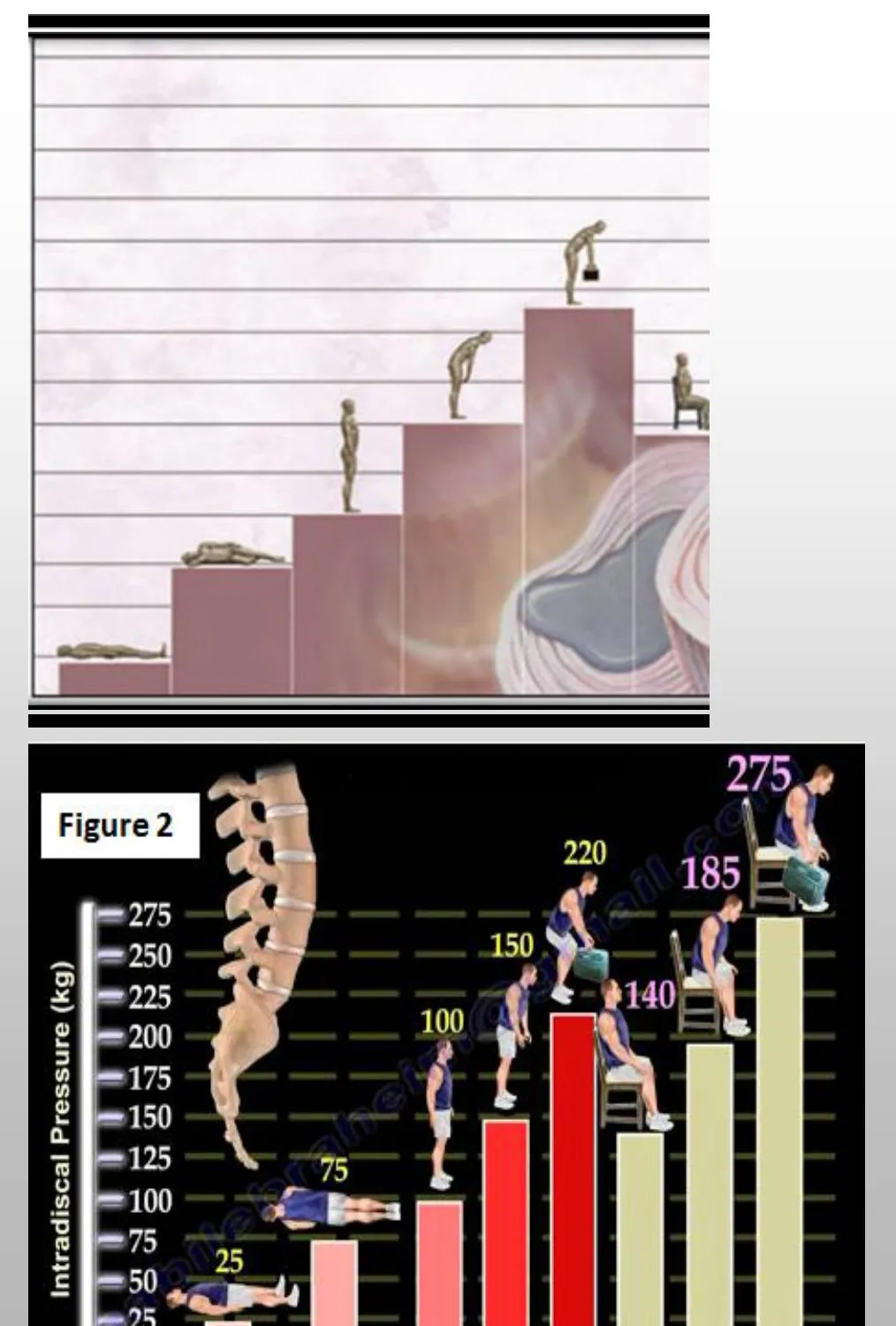
Pattern to remember: lying < standing < sitting, and bending forward or lifting raises every position. Sitting bent forward while lifting is the worst.
Low Back Pain: Definition and Types
Definition: pain and discomfort below the Costal marginThe lower edge of the rib cage.General meaning, not from the slides and above the inferior Gluteal foldsThe skin creases under the buttocks, where the buttocks meet the thighs.General meaning, not from the slides, with or without leg pain.
| Type | Meaning |
|---|---|
| 1. Non-specific LBPPersistent pain without identifiable nerve-root involvement, specific spinal pathology or radicular symptoms. (“IdiopathicOf unknown cause.General meaning, not from the slides”), 85% | Persistent pain without identifiable nerve-root involvement, specific spinal pathology or Radicular painPain caused by irritation of a spinal nerve root, felt along the area the nerve supplies.General meaning, not from the slides |
| 2. Specific | A clearly identifiable spinal or non-spinal cause |
| 3. Mechanical LBPPain that arises intrinsically from the spine, discs or surrounding soft tissues. | Arises intrinsically from the spine, discs or surrounding soft tissues: A. DegenerativeInvolving gradual wear and breakdown of a tissue.General meaning, not from the slides diseases (e.g. Lumbar spondylosisDegenerative changes in the vertebral bone, discs and facet joints; also called spinal osteoarthritis., degenerative Disc lesionDamage to an intervertebral disc, such as a bulge or herniation.General meaning, not from the slides), B. disc HerniationA general term for any change in the annulus that makes it bulge beyond its normal perimeter., C. traumatic |
| 4. Non-mechanical LBPPain that does not arise from the mechanics of the spine, discs and soft tissues; the slide's example is idiopathic scoliosis (developmental). (developmental) | e.g. idiopathic ScoliosisA sideways curve of the spine.General meaning, not from the slides |
Other causes (Red flagsWarning signs that may point to a serious underlying cause of the pain.General meaning, not from the slides): bladder/kidney infection, EndometriosisA condition in which tissue like the womb lining grows outside the womb.General meaning, not from the slides, cancer, ovarian problems.
Course of LBP
| Stage | Definition on the slide |
|---|---|
| AcuteRecent or sudden onset. In the course of LBP the slide defines acute as less than 1 month. | Less than 1 month |
| SubacuteBetween 2 and 3 months. | Between 2 and 3 months |
| ChronicLong-standing. In the course of LBP the slide defines chronic as more than 3 months since the first episode began. | More than 3 months since the first episode began |
| RecurrentAssociated with increased sitting time, previous episodes of LBP and low educational level (the slide's wording). | Associated with increased sitting time, previous episodes of Low back pain (LBP)Pain and discomfort below the costal margin and above the inferior gluteal folds, with or without leg pain. and low educational level (slide: “low educational time”) |
The slide leaves a gap: acute is “< 1 month” and subacute “2–3 months”, so 1–2 months is not covered. Learn the numbers as written.
Prognostic factorsThings that help predict how a condition is likely to turn out.General meaning, not from the slides for developing chronic pain:
- Symptoms below the knee
- Psychological distress or depression
- Fear of pain, movement and re-injury, or low expectations of recovery
- High pain intensity
Lumbar Spondylosis
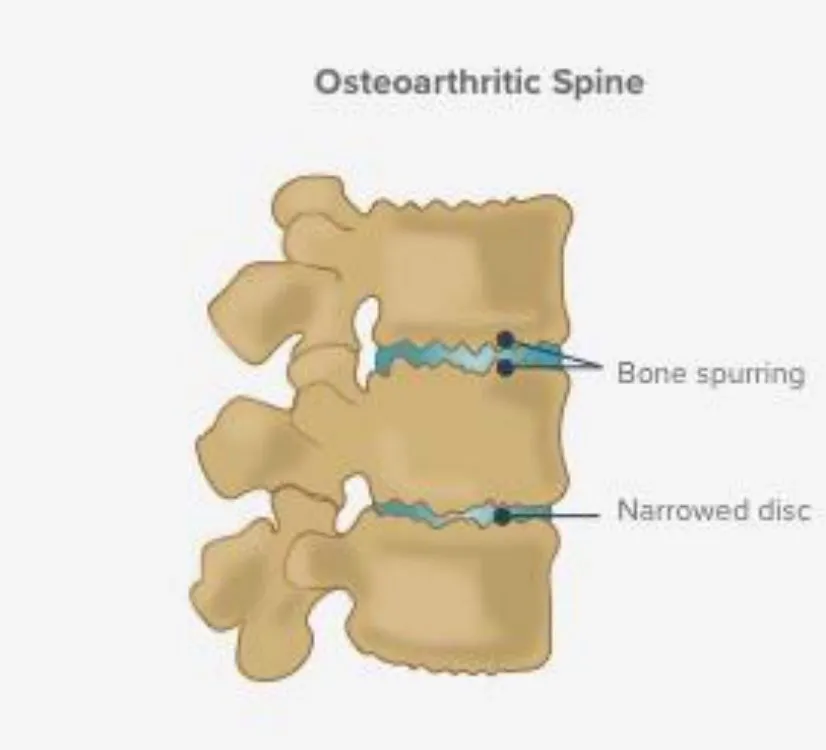
- Definition: DegenerativeInvolving gradual wear and breakdown of a tissue.General meaning, not from the slides changes in the vertebral bone, discs and Facet jointA small paired joint at the back of each vertebra that guides and limits spinal movement.General meaning, not from the slides. Also called spinal OsteoarthritisWear-and-tear arthritis in which joint cartilage thins and the joint becomes stiff and painful.General meaning, not from the slides.
- Associated with ageing, but not a result of it. The site and rate of degeneration vary by individual.
- Commonly affected sites: L2–L4.
Risk factors
Age · obesity · poor posture · occupational stress · prolonged sitting (pressure on the LumbarRelating to the lower back, the part of the spine between the chest and the pelvis.General meaning, not from the slides VertebraOne of the bones that stack to form the spine.General meaning, not from the slides) · prior injury · heredity/family history.
Pathology
- With ageing, the disc spaces narrow.
- The ligaments around the disc and facet joints thicken, and may later CalcifyTo harden through a build-up of calcium.General meaning, not from the slides.
- Discs lose water, so they lose height and shock absorption and distribute pressure less evenly, which makes them easier to damage.
- OsteophytesBone spurs: extra bony growths along the edges of joints. (bone spurs) form.
- The Spinal canalThe bony tunnel formed by the vertebrae, containing the spinal cord and nerve roots.General meaning, not from the slides or the Intervertebral foraminaThe openings, between each spinal segment, where the spinal nerves leave. (where the nerves exit) can be compromised.
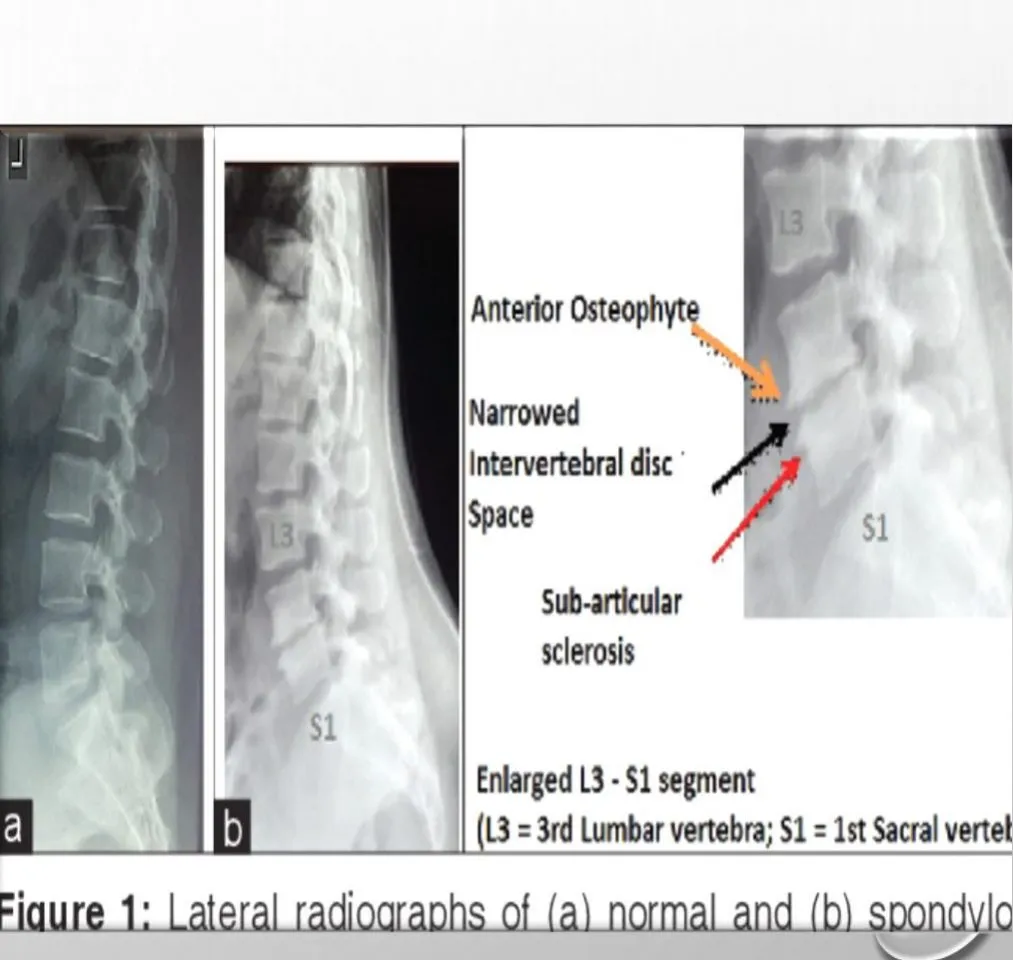
Clinical features
- Many people have no symptoms.
- Onset: gradual. AcuteRecent or sudden onset. In the course of LBP the slide defines acute as less than 1 month. pain is often triggered by unaccustomed activity.
- Pain: most commonly across the SacrumThe triangular bone at the base of the spine, between the two hip bones.General meaning, not from the slides between the SI jointSacroiliac joint: the joint where the sacrum meets the ilium of the pelvis.General meaning, not from the slides, may radiate to one or both buttocks. If central, it may be at L4, L5, S1.
- Radicular painPain caused by irritation of a spinal nerve root, felt along the area the nerve supplies.General meaning, not from the slides in the DermatomeThe area of skin supplied by a single spinal nerve root.General meaning, not from the slides if a Nerve rootThe part of a spinal nerve where it leaves the spinal cord, before it branches.General meaning, not from the slides is irritated.
- Nature: dull or severe ache with occasional sharp stabbing pain.
- ParesthesiaAbnormal skin sensations such as pins and needles, 'creeping ants' or numbness. in a dermatomal pattern (pins and needles, “creeping ants”, numbness).
- Muscle spasmA sudden, involuntary tightening of a muscle.General meaning, not from the slides: usually Erector spinaeThe long muscles along each side of the spine that straighten and extend the back.General meaning, not from the slides; one or both Quadratus lumborumA deep muscle of the lower back that runs from the pelvis up to the lowest rib and the lumbar spine.General meaning, not from the slides; unequal Muscle toneThe slight constant tension in a resting muscle.General meaning, not from the slides between hip Hip abductorsThe muscles on the outer hip that lift the leg out to the side.General meaning, not from the slides and Hip adductorsThe muscles on the inner thigh that pull the leg toward the midline.General meaning, not from the slides.
- Limitation of motion: lumbar flexion; unequal limitation of hip movement. Causes: muscle spasm (acute), soft-tissue tightness, facet joint AdhesionsBands of scar tissue that stick structures together.General meaning, not from the slides (ChronicLong-standing. In the course of LBP the slide defines chronic as more than 3 months since the first episode began.).
- Muscle weakness: poor posture with weak abdominal and gluteal muscles; the painful leg is usually weaker; ± MyotomeThe group of muscles supplied by a single spinal nerve root.General meaning, not from the slides involvement.
- RadiographAn X-ray image.General meaning, not from the slides: often little correlation between the patient’s disability and the X-ray.
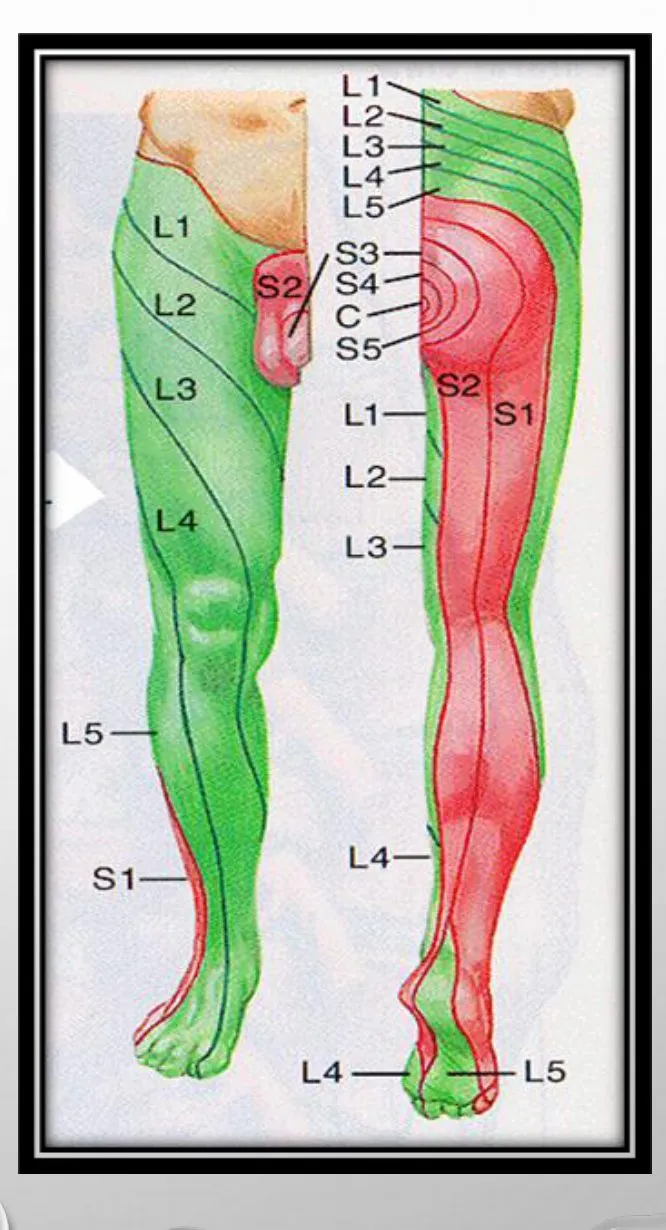
Lower limb myotomes (slide table)
| Root | Action | Muscles |
|---|---|---|
| L1, L2 | Hip flexion | IliopsoasThe deep hip flexor muscle running from the lower spine and pelvis to the top of the femur.General meaning, not from the slides |
| L2/L3 | Hip AdductionMoving a limb toward the midline of the body.General meaning, not from the slides | Adductor longus/magnusTwo inner-thigh muscles that pull the thigh toward the midline.General meaning, not from the slides |
| L3, L4 | Knee extension | Quadriceps femorisThe muscle group at the front of the thigh that straightens the knee.General meaning, not from the slides |
| L4 | Ankle DorsiflexionPulling the foot up toward the shin.General meaning, not from the slides | Tibialis anteriorThe muscle at the front of the shin that lifts the foot upward.General meaning, not from the slides |
| L5 | Toe extension | Extensor digitorum longus / hallucis longusMuscles on the front of the lower leg that lift the toes (digitorum) and the big toe (hallucis).General meaning, not from the slides |
| L4/L5 | Hip AbductionMoving a limb away from the midline of the body.General meaning, not from the slides | Gluteus medius/minimusTwo muscles on the outer side of the hip that move the thigh out to the side and steady the pelvis.General meaning, not from the slides |
| L5, S1 | Hip extension | Gluteus maximusThe large buttock muscle that extends the hip.General meaning, not from the slides |
| S1 | Knee flexion | HamstringsThe muscle group at the back of the thigh that bends the knee and extends the hip.General meaning, not from the slides |
| S1, S2 | Ankle PlantarflexionPointing the foot downward, away from the shin.General meaning, not from the slides | GastrocnemiusThe large calf muscle that points the foot down and helps bend the knee.General meaning, not from the slides, SoleusA flat calf muscle under the gastrocnemius that points the foot downward.General meaning, not from the slides |
| S1, S2 | Toe flexion | Flexor digitorum / hallucis longusMuscles in the back of the lower leg that curl the toes (digitorum) and the big toe (hallucis) downward.General meaning, not from the slides |
Spondylolysis
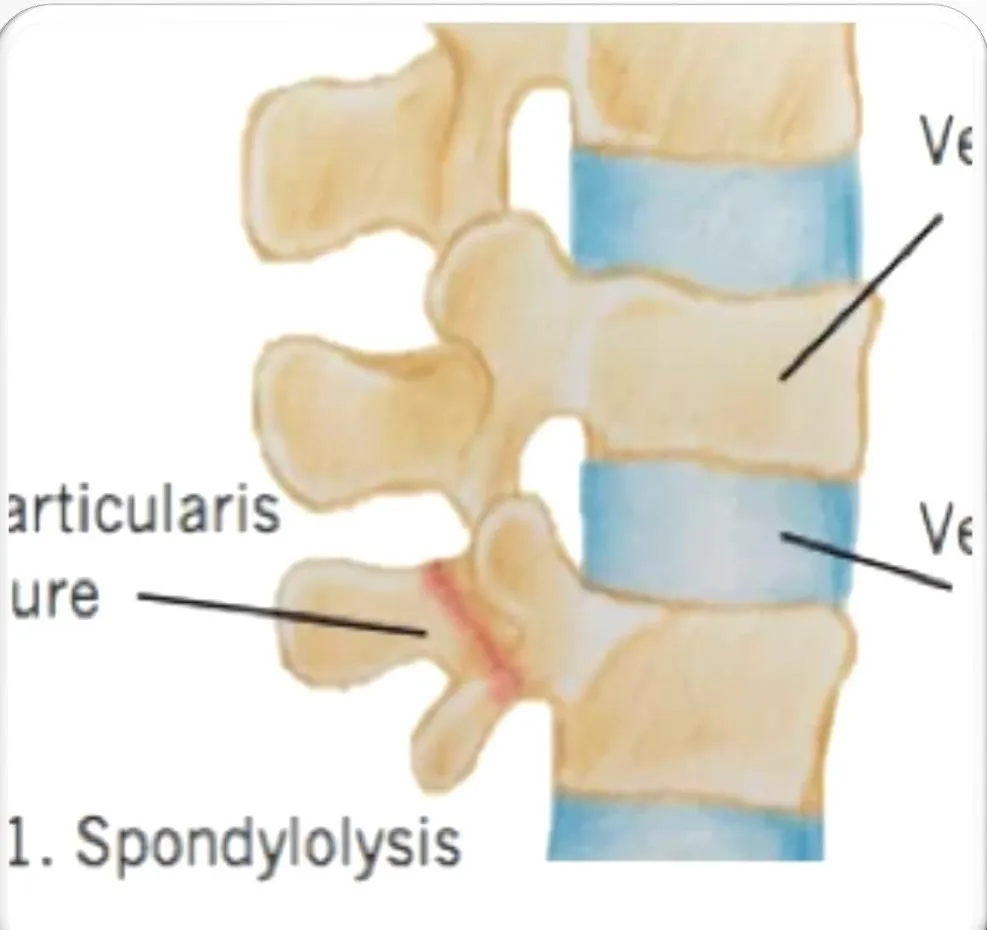
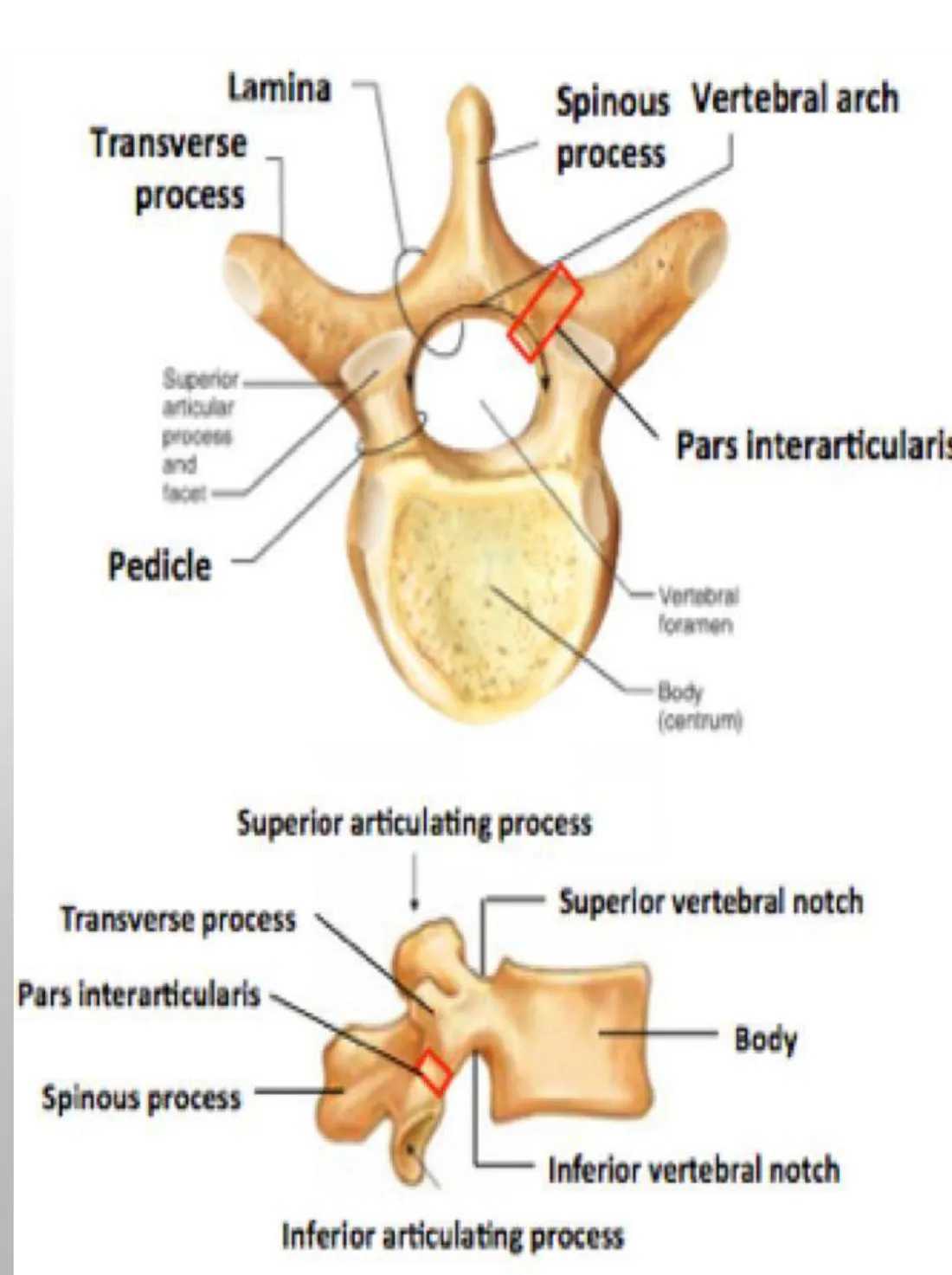
- Defect in the Pars interarticularisThe bridge of bone joining the inferior articular process and lamina to the superior articular process and pedicle., the bridge of bone joining the Articular processA bony projection of a vertebra that carries a facet joint surface, linking it to the vertebra above or below.General meaning, not from the slides and LaminaThe flat bony plate on each side of the vertebral arch, at the back of the spinal canal.General meaning, not from the slides to the superior articular process and PedicleThe short bony stalk that joins the back part of a vertebra to its main body.General meaning, not from the slides (or in the Vertebral archThe bony ring at the back of a vertebra that encloses the spinal canal.General meaning, not from the slides).
- Causes:
- Stress fractureA small crack in a bone caused by repeated loading rather than a single injury.General meaning, not from the slides from sports or activities with repeated back extension.
- Congenital abnormality: Fibrous tissueTough, scar-like connective tissue.General meaning, not from the slides replaces the narrow part of the pars.
- Commonest levels: L4–5 and L5–S1.
Clinical picture:
- Signs and symptoms are often not directly attributable to the defect; it may be an accidental X-ray finding.
- Insidious onsetStarting gradually and subtly, without a clear moment of onset.General meaning, not from the slides onset of Low back pain (LBP)Pain and discomfort below the costal margin and above the inferior gluteal folds, with or without leg pain., linked to sporting movements.
- Dull LBP in static weight-bearing positions, like a muscle strain.
- Hallmark: pain that worsens with spinal HyperextensionStraightening a joint beyond its normal limit; in the spine, bending backward.General meaning, not from the slides (bending backward).
- Pain may occasionally radiate to the buttocks or legs, but Neurological deficitsLoss of nerve function, such as weakness, numbness or loss of reflexes.General meaning, not from the slides are rare.
- A small rotation or offset of the Spinous processThe bony projection at the back of each vertebra that can be felt down the middle of the back.General meaning, not from the slides at the defect level.
- Prompt imaging matters: pars injuries caught in the AcuteRecent or sudden onset. In the course of LBP the slide defines acute as less than 1 month. phase heal better with conservative management. Standard APAnteroposterior: an X-ray view taken from front to back.General meaning, not from the slides and lateral RadiographAn X-ray image.General meaning, not from the slides are the initial screening.
Spondylolisthesis
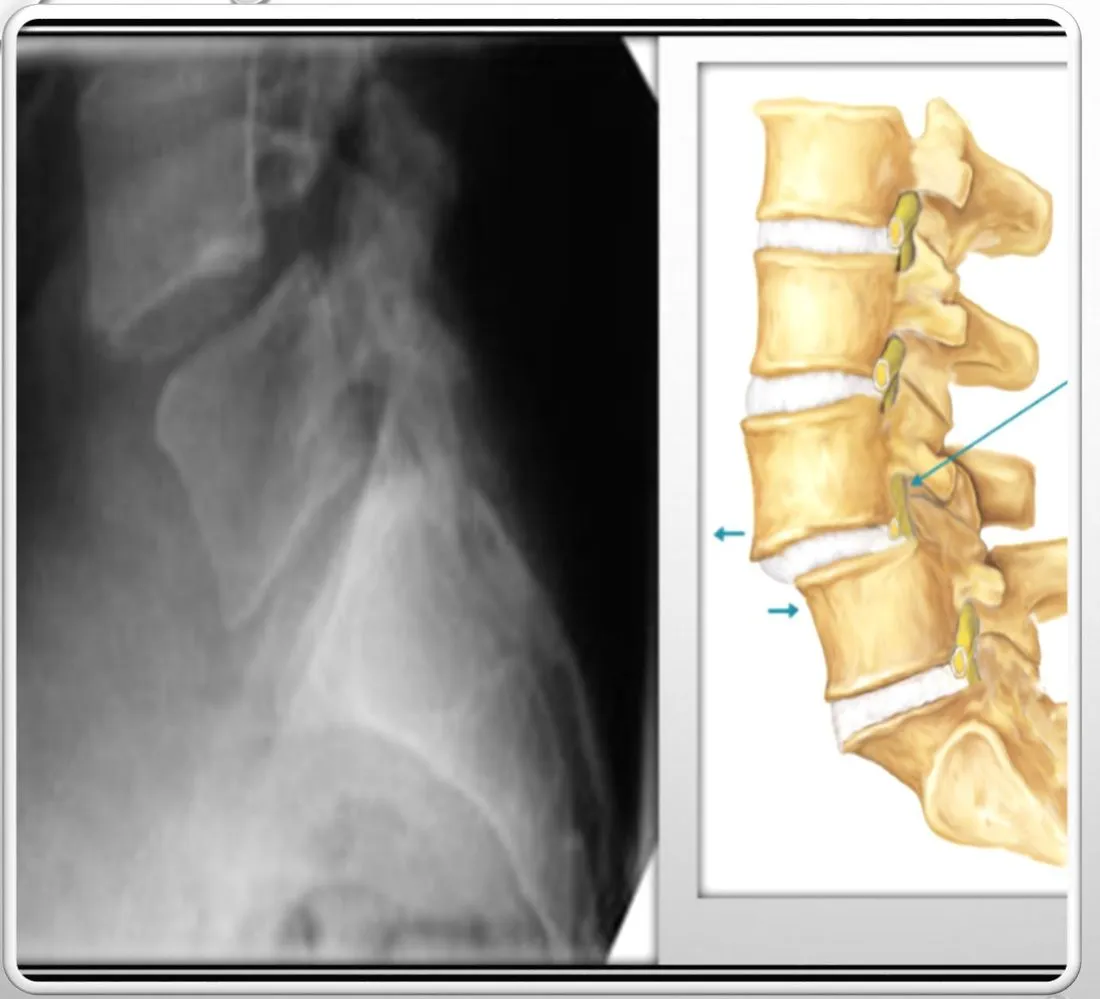
Forward displacement of the VertebraOne of the bones that stack to form the spine.General meaning, not from the slides above over the vertebra below. Common at L5/S1 and L4/L5.
Causes:
- SpondylolysisA defect in the pars interarticularis, the bridge of bone in the vertebral arch. (separated Pars interarticularisThe bridge of bone joining the inferior articular process and lamina to the superior articular process and pedicle.)
- DegenerativeInvolving gradual wear and breakdown of a tissue.General meaning, not from the slides changes (Facet jointA small paired joint at the back of each vertebra that guides and limits spinal movement.General meaning, not from the slides SubluxationA partial dislocation, where the joint surfaces are shifted but still touch.General meaning, not from the slides)
- Congenital underdevelopment of the Superior articular facetThe upper joint surface of a vertebra, which meets the vertebra above.General meaning, not from the slides of S1, letting L5 slip forward on the SacrumThe triangular bone at the base of the spine, between the two hip bones.General meaning, not from the slides
- Fracture
- Diseases, e.g. OsteoporosisLoss of bone density that leaves bones weak and fragile.General meaning, not from the slides or tumour
Grades (by how far the vertebra has slipped, from the slide figure):
| Grade | Slip |
|---|---|
| 1 | < 25% |
| 2 | 25–50% |
| 3 | 50–75% |
| 4 | > 75% |
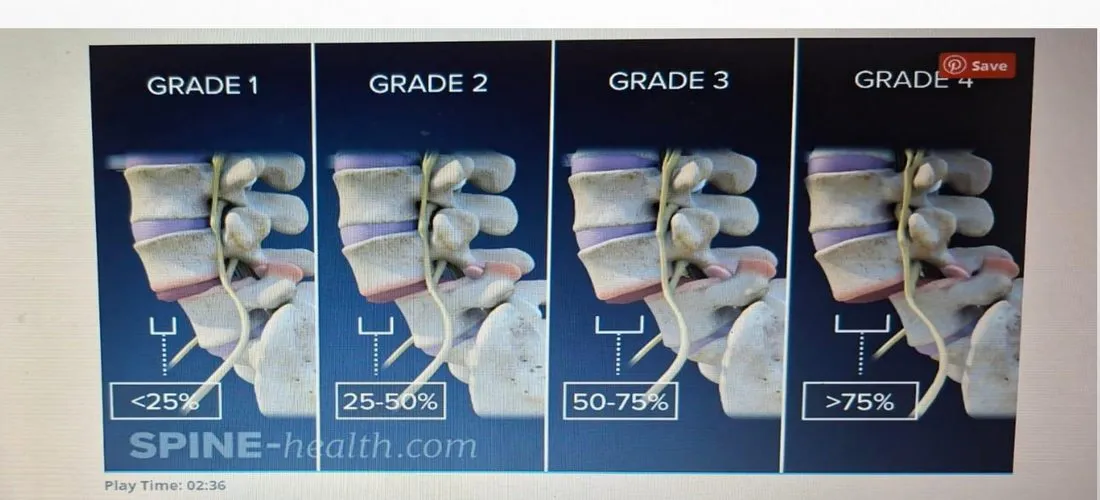
Clinical picture varies with the cause:
- Younger patients: back pain after running, jumping and twisting (gymnastics).
- Older patients: pain after working with the arms overhead for a long time, or after prolonged standing, plus weak abdominal muscles.
- On examination: a PalpationExamining by touch; palpable means able to be felt by touch.General meaning, not from the slides Step-offA step-like drop felt with the fingers where one bone sits forward of its neighbour.General meaning, not from the slides at the affected level.
Other Pathologies
| Condition | Meaning |
|---|---|
| RetrolisthesisBackward displacement of the vertebra above on the one below. | Backward displacement of the VertebraOne of the bones that stack to form the spine.General meaning, not from the slides above on the one below |
| Lumbarization of S1The S1 segment becomes mobile, behaving like a lumbar vertebra. | The S1 segment becomes mobile, behaving like a LumbarRelating to the lower back, the part of the spine between the chest and the pelvis.General meaning, not from the slides vertebra |
| SacralizationL5 is fused to the sacrum or ilium. | L5 fused to the SacrumThe triangular bone at the base of the spine, between the two hip bones.General meaning, not from the slides or IliumThe large upper bone of the pelvis (the hip bone).General meaning, not from the slides |
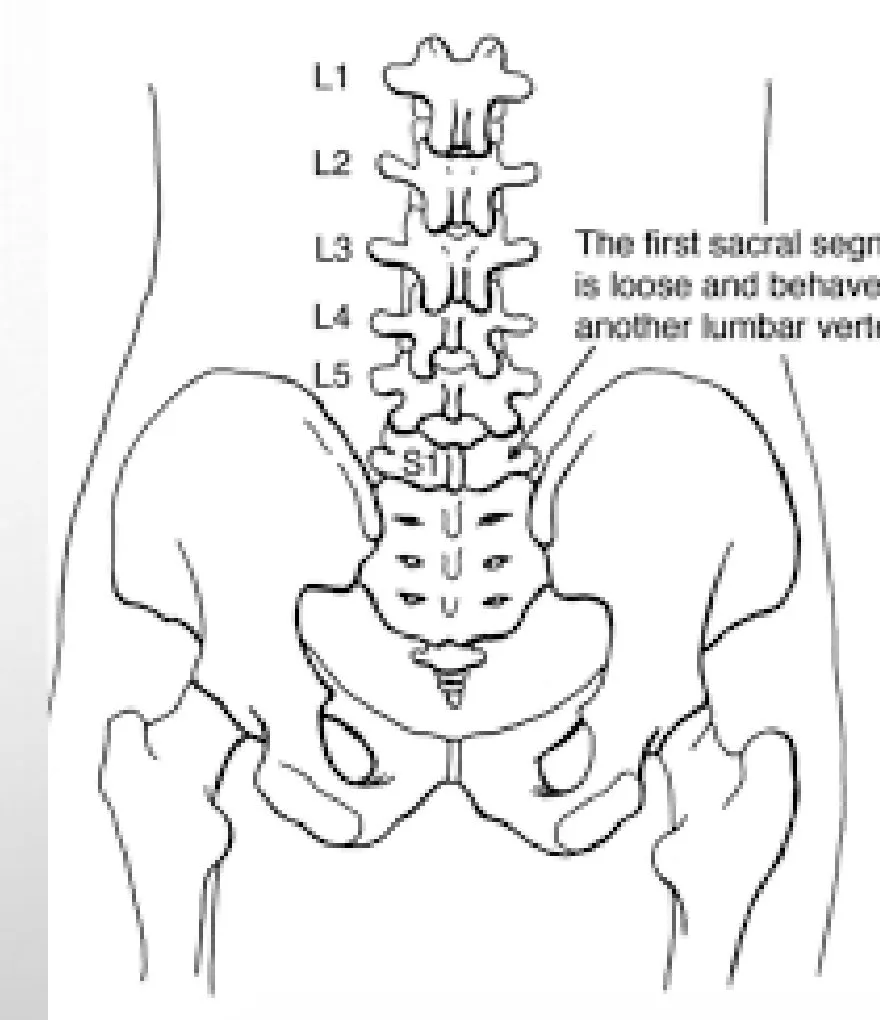
Easy pair: lumbarization means the sacrum acts lumbar (S1 freed); sacralization means the lumbar acts sacral (L5 fused).
Intervertebral Disc (IVD) Lesions
- The disc ages as described in Lumbar spondylosisDegenerative changes in the vertebral bone, discs and facet joints; also called spinal osteoarthritis.. Because the Nucleus pulposusThe soft, jelly-like centre of the intervertebral disc. becomes less fluid, true ExtrusionNuclear material goes beyond the posterior longitudinal ligament or above or below the disc space, but is still in contact with the disc. is less likely in older people.
- Common age: 20–55 (can be older).
- Common levels: L5/S1 and L4/L5, but all levels are vulnerable.
Causes:
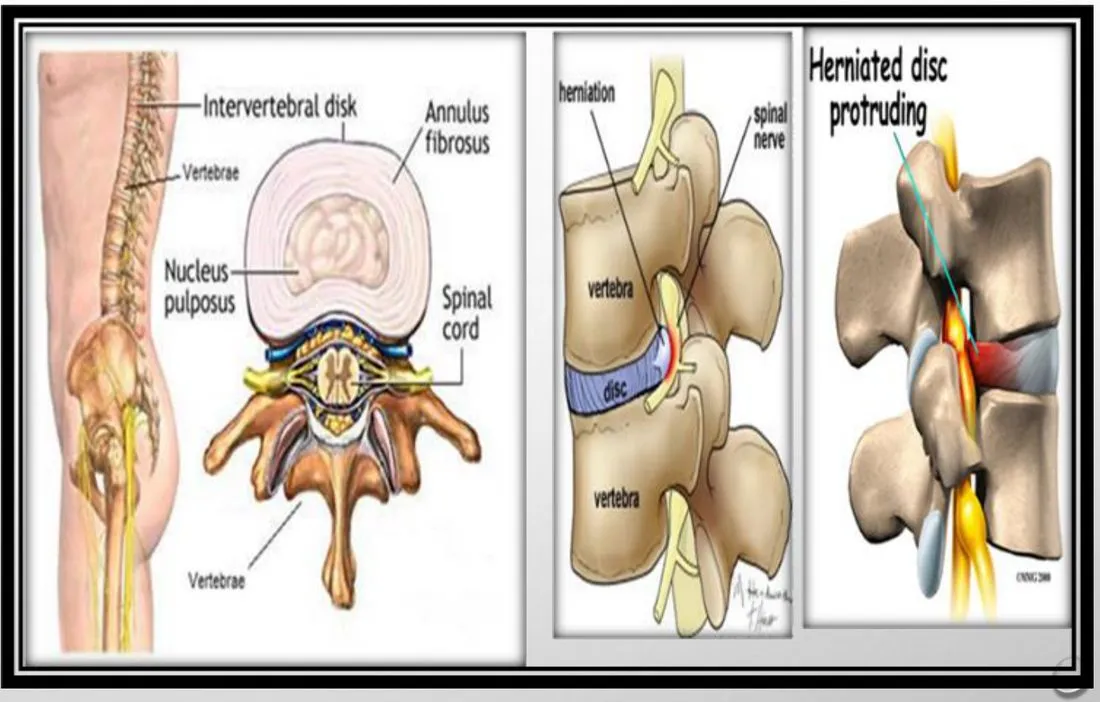
- Most common: the DegenerativeInvolving gradual wear and breakdown of a tissue.General meaning, not from the slides process. The nucleus becomes less hydrated and weaker, leading to progressive HerniationA general term for any change in the annulus that makes it bulge beyond its normal perimeter..
- Second most common: trauma.
- Others: connective tissue disorders; congenital disorders such as short PedicleThe short bony stalk that joins the back part of a vertebra to its main body.General meaning, not from the slides.
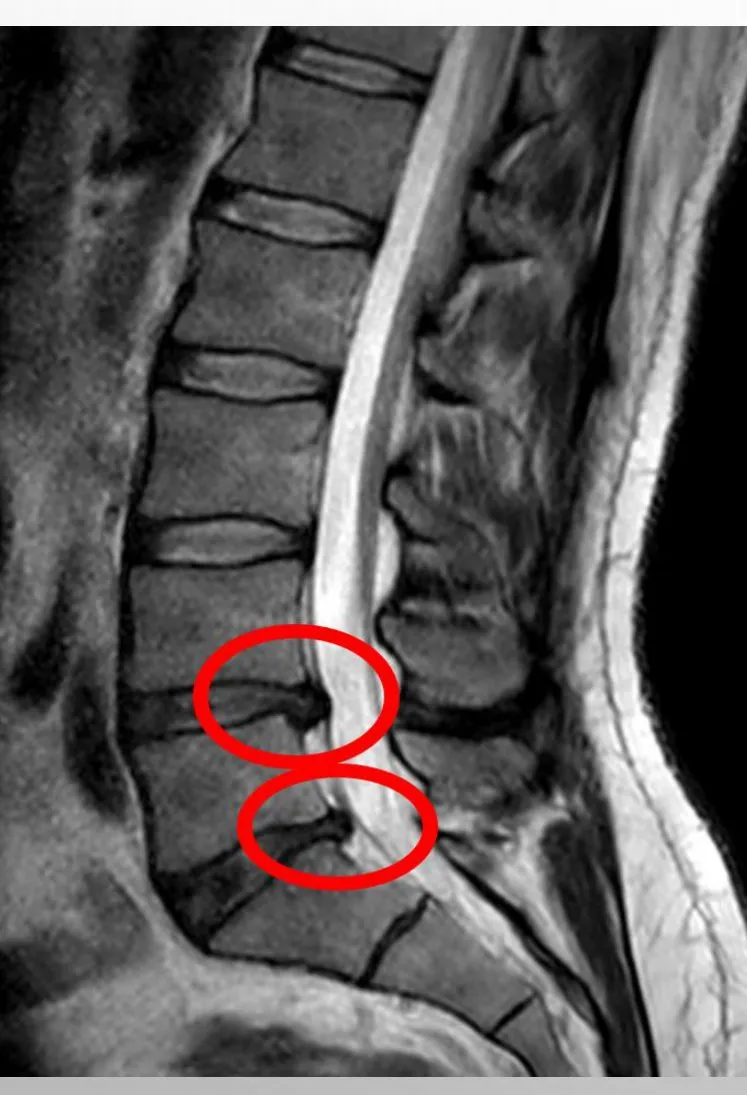
Types of disc lesion
| Term | What happens |
|---|---|
| Herniation | General term: any change in the Annulus fibrosusThe outer rings (lamellae) of the intervertebral disc. that makes it bulge beyond its normal perimeter |
| ProtrusionNuclear material is still contained by the outer annulus and ligaments. | Nuclear material still contained by the outer annulus and ligaments |
| ProlapseFrank rupture of nuclear material into the vertebral canal. | Frank rupture of nuclear material into the Spinal canalThe bony tunnel formed by the vertebrae, containing the spinal cord and nerve roots.General meaning, not from the slides |
| Extrusion | Nuclear material goes beyond the Longitudinal ligamentsTwo long ligaments running down the front and back of the vertebral bodies.General meaning, not from the slides or above/below the disc space, but is still in contact with the disc |
| Free sequestrationThe extruded nucleus has separated from the disc and moved away. | The extruded nucleus has separated from the disc and moved away |
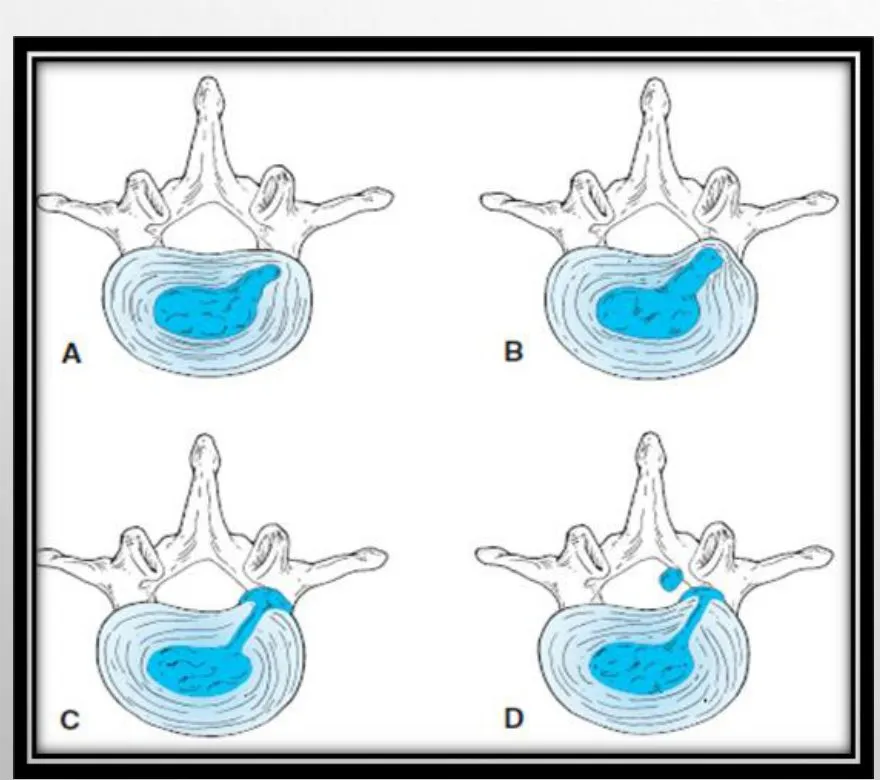
The sequence gets steadily worse: protrusion (contained) → prolapse (ruptured) → extrusion (escaped, still attached) → sequestration (detached).
Clinical features of an acute disc lesion
- Pain onset: sudden (trauma) or gradual (degenerative).
- Site: central, or Referred painPain felt in a different place from where it starts.General meaning, not from the slides: “dull, poorly defined” versus “sharp, stabbing, shooting down the leg”. ParesthesiaAbnormal skin sensations such as pins and needles, 'creeping ants' or numbness. or numbness along the Nerve rootThe part of a spinal nerve where it leaves the spinal cord, before it branches.General meaning, not from the slides.
- Muscle weakness.
- ReflexesAutomatic, involuntary muscle responses, for example when a tendon is tapped.General meaning, not from the slides: ↓ Quadriceps femorisThe muscle group at the front of the thigh that straightens the knee.General meaning, not from the slides (L3/L4) and ↓ Tendo-calcanealRelating to the Achilles tendon (tendo-calcaneus), which attaches to the heel bone.General meaning, not from the slides (L5/S1) if those roots are compressed.
- Spinal movements:
- Flexion is very limited.
- Side bendingBending the trunk sideways, to the left or right.General meaning, not from the slides free to one side (with discomfort) and restricted to the other.
- Extension not possible beyond straightening the LumbarRelating to the lower back, the part of the spine between the chest and the pelvis.General meaning, not from the slides spine.
- Sitting: the patient dislikes sitting, takes the trunk’s weight on the hands, and “walks the hands up the thigh” to stand.
- PalpationExamining by touch; palpable means able to be felt by touch.General meaning, not from the slides: TendernessPain or soreness when the area is touched or pressed.General meaning, not from the slides, Muscle spasmA sudden, involuntary tightening of a muscle.General meaning, not from the slides, warmth.
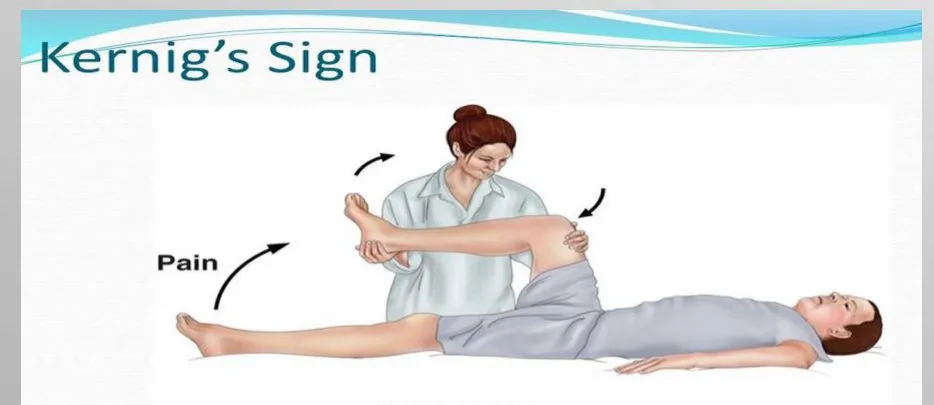
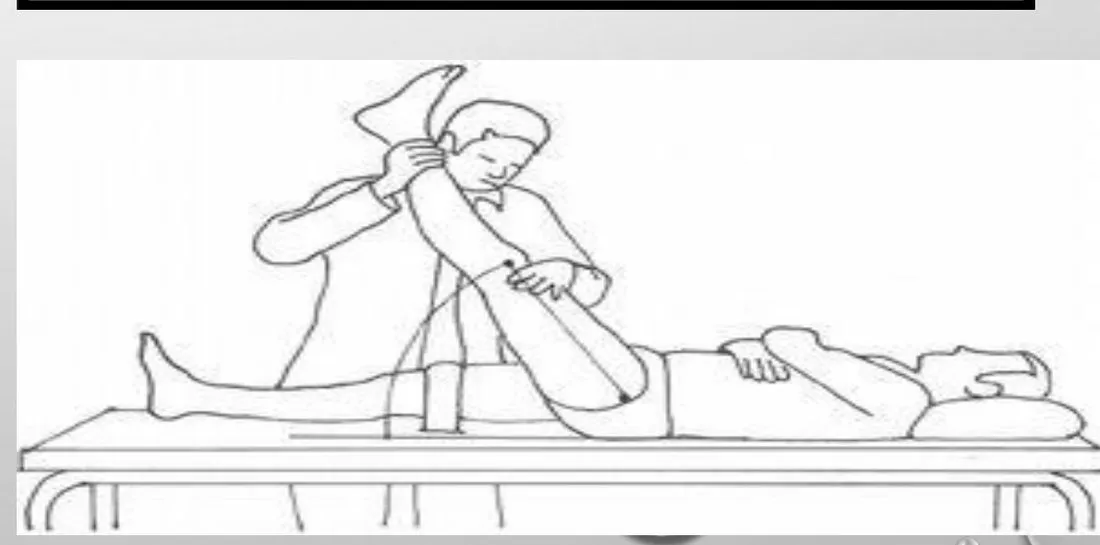
- Special tests (if the Sciatic nerveThe largest nerve in the body, running from the lower back through the buttock and down the back of the leg.General meaning, not from the slides is irritated): SLRStraight leg raise: a test that stretches the sciatic nerve. (sciatic nerve stretch) and Kernig's signA test in which, with the hip bent, the examiner straightens the knee; pain or resistance suggests nerve irritation.General meaning, not from the slides. MRIMagnetic resonance imaging: a scan that uses magnets and radio waves to make detailed pictures of soft tissues.General meaning, not from the slides confirms.
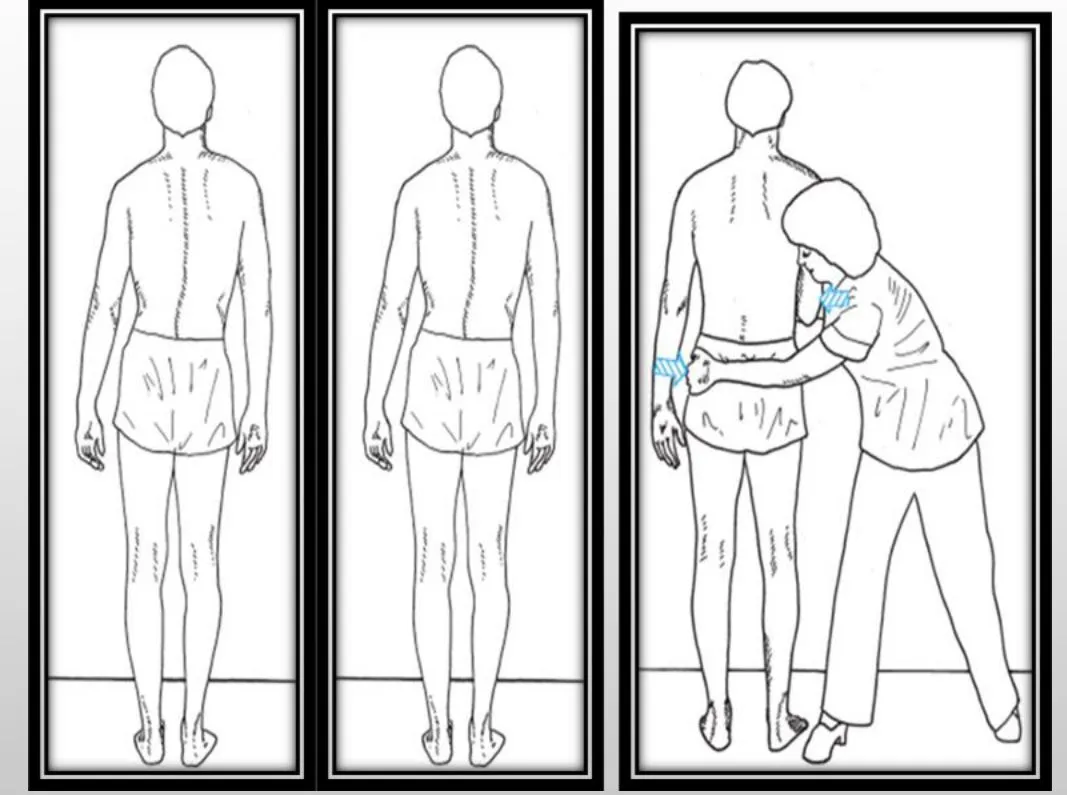
Sciatic shift (lateral shift)
| Where the protrusion is | Trunk shifts |
|---|---|
| Lateral to the nerve root | Away from the lesion side |
| Medial to the nerve root | Toward the lesion side |
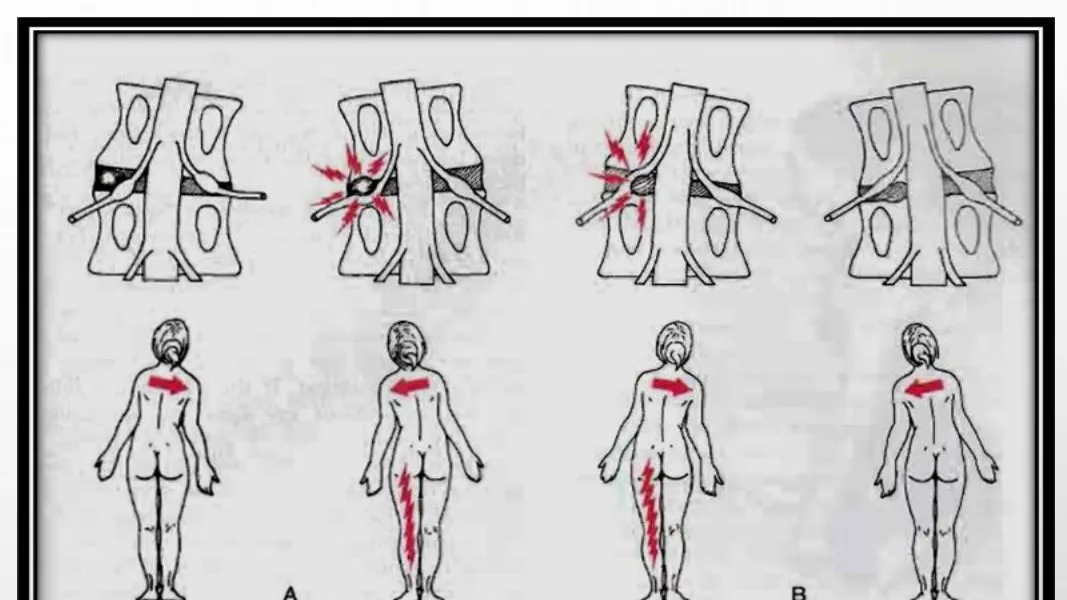
Logic: the trunk leans whichever way moves the nerve root away from the bulge.
Assessment of the Lumbar Spine
Red flags of spinal pathology
- Age < 20 or > 55
- Non-mechanical LBPPain that does not arise from the mechanics of the spine, discs and soft tissues; the slide's example is idiopathic scoliosis (developmental). pain
- History of cancer
- History of significant trauma
- Systemic symptoms: fever, chills, unexplained weight loss
- Severe or progressive Neurological deficitsLoss of nerve function, such as weakness, numbness or loss of reflexes.General meaning, not from the slides: Saddle anaesthesiaNumbness in the area that would touch a saddle: the groin, inner thighs and buttocks.General meaning, not from the slides, bowel or bladder symptoms, multi-root deficits
Inspection: postural analysis (Table 14.1)
| View | Observation | Possible indication |
|---|---|---|
| Posterior | Iliac crestThe top curved edge of the hip bone, which you can feel at the waist.General meaning, not from the slides inequality | Leg-length discrepancyOne leg is longer than the other.General meaning, not from the slides or SI rotationA twisting of one side of the pelvis at the sacroiliac joint.General meaning, not from the slides |
| Flattened gluteal muscles | Weak GlutesShort for the gluteal (buttock) muscles.General meaning, not from the slides with IpsilateralOn the same side of the body as the structure being discussed.General meaning, not from the slides SI jointSacroiliac joint: the joint where the sacrum meets the ilium of the pelvis.General meaning, not from the slides dysfunction | |
| Asymmetrical, HypertrophiedEnlarged in size.General meaning, not from the slides ParaspinalsThe muscles that run alongside the spine.General meaning, not from the slides | Impaired deep stabilization, especially the abdominals | |
| Sciatic shift (lateral shift)The trunk shifts sideways because of a disc protrusion: away from the lesion side if it is lateral to the nerve root, toward it if medial. of pelvis | Weak Gluteus medius/minimusTwo muscles on the outer side of the hip that move the thigh out to the side and steady the pelvis.General meaning, not from the slides on the side the pelvis shifts toward | |
| Lateral | Increased LordosisThe normal inward curve of the lower back.General meaning, not from the slides | Tight Hip flexorsThe muscles at the front of the hip that lift the thigh forward and up.General meaning, not from the slides or weak glutes |
| GlenohumeralRelating to the shoulder joint, where the humerus meets the shoulder blade.General meaning, not from the slides medially rotated | Tight Pectoralis majorThe large chest muscle that pulls the arm forward and across the body.General meaning, not from the slides or weak middle/lower Scapular stabilizersThe muscles that hold the shoulder blade steady against the rib cage.General meaning, not from the slides | |
| Chin and neck angle | Hypertrophied Deep neck flexorsMuscles at the front of the neck that bend the head and neck forward; the deep ones lie close to the spine.General meaning, not from the slides; weak/inhibited deep neck flexors | |
| Anterior | SCMSternocleidomastoid: the muscle on each side of the neck that turns the head and bends the neck.General meaning, not from the slides hypertrophy | Tight SCM; Accessory respirationUsing extra muscles, besides the diaphragm, to help breathe.General meaning, not from the slides |
| Deep abdominal creases | Impaired coordination of the abdominals | |
| Lower rib cage angle flaring | Impaired respiration and deep spinal stabilizing system |
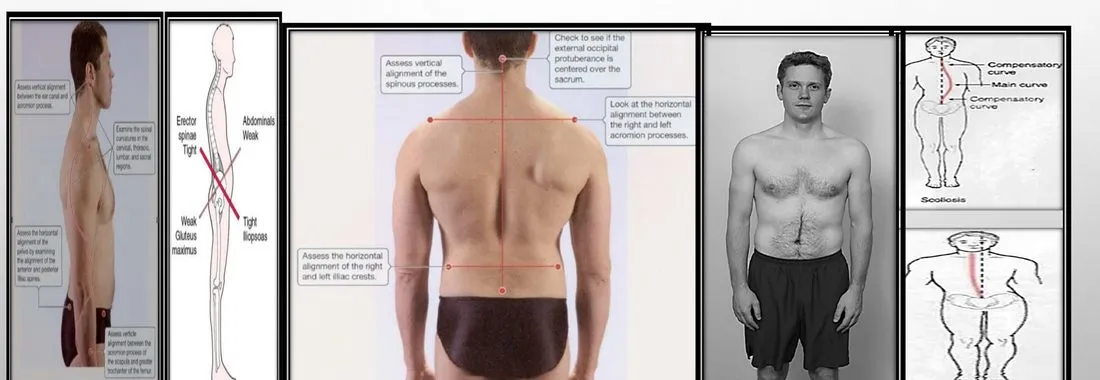
ROM assessment
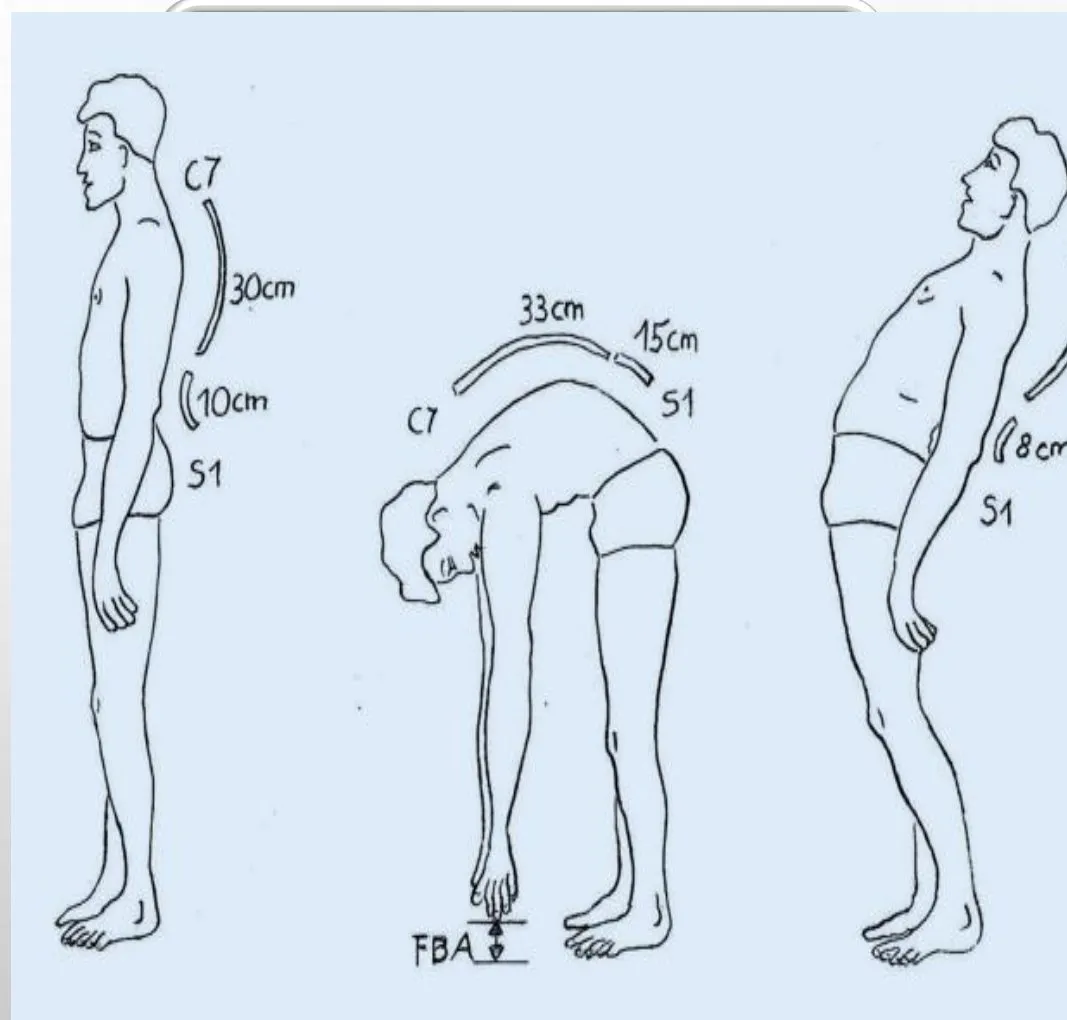
Schober's testA skin-mark measurement of spinal flexion over the whole spine (C7–S1), used to diagnose and monitor ankylosing spondylitis. (whole spine)
- Purpose: diagnose and monitor Ankylosing spondylitisA long-term inflammatory disease that mainly affects the spine and can make it stiff.General meaning, not from the slides and other inflammatory SpondyloarthropathiesA family of inflammatory joint diseases that affect the spine and other joints.General meaning, not from the slides; serial measurements track progression.
- Measured over the whole spine, C7–S1.
- Normally increases by about 4 inches in flexion (slide wording: “increased from 4 inches”) and decreases about 2 inches in extension.
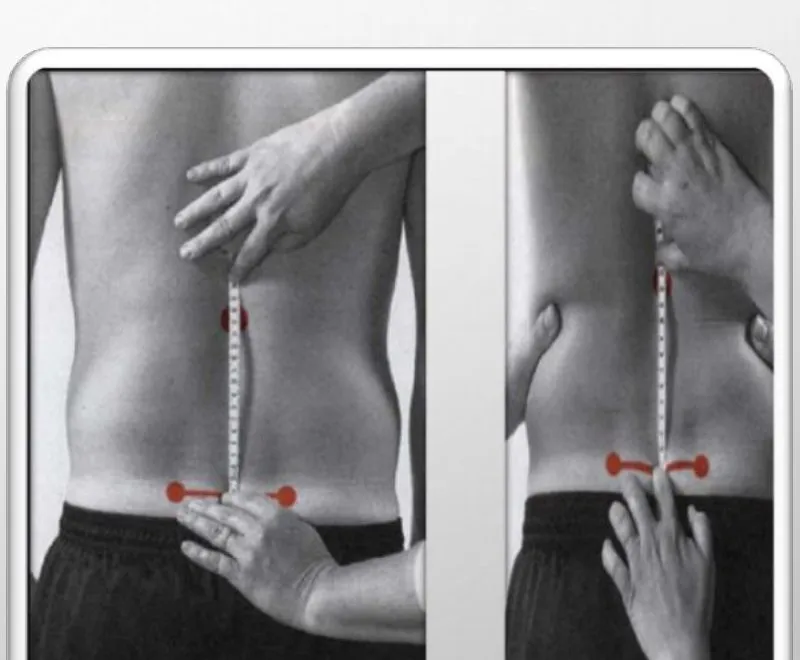
| Test | Distal mark | Proximal mark(s) | Normal increase in flexion |
|---|---|---|---|
| Modified SchoberA version of Schober's test using the L5–S1 junction, with marks 10 cm above and 5 cm below; the normal increase in flexion is 30–50%. | L5–S1 junction | 10 cm above and 5 cm below | 30–50% |
| Modified-modified SchoberA version of Schober's test using a point midway between both PSIS, with a mark 15 cm above; the normal increase in flexion is 30–50%. | Midway between both PSISPosterior superior iliac spine: the bony bump at the back of the pelvis, felt beside the base of the spine.General meaning, not from the slides | 15 cm above | 30–50% |
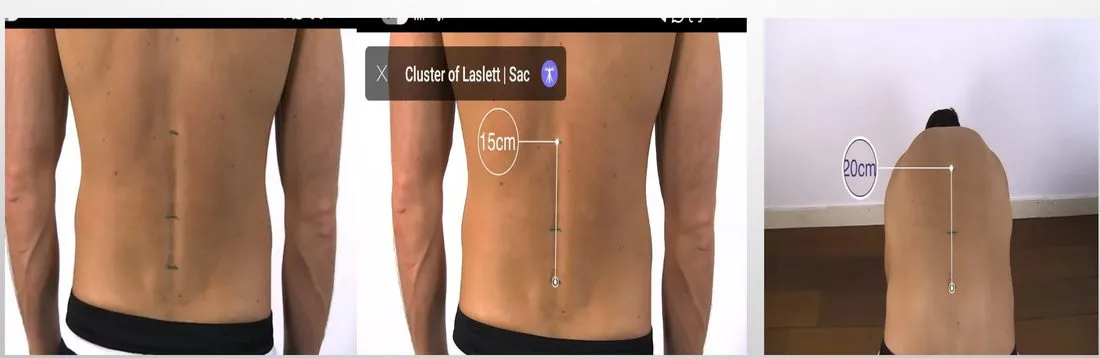
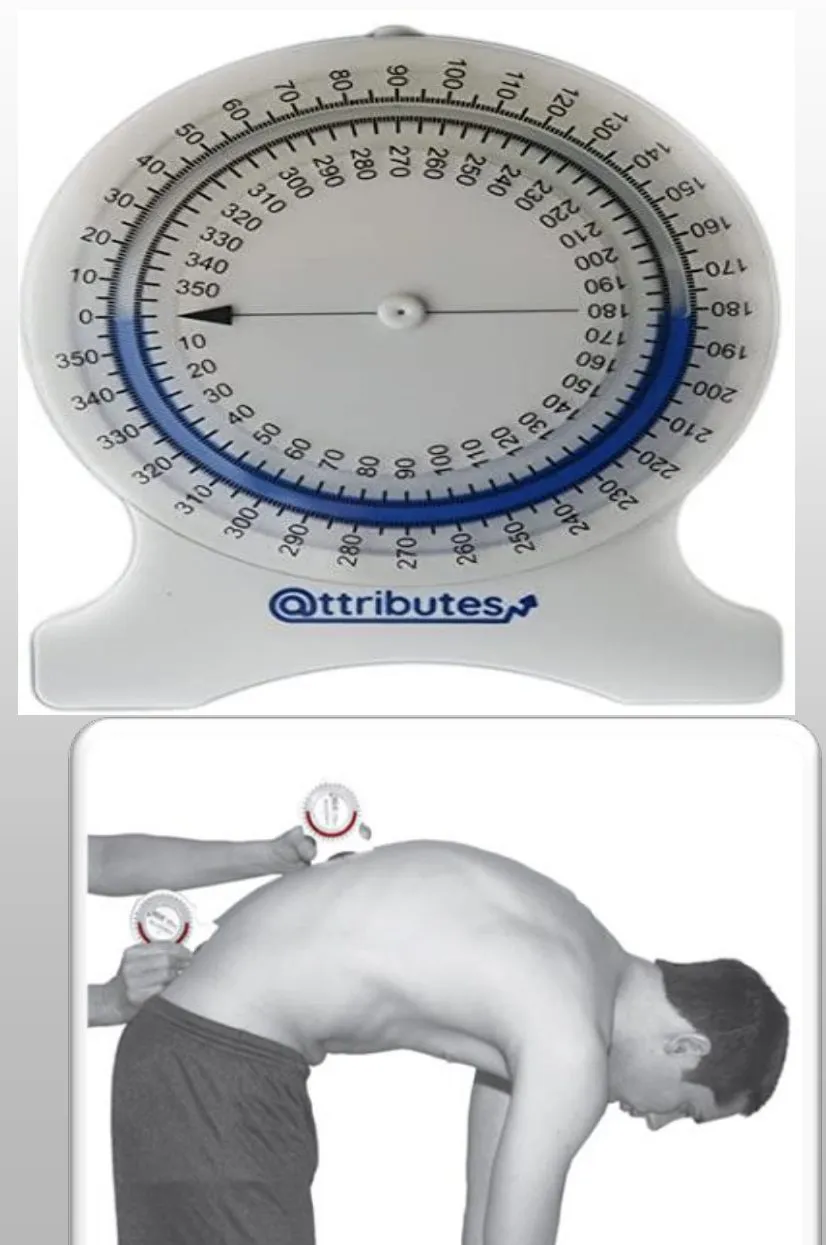
InclinometerA tool with a gravity-sensitive sensor that measures joint angles. It can be a dial device or a smartphone app. (LumbarRelating to the lower back, the part of the spine between the chest and the pelvis.General meaning, not from the slides AROMActive range of motion: movement the patient performs by their own muscle effort.General meaning, not from the slides):
- Measures flexion, extension and Side bendingBending the trunk sideways, to the left or right.General meaning, not from the slides. It’s a reliable tool with a gravity-sensitive sensor; it can be a dial device or a smartphone app.
- Placed at the TL junctionThoracolumbar junction: where the chest (thoracic) part of the spine meets the lumbar part.General meaning, not from the slides and SacrumThe triangular bone at the base of the spine, between the two hip bones.General meaning, not from the slides. Differences between TL and pelvic motion are noted for flexion, extension and side bending.
- Alternative: one inclinometer at the TL junction recording total motion.
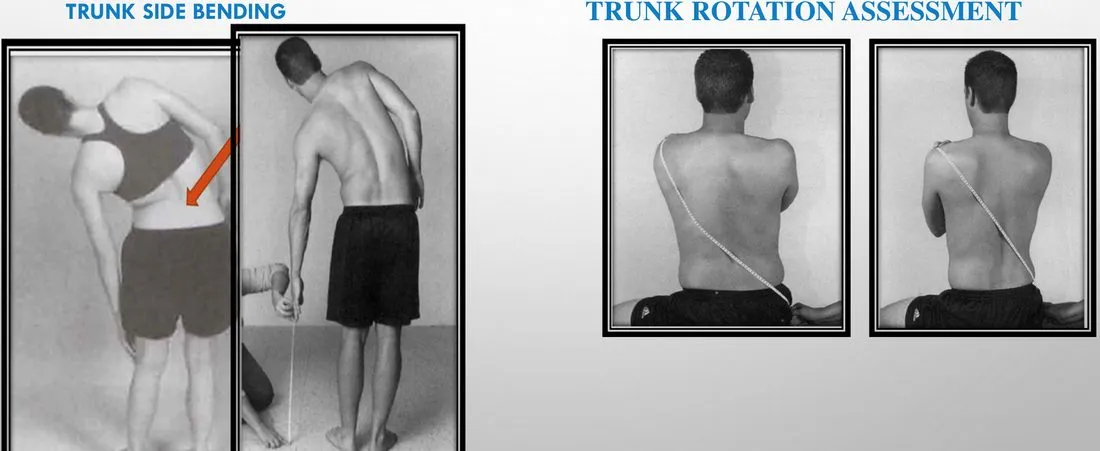
- Trunk side bending and rotation are also assessed (slide photos).
Segmental mobility: PA assessment
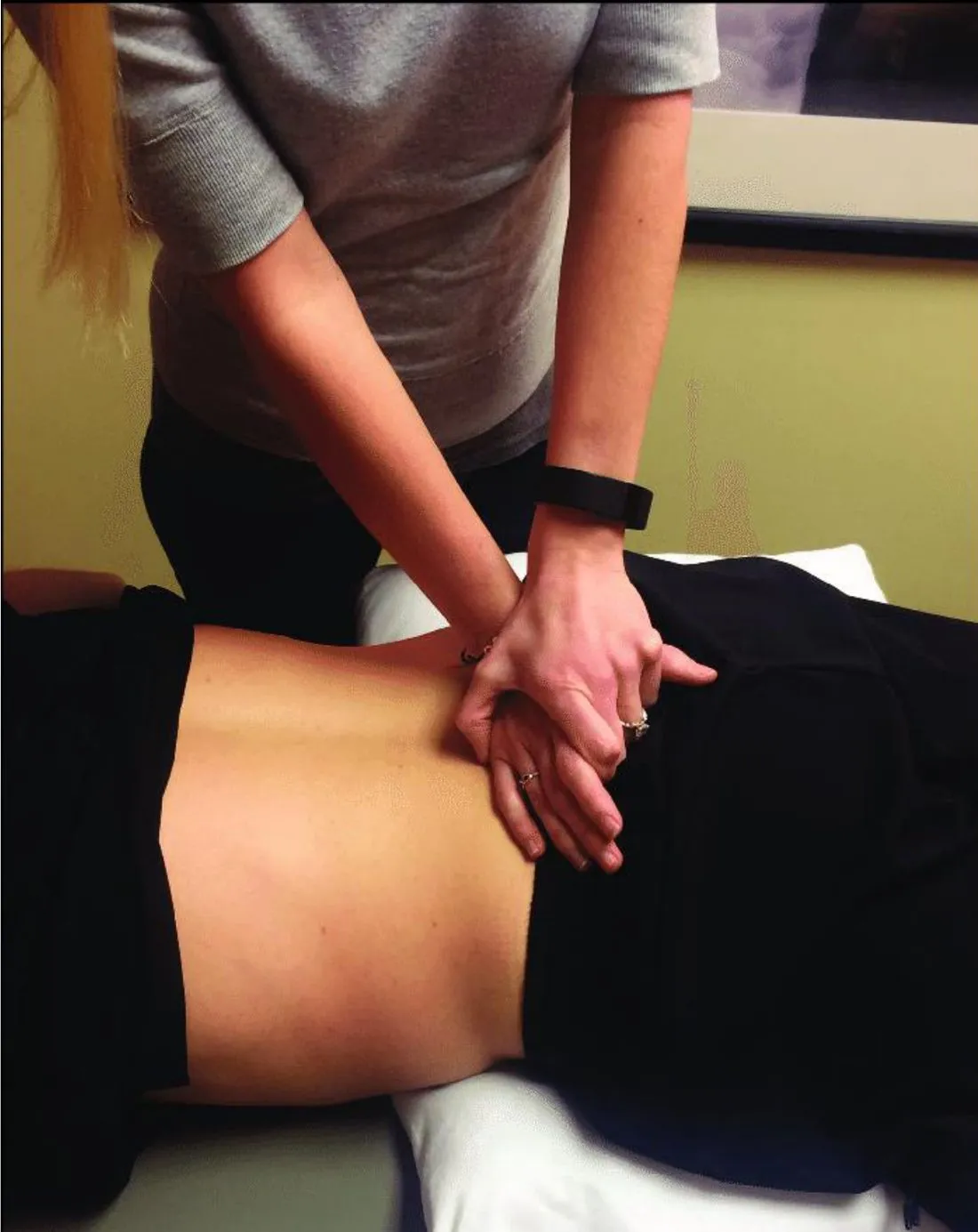
- Patient ProneLying face down.General meaning, not from the slides. The examiner applies an OscillatingMoving rhythmically back and forth.General meaning, not from the slides posterior-to-anterior force on the Spinous processThe bony projection at the back of each vertebra that can be felt down the middle of the back.General meaning, not from the slides with the thumb or Hypothenar eminenceThe fleshy pad on the little-finger side of the palm.General meaning, not from the slides.
- Each segment is judged normal, Hypermobile / hypomobileHypermobile means moving more than normal; hypomobile means moving less than normal.General meaning, not from the slides or hypomobile compared with the segments above and below.
- Pain provocation is noted from the patient’s response.
Muscle testing, flexibility and special tests
- Manual muscle testingTesting muscle strength by having the patient work against the examiner's resistance.General meaning, not from the slides of the back, abdominal and hip muscles.
- Flexibility testing: low back muscles, HamstringsThe muscle group at the back of the thigh that bends the knee and extends the hip.General meaning, not from the slides, hip flexors, calf muscles, PiriformisA deep buttock muscle that turns the hip outward.General meaning, not from the slides, Quadratus lumborumA deep muscle of the lower back that runs from the pelvis up to the lowest rib and the lumbar spine.General meaning, not from the slides.
- Special tests are as in the applied physical therapy book.
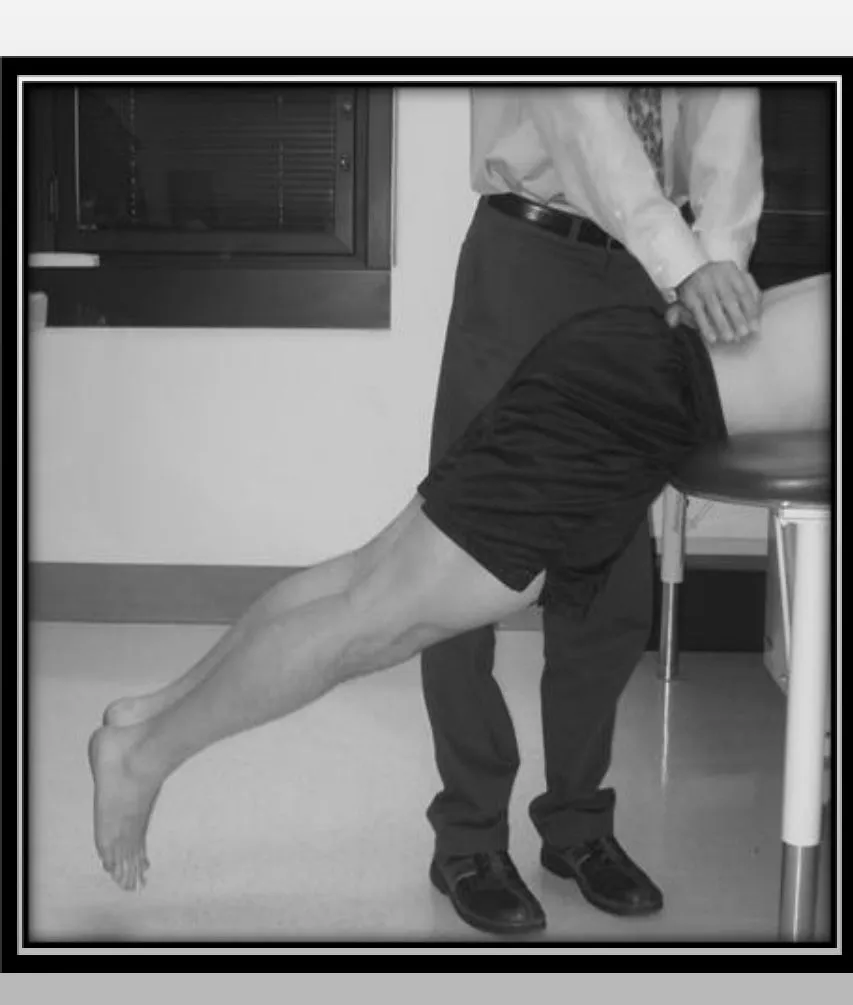
Prone instability test
- Patient prone with the trunk on the table, legs over the edge and feet on the floor. The examiner applies PA assessmentPosteroanterior: a force applied from back to front, for example on a spinous process, to judge how a segment moves.General meaning, not from the slides; any pain is noted.
- The patient lifts the legs off the floor and PA pressure is repeated.
- Positive if pain is significantly decreased or abolished with the feet off the floor.
- Meaning: active muscle stabilization relieves symptoms, so the patient is likely to benefit from trunk Lumbar stabilization exercisesExercises that train the trunk muscles to hold the lumbar spine steady, starting with the abdominal brace.General meaning, not from the slides.
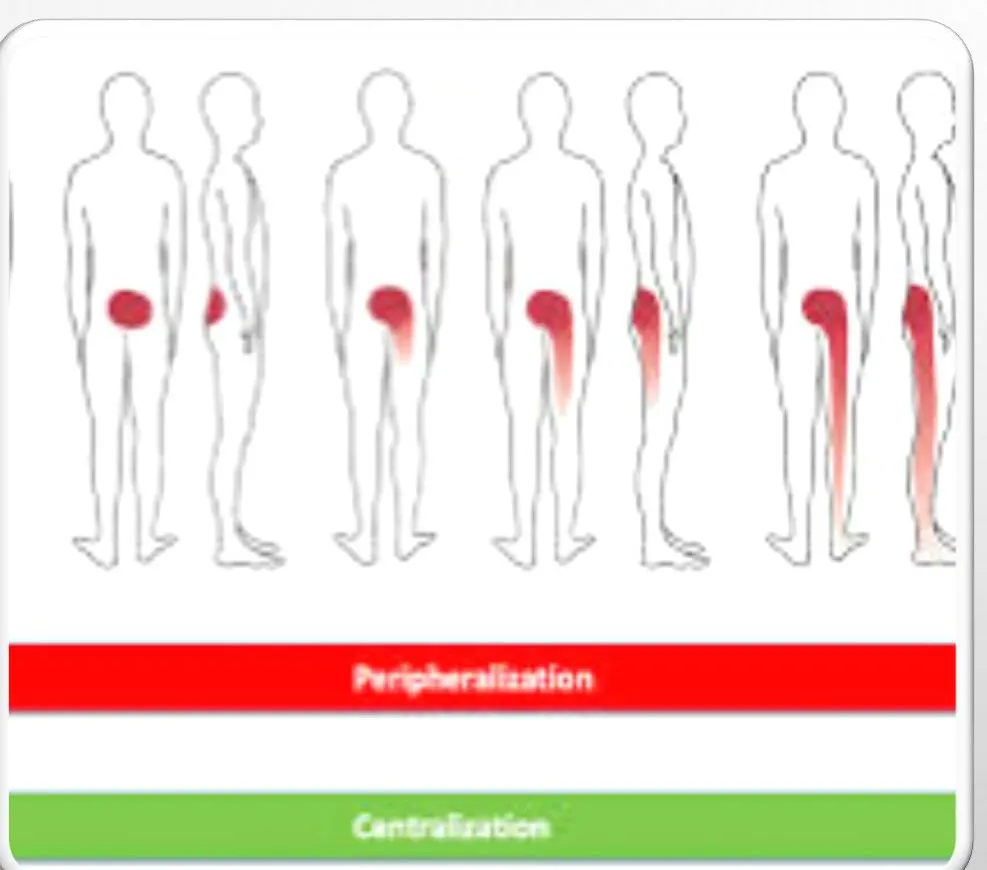
Centralization vs peripheralization
Symptoms are compared with their baseline during active and passive movement tests:
- CentralizationSymptoms move proximally, toward the spine.: symptoms move ProximalCloser to the trunk or the point of attachment of a limb; proximally means in that direction.General meaning, not from the slides (toward the spine).
- PeripheralizationSymptoms move more distally, down the leg.: symptoms move more DistalFarther from the trunk or the point of attachment of a limb; distally means in that direction.General meaning, not from the slides (down the leg).
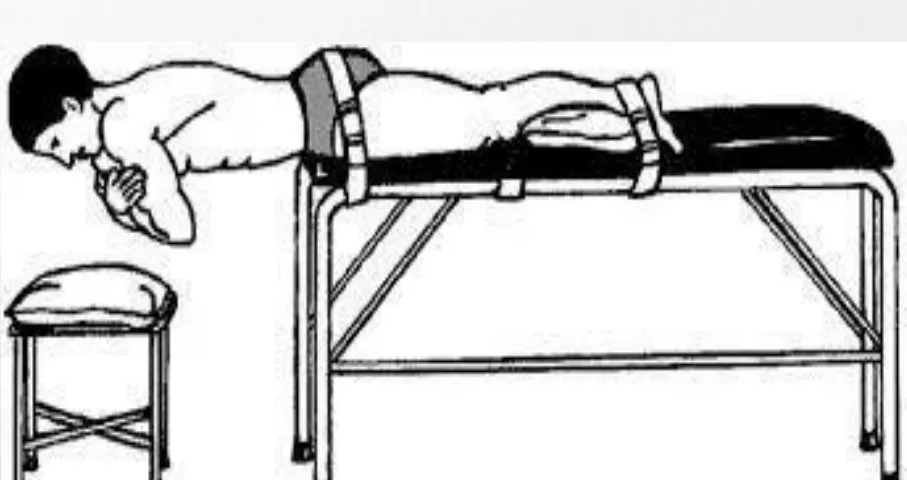
Endurance: Biering-Sørensen test
- Measures the IsometricA muscle contraction in which the muscle tenses but the joint does not move.General meaning, not from the slides endurance of the Trunk extensorsThe back muscles that straighten the trunk.General meaning, not from the slides. Rapid, simple and reproducible.
- The patient holds the upper body horizontal, unsupported off the end of the table; the hold time is recorded.
- It discriminates healthy people from Low back pain (LBP)Pain and discomfort below the costal margin and above the inferior gluteal folds, with or without leg pain. patients and may predict future LBP.
- < 58 seconds is linked to a three-fold increase in the risk of LBP.
Functional assessment
- Arabic Oswestry Disability IndexA questionnaire that scores disability in 10 activities of daily living, such as pain intensity, personal care, lifting and walking.: disability in 10 activities of daily living: pain intensity, personal care, lifting, walking, sitting, standing, sleeping, sex (if applicable), social life and travel.
- PainDETECT questionnaireA questionnaire used for leg pain (Arabic version). (Arabic version) for leg pain.
Treatment and Rehabilitation
Pharmacological management
Considered when conservative treatment is insufficient or for pain flare-ups. Medication is generally used for limited periods, enough to reduce pain so the patient can exercise again.
Lumbar spondylosis: general rehabilitation
- Hot application, UltrasoundSound waves above the range of hearing, used in therapy to treat deep tissues.General meaning, not from the slides
- Stretching and strengthening exercises
- Lumbar stabilization exercisesExercises that train the trunk muscles to hold the lumbar spine steady, starting with the abdominal brace.General meaning, not from the slides exercises
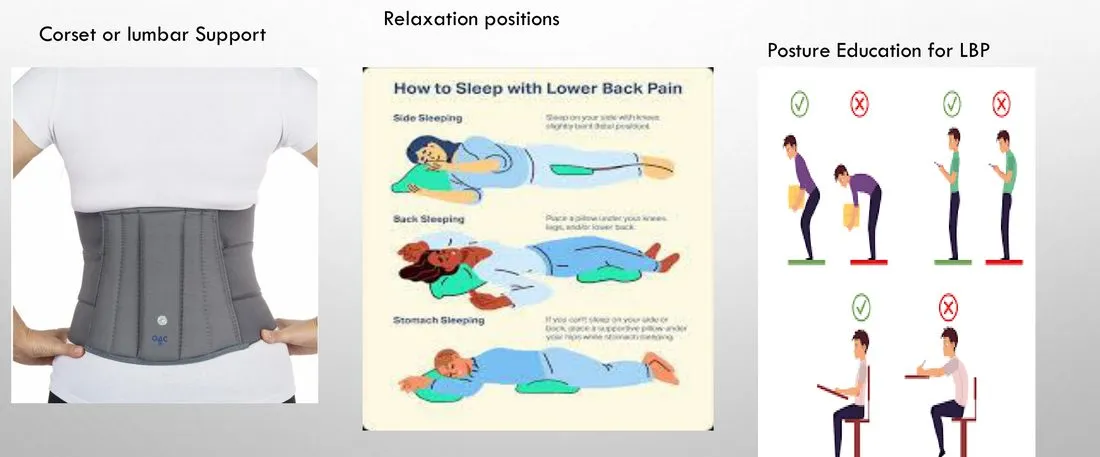
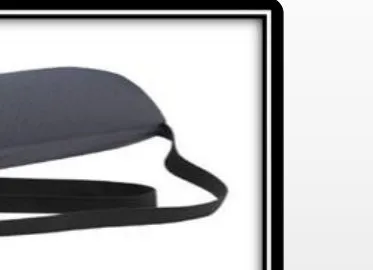
- CorsetA supportive garment worn around the trunk.General meaning, not from the slides or Lumbar supportA belt, brace or cushion that supports the lower back.General meaning, not from the slides
- Relaxation (relaxation and sleeping positions)
- Posture education
- Mobilizing exercisesExercises that gently move a joint or region to improve how freely it moves.General meaning, not from the slides
- Positional tractionA manual technique using pillows, blocks or sandbags to place the patient in a comfortable position that stretches the low back with a gentle longitudinal pull.
- HydrotherapyExercise or treatment carried out in water.General meaning, not from the slides
- Advice: weight reduction, proper carrying, active ROMRange of motion: how far a joint can move in each direction.General meaning, not from the slides, lumbar support
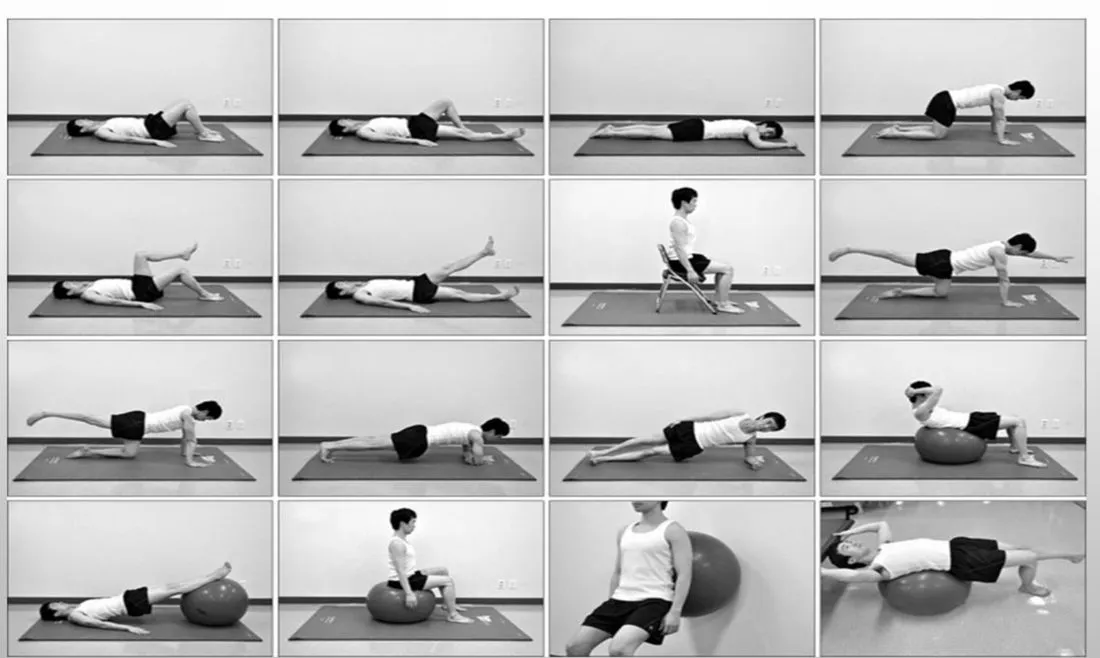
Lumbar stabilization exercises
- The patient learns the Abdominal braceA contraction of the abdominal muscles learned while breathing normally, without going into a posterior pelvic tilt or lumbar flexion. while breathing normally, without going into a Posterior pelvic tiltTilting the pelvis so the front rises and the lower back flattens.General meaning, not from the slides or LumbarRelating to the lower back, the part of the spine between the chest and the pelvis.General meaning, not from the slides flexion.
- Once mastered SupineLying face up, on the back.General meaning, not from the slides, limb movements are added to challenge the CNSCentral nervous system: the brain and spinal cord.General meaning, not from the slides to keep the Co-contractionTwo muscle groups tightening at the same time.General meaning, not from the slides and Intra-abdominal pressure (IAP)Pressure inside the abdomen. A rise in IAP contributes to spinal stability and is produced by contraction of the abdominal muscles, pelvic floor and diaphragm. during movement.
- Progression: more postures → reciprocal limb movements → resistance → Labile surfacesUnstable surfaces, such as a foam pad or ball, that challenge balance and control.General meaning, not from the slides → dynamic functional movements (squatting, lifting, reaching, pulling, pushing) → the patient’s own functional activities.
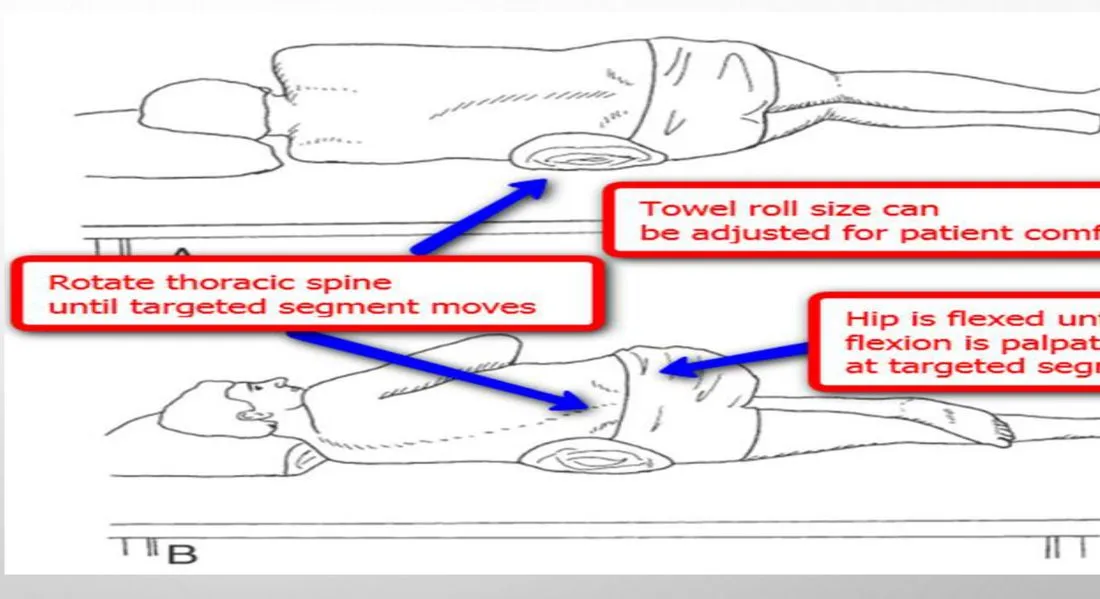
Lumbar positional traction
- A manual technique using pillows, blocks or sandbags to put the patient in a comfortable position that stretches the low back with a gentle longitudinal pull.
- It can increase the space between VertebraOne of the bones that stack to form the spine.General meaning, not from the slides, which may help reposition disc material and relieve nerve-root pressure.
- It differs from other TractionA pulling force applied to the spine or a limb.General meaning, not from the slides because it concentrates the force in a smaller area.
Spondylolisthesis
Treat according to the clinical findings, with emphasis on:
- Lumbar stabilization exercises
- Abdominal strengthening
- Lumbar support
Intervertebral disc lesions
Aims: allow healing (AcuteRecent or sudden onset. In the course of LBP the slide defines acute as less than 1 month. only) · relieve pain · restore mobility · restore posture and strength · prevent recurrence.
Acute stage:
- Bed rest: not absolute, for 7–10 days.
- Lumbar support, avoiding flexion and rotation.
- ProneLying face down.General meaning, not from the slides lying. If painful, start with 2–3 pillows under the abdomen and remove them gradually; ± correct the shift.
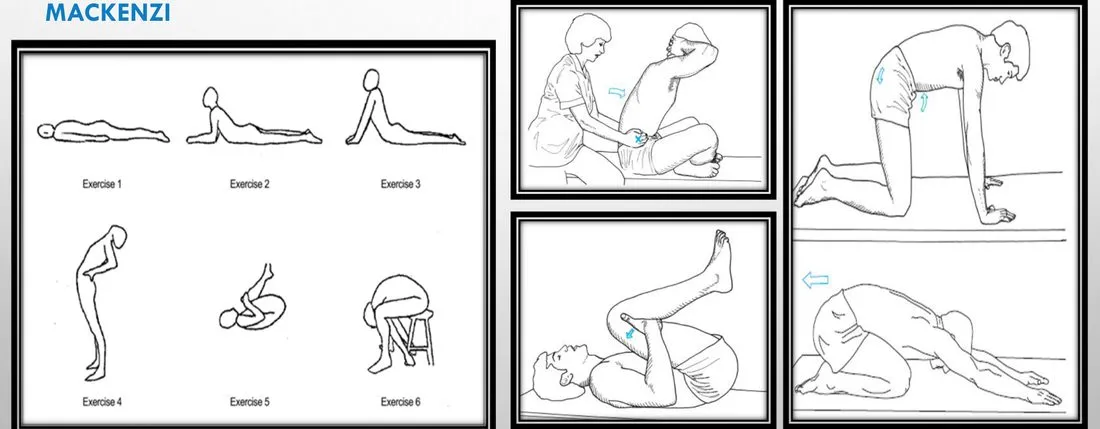
- McKenzie method (MDT)Mechanical Diagnosis and Therapy: a system for assessing and treating spinal problems, developed by Robin McKenzie, that relies mainly on self-treatment. (Mechanical Diagnosis and Therapy, MDT).
- Spinal mobility: Pelvic tiltingRocking the pelvis forward and backward.General meaning, not from the slides, knee rolling side to side, getting out of bed while keeping the LordosisThe normal inward curve of the lower back.General meaning, not from the slides.
- Nerve mobility: keep the roots moving, e.g. alternate ankle DorsiflexionPulling the foot up toward the shin.General meaning, not from the slides and PlantarflexionPointing the foot downward, away from the shin.General meaning, not from the slides.
After 3 weeks (ChronicLong-standing. In the course of LBP the slide defines chronic as more than 3 months since the first episode began.): start Side bendingBending the trunk sideways, to the left or right.General meaning, not from the slides in standing (in front of the PlinthA firm, padded treatment table.General meaning, not from the slides), then progress gradually in all directions.
Radicular painPain caused by irritation of a spinal nerve root, felt along the area the nerve supplies.General meaning, not from the slides: positional traction · posture and strength (as in Lumbar spondylosisDegenerative changes in the vertebral bone, discs and facet joints; also called spinal osteoarthritis.) · Lumbar rollA rolled cushion or towel placed in the small of the back to help keep its inward curve when sitting.General meaning, not from the slides · correction of Sciatic shift (lateral shift)The trunk shifts sideways because of a disc protrusion: away from the lesion side if it is lateral to the nerve root, toward it if medial..
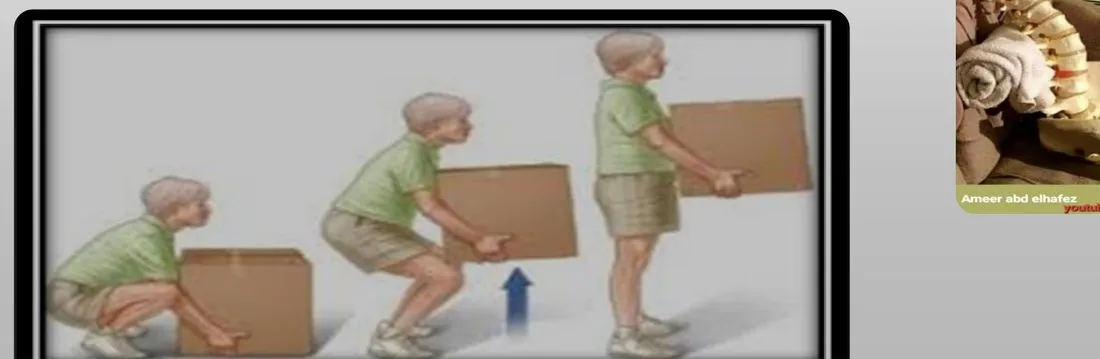
Prevention of recurrence: posture advice (lumbar roll) and teaching the correct way to lift and carry.
Exercise techniques (slide figures)
- McKenzie exercises (Exercises 1–6)
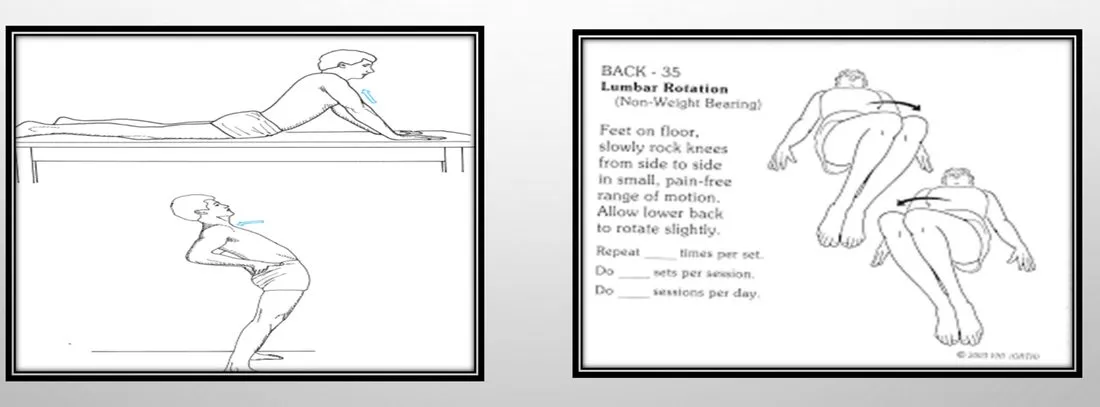
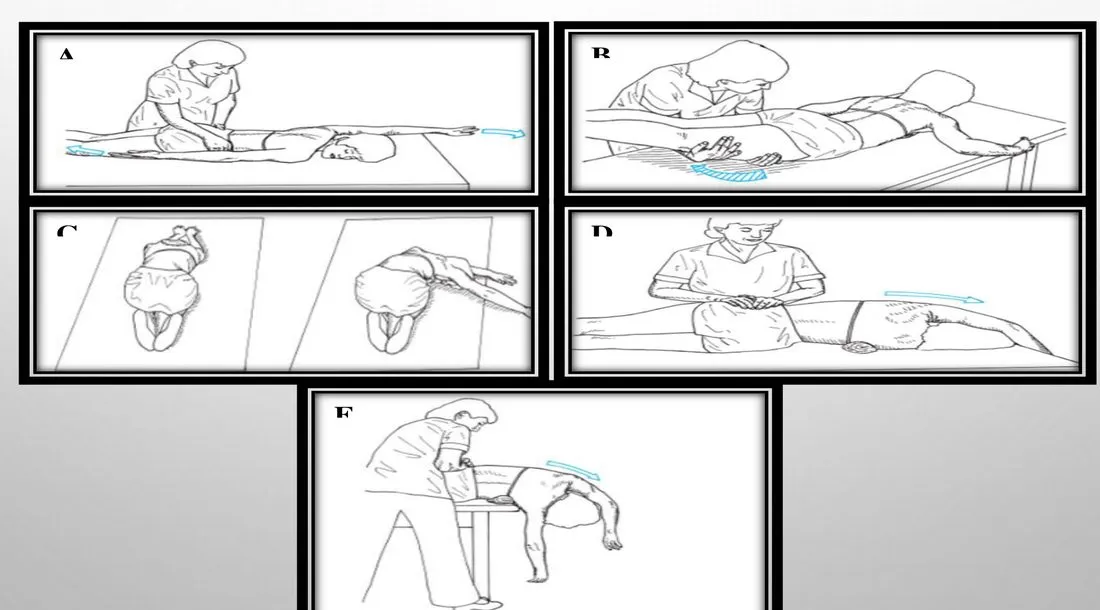
- Techniques to increase lumbar flexion, extension and lateral flexibility
- Lumbar rotation exercises
Lumbar Spinal Stenosis
-
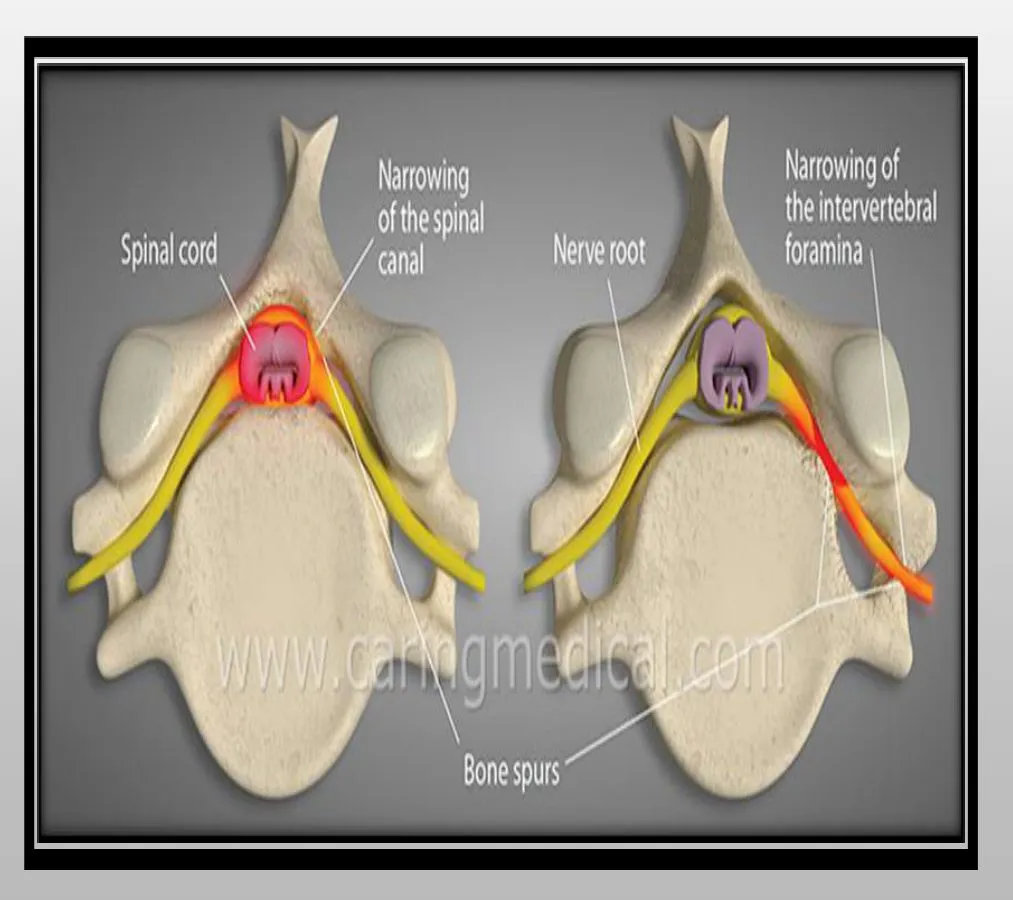
A common DegenerativeInvolving gradual wear and breakdown of a tissue.General meaning, not from the slides condition in the elderly: narrowing of the Spinal canalThe bony tunnel formed by the vertebrae, containing the spinal cord and nerve roots.General meaning, not from the slides or nerve-root canals from Facet jointA small paired joint at the back of each vertebra that guides and limits spinal movement.General meaning, not from the slides and disc arthritis and thickened ligaments. Often comes with ChronicLong-standing. In the course of LBP the slide defines chronic as more than 3 months since the first episode began. Low back pain (LBP)Pain and discomfort below the costal margin and above the inferior gluteal folds, with or without leg pain. and leg symptoms.
-
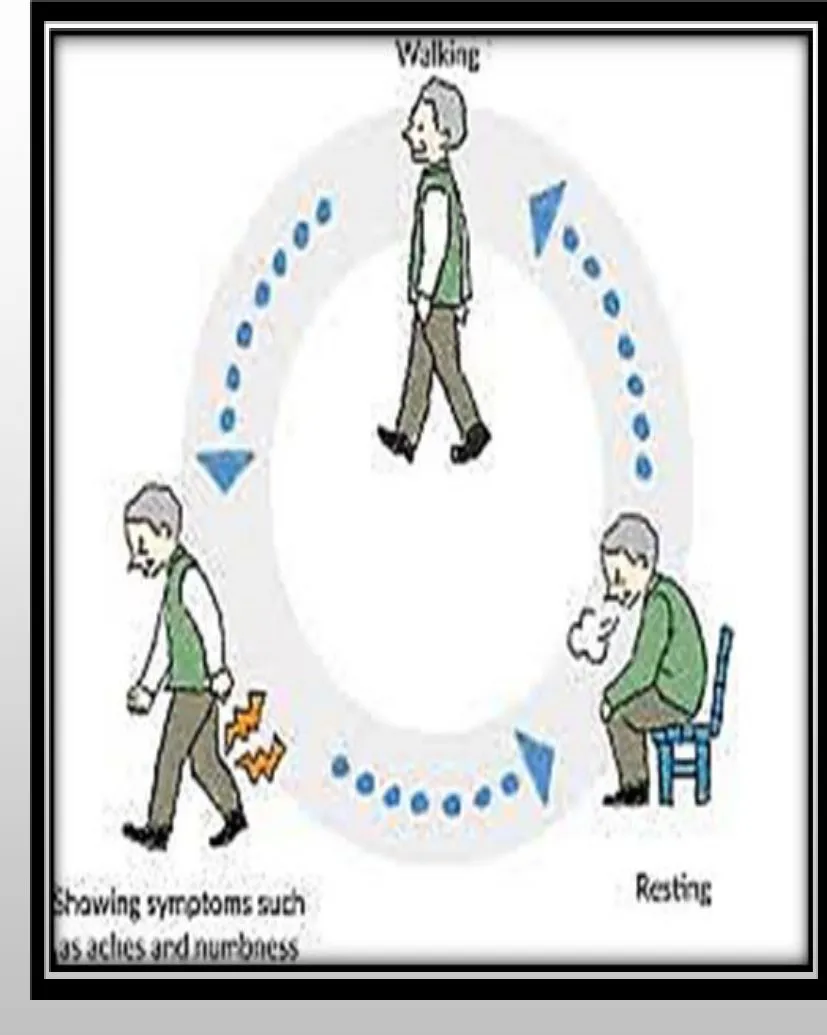
Neurogenic claudicationLeg pain and fatigue during walking: multilevel stenosis compresses the vertebral venous plexus, causing venous pooling, congestion and ischaemia.: multilevel StenosisNarrowing of the spinal canal or nerve-root canals. compresses the Vertebral venous plexusA network of veins around the spine.General meaning, not from the slides. That causes venous pooling and congestion, leading to IschaemiaToo little blood supply to a tissue, so it does not get enough oxygen.General meaning, not from the slides pain and fatigue in the legs during walking.
-
Extension is commonly limited. Sitting or bending forward (flexion) eases the leg symptoms.
Links back to the Intervertebral foraminaThe openings, between each spinal segment, where the spinal nerves leave.: flexion opens the canal and foramina, and extension narrows them. That’s why stenosis patients lean forward and disc patients often don’t tolerate flexion.
Case Study (S.M.)
- 46-year-old computer programmer with a 10-year history of intermittent Low back pain (LBP)Pain and discomfort below the costal margin and above the inferior gluteal folds, with or without leg pain. that sometimes stops him working or playing soccer and basketball.
- Latest flare: sharp, stabbing low back pain with Referred painPain felt in a different place from where it starts.General meaning, not from the slides pain to the left buttock while lifting a lounge chair. It eased after 3–4 days off work and over-the-counter anti-inflammatories.
- Back at work (sitting most of the day): constant deep throbbing pain, 2–6/10, plus intermittent left buttock symptoms.
- Aggravated by: sitting > 30 min, bending to pick things up, putting on trousers or socks, getting in and out of the car, taking off a shirt, sport. Eased by: medication and SupineLying face up, on the back.General meaning, not from the slides Hook-lyingLying on the back with the knees bent and the feet flat.General meaning, not from the slides.
- MRIMagnetic resonance imaging: a scan that uses magnets and radio waves to make detailed pictures of soft tissues.General meaning, not from the slides: Disc desiccationDrying out of the intervertebral disc, so it loses water.General meaning, not from the slides with a 4 mm Broad-based bulgeA disc bulge that spreads across a wide part of the disc's edge.General meaning, not from the slides into the left Intervertebral foraminaThe openings, between each spinal segment, where the spinal nerves leave. (Foraminal narrowingNarrowing of the intervertebral foramen, the opening where a spinal nerve leaves.General meaning, not from the slides), mild–moderate canal StenosisNarrowing of the spinal canal or nerve-root canals. and HypertrophiedEnlarged in size.General meaning, not from the slides Facet jointA small paired joint at the back of each vertebra that guides and limits spinal movement.General meaning, not from the slides changes. No Red flagsWarning signs that may point to a serious underlying cause of the pain.General meaning, not from the slides.
- Goals: prevent future flare-ups and return to recreational soccer and basketball.
The slide gives no answer. Notice that his aggravating activities are mostly flexion and sitting (which raise disc pressure, per the Intradiscal pressureThe pressure inside the intervertebral disc.General meaning, not from the slides table) and he’s eased lying supine. That points to the disc-lesion programme: stabilization, posture education with a Lumbar rollA rolled cushion or towel placed in the small of the back to help keep its inward curve when sitting.General meaning, not from the slides for sitting, and lifting advice.