Rehabilitation of Ligamentous Knee Injuries (ACL)
Quiz this lecture (190 questions)Prof. Dr. Nasr Awad’s lecture (PTPhysical therapy, or physical therapist.General meaning, not from the slides 406, Physical Therapy for Sport Injuries) covers the ACLAnterior cruciate ligament: a strong band inside the knee that stops the shin bone (tibia) sliding forward under the thigh bone (femur).General meaning, not from the slides (ACL): its anatomy and biomechanics, the mechanism of injury and risk factors (especially in females), diagnosis (mainly MRIMagnetic resonance imaging: a scan that uses magnets and radio waves to show soft tissues such as ligaments.General meaning, not from the slides signs), non-operative vs operative treatment and GraftTissue used to replace the torn ligament.General meaning, not from the slides choices, and a phase-by-phase rehabilitation protocol from PREProgressive resistive exercise: strengthening with gradually increasing resistance.General meaning, not from the slides-operative care to RTSReturn to sport.General meaning, not from the slides, with modifications for ConcomitantHappening or done at the same time as something else.General meaning, not from the slides procedures. The last section is the course’s ACL 1 high-yield exam-question sheet (41 questions). Facts that come only from that sheet are marked (exam sheet).
Learning objectives
By the end of the lecture the student should be able to:
- Understand the basic anatomy, function and biomechanics of the ACLAnterior cruciate ligament: a strong band inside the knee that stops the shin bone (tibia) sliding forward under the thigh bone (femur).General meaning, not from the slides.
- Explain the mechanism of ACL injury.
- Discuss ACL injury risk and how to prevent it.
- Discuss the findings of Stress testA test that applies a controlled force to a joint to see how much the ligaments let it move.General meaning, not from the slides for the cruciate injuries.
- Differentiate between operative and non-operative treatment of ACL injuries.
- Formulate a proper plan of treatment based on patient presentation and stage of operation.
Each objective on the slide carries a programme-outcome code (for example “a1-Prog.A9”). These codes are left out here.
ACL anatomy
Role and bundles
- The ACLAnterior cruciate ligament: a strong band inside the knee that stops the shin bone (tibia) sliding forward under the thigh bone (femur).General meaning, not from the slides is the main stabilizer of the knee for athletic pivotal activities.
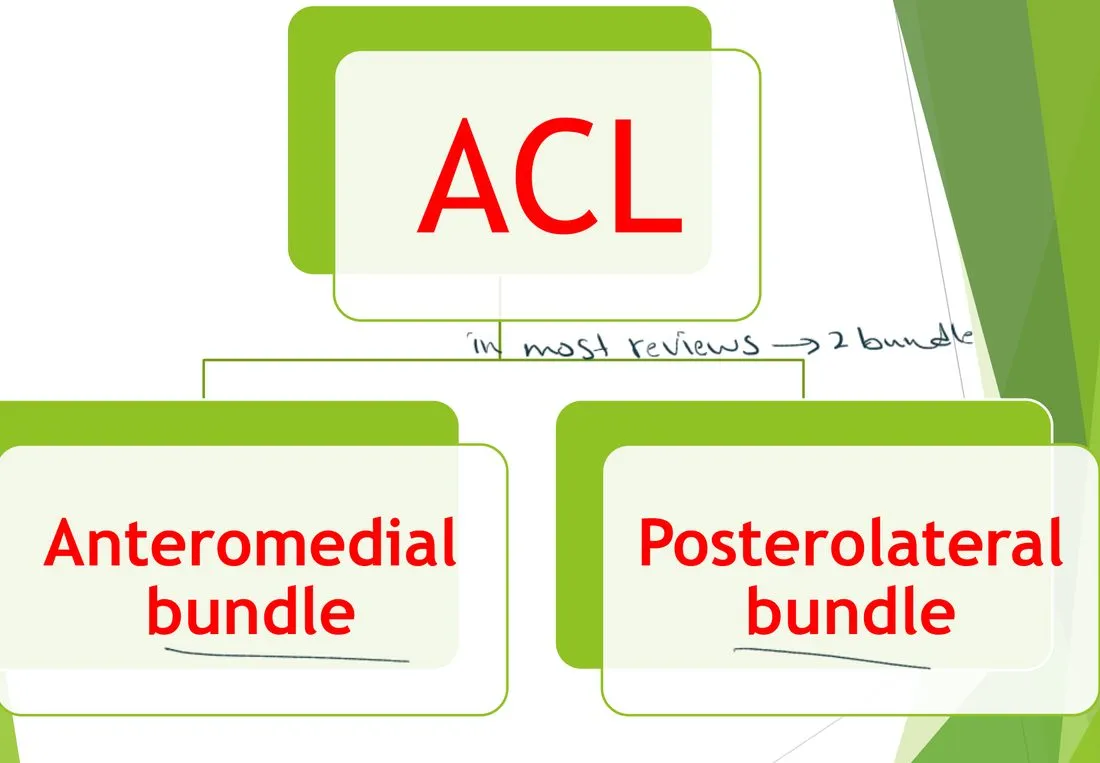
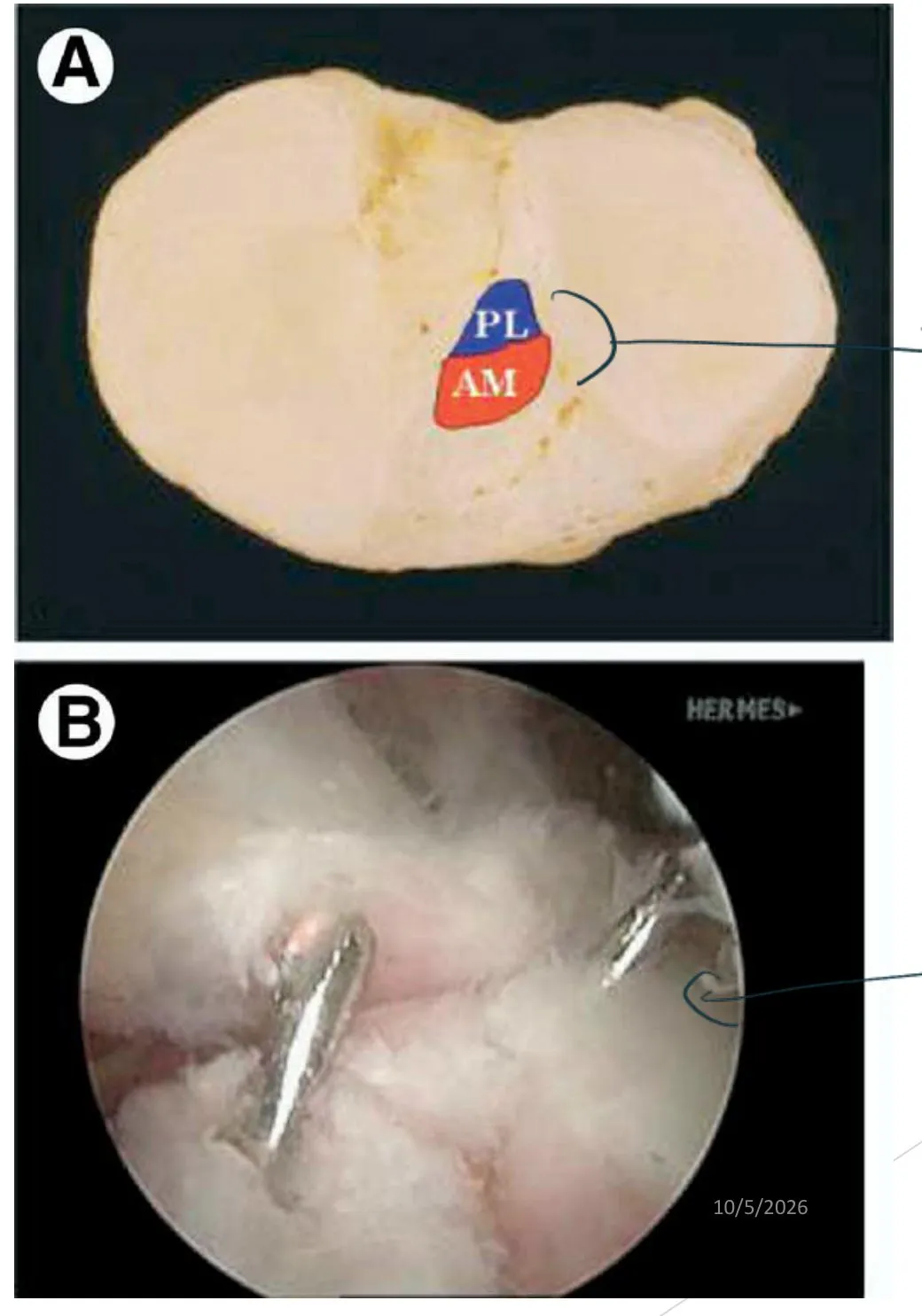
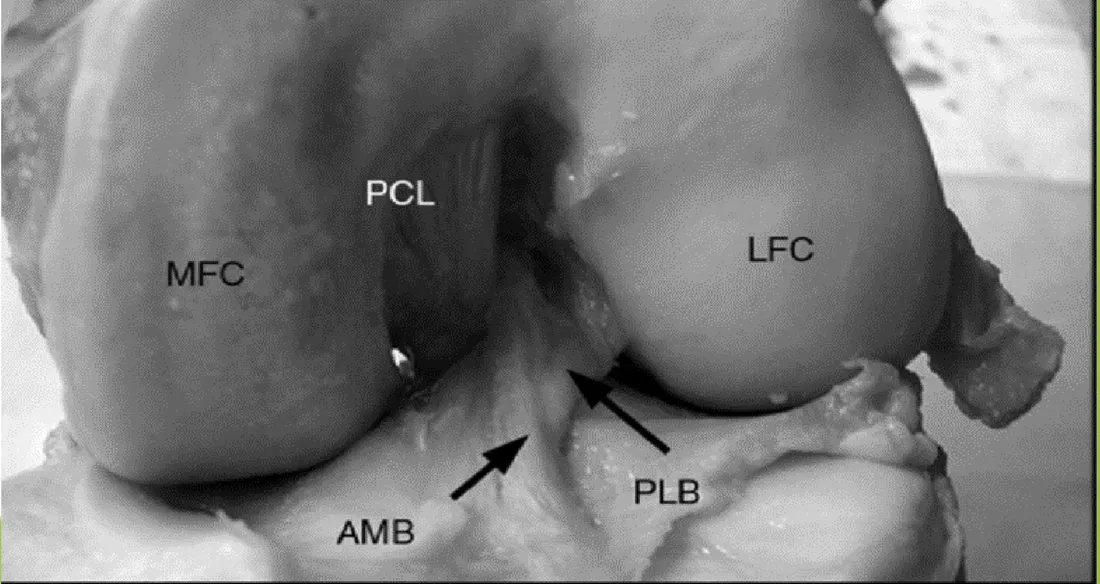
- It has two bundles: the Anteromedial bundleOne of the two bundles of the ACL (AMB). It is slack in knee extension and taut in flexion. (AMB) and the Posterolateral bundleOne of the two bundles of the ACL (PLB). It is slack in knee flexion and taut in extension, and gives more rotational stability. (PLB).
- It is enveloped into the Synovial membraneThe thin lining of a joint that produces the lubricating joint fluid.General meaning, not from the slides of the knee joint, which by definition places the ligament Intra-articularInside the joint.General meaning, not from the slides but Extra-synovialOutside the synovial cavity: inside the joint but not bathed in the joint fluid.General meaning, not from the slides. The ACL is intra-articular and extra-synovial (exam sheet: same fact).
Origin and insertion
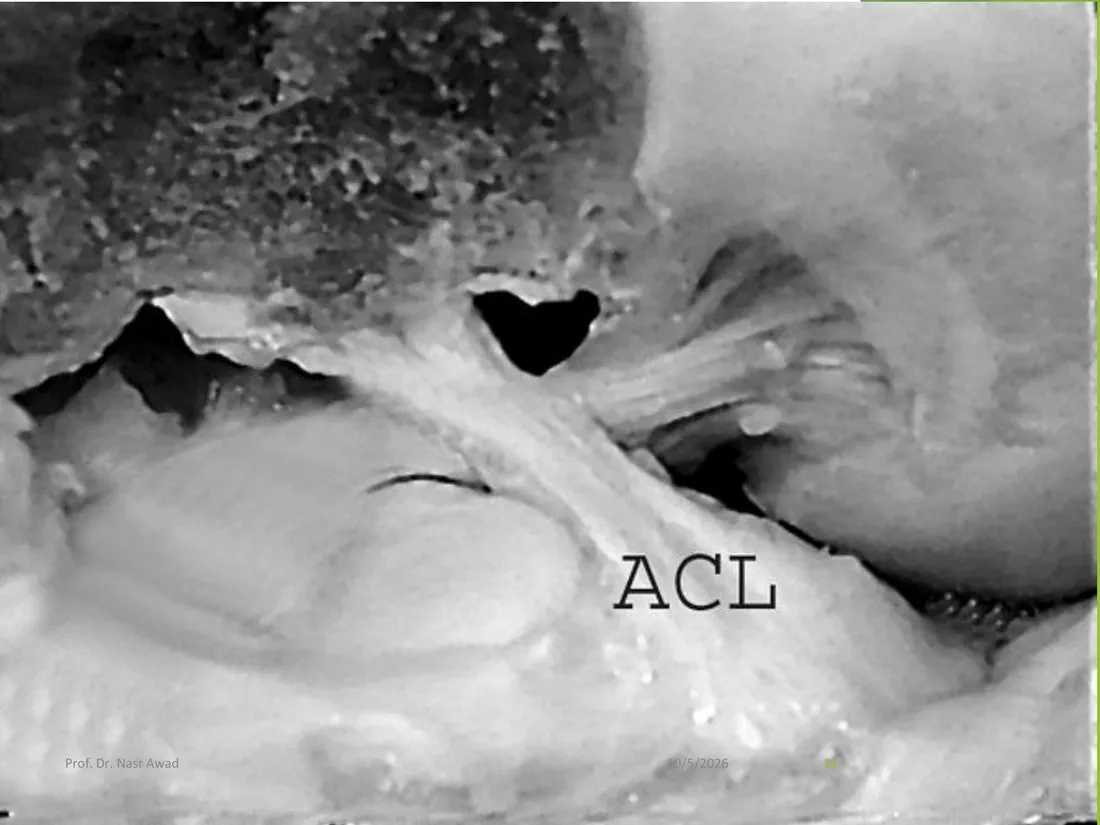
- Origin (femur): the medial side of the Femoral condyleOne of the two rounded bumps at the lower end of the thigh bone (femur) that sit on top of the shin bone.General meaning, not from the slides, at the posterior part of its medial surface.
- Course: an oblique course through the Intercondylar fossaThe notch between the two femoral condyles at the lower end of the thigh bone, through which the ACL runs.General meaning, not from the slides, distal–anterior–medial, to the insertion at the Tibial eminenceThe raised ridge in the middle of the top of the shin bone, between the tibial spines.General meaning, not from the slides.
- Insertion (tibia): the area between the medial and lateral Tibial spinesThe two small bony points (medial and lateral) on the top of the shin bone.General meaning, not from the slides.
Size
- Width: 7 mm to 12 mm.
- The ligament fans out toward its insertion on the tibia; the narrowest diameter is in the MidsubstanceThe middle part of a ligament, between its two attachment ends.General meaning, not from the slides area.
- Intra-articular length: between 28 and 31 mm.
- The attachment sites on the tibia and femur have a fairly small Isometric centerThe attachment point where the ligament length stays nearly constant as the knee moves.General meaning, not from the slides.
- Articular length 25–35 mm, approximately 3 cm (exam sheet).
The slide (13) gives 28–31 mm and the exam sheet gives 25–35 mm (about 3 cm). Both are kept. In the question bank the sheet’s value is the keyed answer, with the slide’s value in the explanation.
The “central pivot”
- The ACL and PCLPosterior cruciate ligament: the knee ligament that crosses the ACL inside the joint and stops the shin bone sliding backward.General meaning, not from the slides are closely intertwined and are called the “Central pivotThe name the lecture gives to the ACL and PCL together, because they are closely intertwined..”
- An injury to either ligament disrupts the function of the joint and may lead to late Degenerative arthritisWear-and-tear arthritis, where joint cartilage gradually breaks down.General meaning, not from the slides.
Tensile strength
- Reported Ultimate failure loadThe greatest pulling force a ligament can take before it breaks, measured in newtons (N).General meaning, not from the slides: 1750 N. Some reviews report 2200 N, and both are accepted (exam sheet).
- Young cadaver specimens were stronger than the older ones.
- The speed of the force applied to the ligament affects the type of tear.
- Slow, twisting, low-velocity injury (as in skiers) may elongate the ligament, then “it ruptures up to 30%”. There may be a partial rupture of the anteromedial bundle, leaving the posterolateral bundle intact, or vice versa. A slow-velocity injury may elongate the ligament and progress to partial rupture (exam sheet).
Slide 17 is written as a chain of arrows (skiers → may elongate the ligament → it ruptures up to 30% → partial rupture of one bundle). The “up to 30%” is kept exactly as written.
Function and biomechanics
Both bundles resist anterior tibial displacement
- Both bundles resist anterior displacement of the tibia relative to the Femoral condyleOne of the two rounded bumps at the lower end of the thigh bone (femur) that sit on top of the shin bone.General meaning, not from the slides.
- The anterior bundle gives more resistance when the knee is FlexionBending a joint.General meaning, not from the slides; the posterior bundle gives more resistance when the knee is ExtensionStraightening a joint.General meaning, not from the slides.
- The Anteromedial bundleOne of the two bundles of the ACL (AMB). It is slack in knee extension and taut in flexion. is slack in extension and the Posterolateral bundleOne of the two bundles of the ACL (PLB). It is slack in knee flexion and taut in extension, and gives more rotational stability. is slack in flexion, but there is a continuum between the two, so some portion of the ACLAnterior cruciate ligament: a strong band inside the knee that stops the shin bone (tibia) sliding forward under the thigh bone (femur).General meaning, not from the slides remains fairly taut throughout the ROMRange of motion: how far a joint can move.General meaning, not from the slides.
- Rotational stabilityHow well the knee resists twisting (rotation) of the shin bone on the thigh bone.General meaning, not from the slides is thought to be provided to a greater extent by the posterolateral bundle than by the anteromedial one.
| Anteromedial bundle (AMB) | Posterolateral bundle (PLB) | |
|---|---|---|
| Knee flexed | Taut; more resistance to Anterior tibial translationThe shin bone (tibia) sliding forward relative to the thigh bone (femur).General meaning, not from the slides | Lax / slack |
| Knee extended | Slack / lax | Taut; more resistance to anterior tibial displacement |
| Rotational stability | Less | Greater extent |
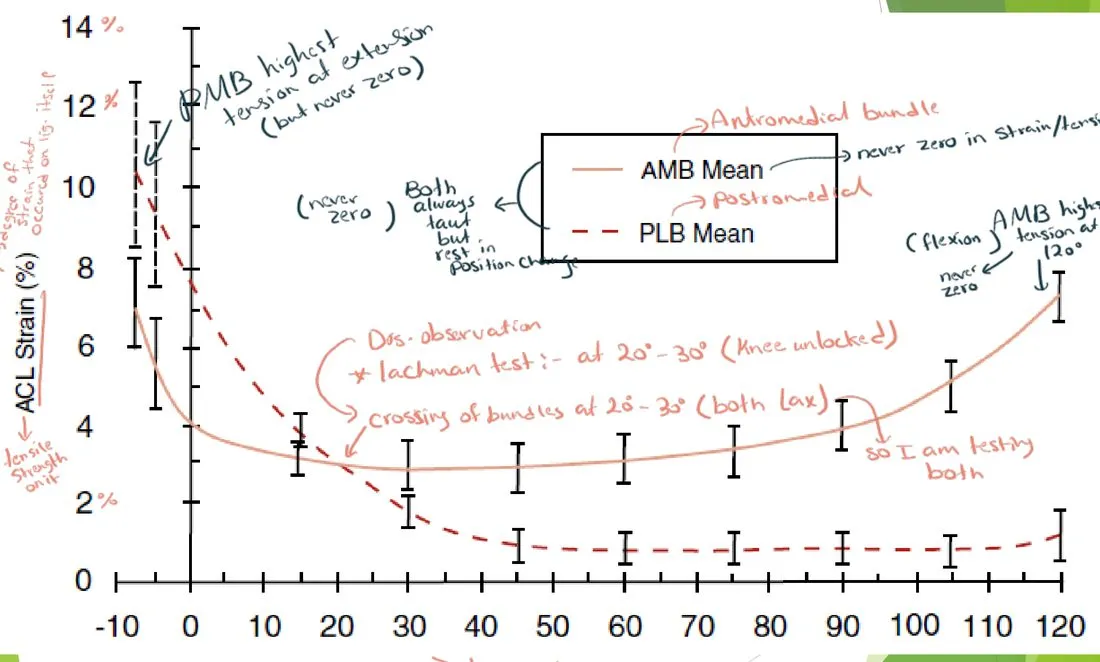
| StrainHow much a tissue stretches, given as a percentage of its resting length.General meaning, not from the slides graph (slide 22) | Rises again toward 120° of flexion | Highest near full extension, falls steeply with flexion |
Exam sheet: the anteromedial bundle is more resistant in flexion; the posterolateral bundle is more resistant in extension.
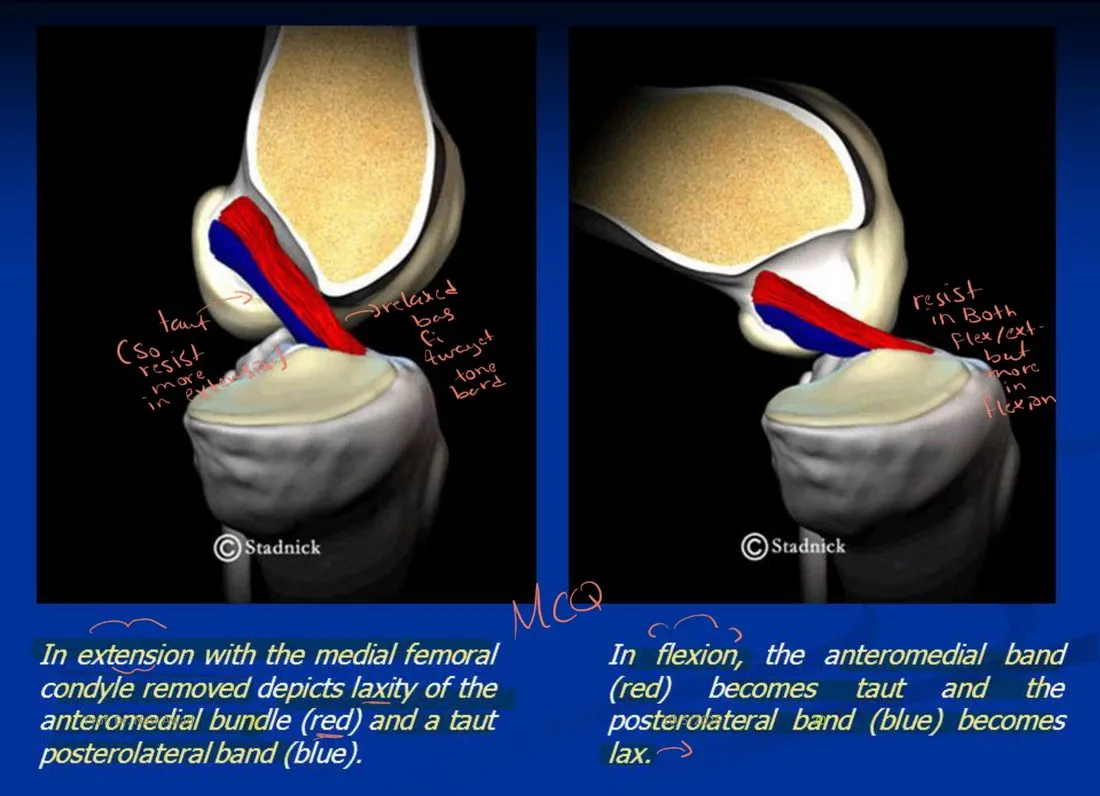
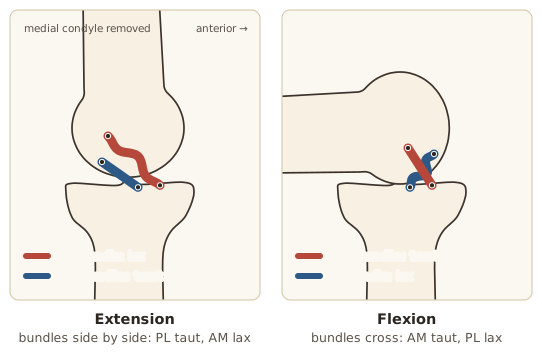
Slide 19 says “anterior bundle” and “posterior bundle”; slides 20–21 use AMB and PLB. They are the same two bundles.
The text of slide 24 runs off the bottom edge of the slide and ends at “than by the anteromedial”. “Bundle” is implied.
ACL strain graph (slide 22)
- The graph plots ACL strain (%) (axis up to 14%) against knee angle in degrees (about −10° to 120°) for the AMB mean (solid line) and the PLB mean (dashed line).
- Read off the curves: the PLB strain is highest at full extension and falls steeply as the knee flexes, staying low from about 45° onward. The AMB strain stays moderate through mid-range and rises again toward 120° of flexion. The two curves cross at roughly 20–30° of flexion.
ACL strain during rehabilitation activities (slide 23, Figure 11-20)
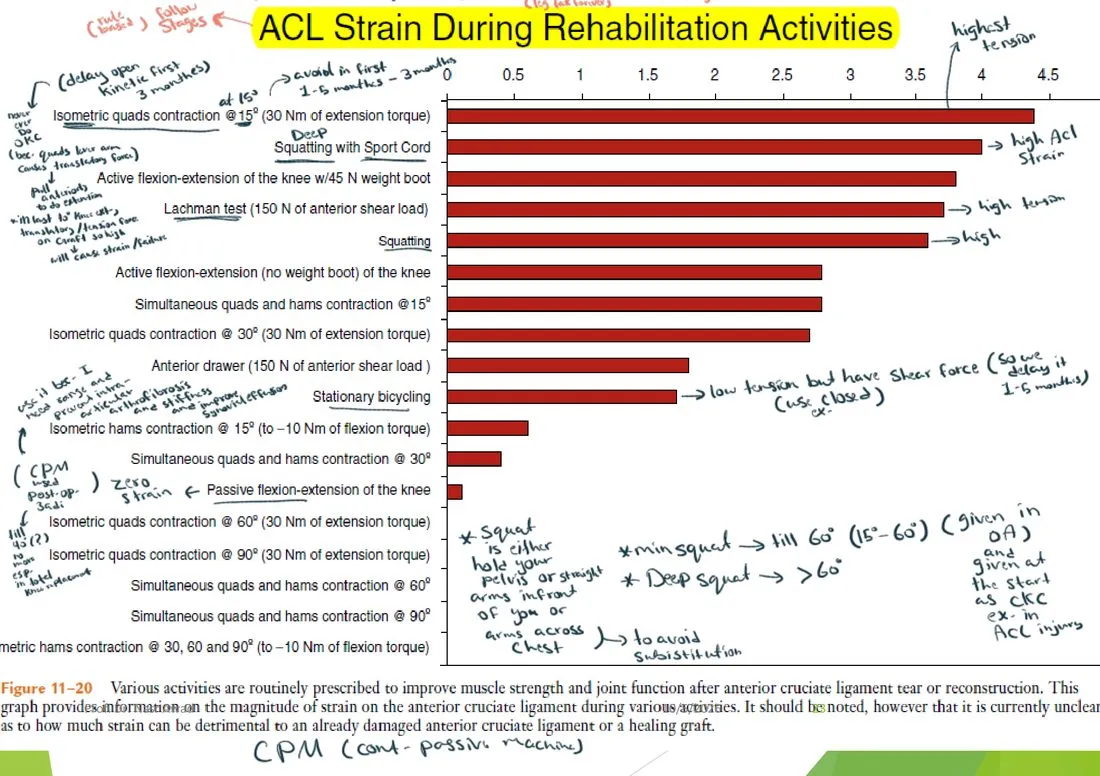
The bar chart ranks activities by the strain they put on the ACL (bar scale 0–4.5). Highest to lowest, with approximate bar lengths read off the chart:
| Rank | Activity | Strain (about) |
|---|---|---|
| 1 | IsometricA muscle contraction without movement at the joint.General meaning, not from the slides QuadricepsThe large muscle group on the front of the thigh that straightens the knee.General meaning, not from the slides contraction @ 15° (30 Nm of extension torque) | 4.4 (highest) |
| 2 | Squatting with Sport Cord | 4.0 |
| 3 | Active flexion-extension of the knee with 45 N weight boot | 3.8 |
| 4 | Lachman testA hands-on test for ACL looseness: with the knee slightly bent, the examiner pulls the shin bone forward on the thigh bone.General meaning, not from the slides (150 N of anterior shear load) | 3.7 |
| 5 | Squatting | 3.6 |
| 6 | Active flexion-extension (no weight boot) | 2.8 |
| 7 | Simultaneous quads and hams contraction @ 15° | 2.8 |
| 8 | Isometric quads contraction @ 30° (30 Nm) | 2.7 |
| 9 | Anterior drawerA test for ACL looseness: with the knee bent, the examiner pulls the shin bone forward.General meaning, not from the slides (150 N of anterior shear load) | 1.8 |
| 10 | Stationary bicycling | 1.7 |
| 11 | Isometric hams contraction @ 15° (to −10 Nm flexion torque) | 0.6 |
| 12 | Simultaneous quads and hams contraction @ 30° | 0.4 |
| 13 | Passive flexion-extension of the knee | 0.1 (lowest) |
- No bar is drawn for: isometric quads at 60° and 90°, simultaneous quads and hams at 60° and 90°, and isometric hams at 30°, 60° and 90°.
- Caption (Fig. 11-20): various activities are routinely prescribed to improve muscle strength and joint function after ACL tear or reconstruction. The graph shows the magnitude of strain on the ACL during them. It is currently unclear how much strain can be detrimental to an already damaged ACL or a healing GraftTissue used to replace the torn ligament.General meaning, not from the slides.
- Exam sheet: an isometric quadriceps contraction at 15° of knee flexion produces high ACL tension.
Quadriceps force and anterior tibial translation (Figure 11-36)
- A. With the knee close to full extension, a forceful quadriceps contraction is capable of inducing an anterior tibial translation.
- B. Once the knee is flexed to greater than 60°, little to no anterior translation occurs.
- The diagram appears twice in the lecture (slide 46 in the risk factors, slide 119 in the rehabilitation section). It is shown once, with slide 119.
Mechanism of injury
Non-contact injuries
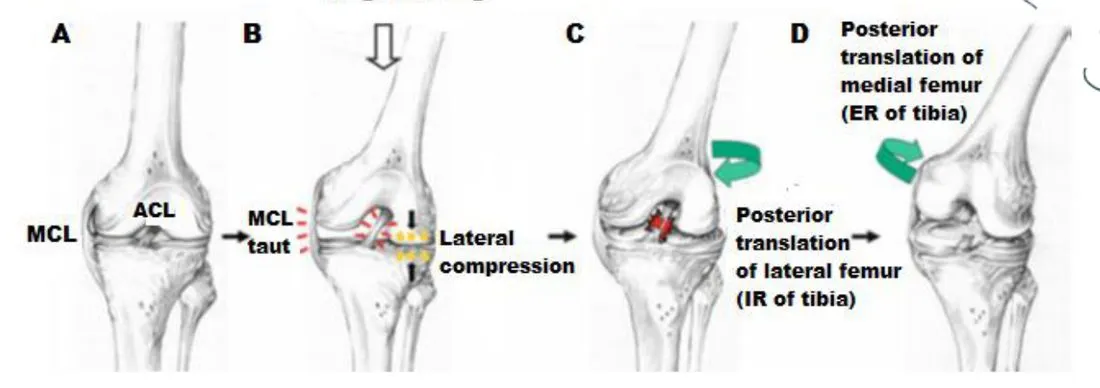
The proposed Non-contact injuryAn injury that happens without a direct blow from another player or object.General meaning, not from the slides mechanism (slide 27, panels a–d):
- (a) An unloaded knee.
- (b) ValgusAngulation where the lower part of the limb points away from the midline. At the knee it is the inward collapse (knock-knee direction).General meaning, not from the slides loading is applied: the MCLMedial collateral ligament: the ligament on the inner side of the knee that resists the knee being pushed inward.General meaning, not from the slides becomes taut and lateral compression occurs.
- (c) This compressive load, plus the anterior force vector from QuadricepsThe large muscle group on the front of the thigh that straightens the knee.General meaning, not from the slides contraction, causes a lateral femoral posterior displacement (because of the posterior slope of the Tibial plateauThe flat top surface of the shin bone that forms the lower half of the knee joint.General meaning, not from the slides). The tibia translates anteriorly and Internal rotationTurning a limb inward, toward the midline.General meaning, not from the slides, resulting in an ACLAnterior cruciate ligament: a strong band inside the knee that stops the shin bone (tibia) sliding forward under the thigh bone (femur).General meaning, not from the slides rupture.
- (d) After the ACL is torn, the primary restraint to Anterior tibial translationThe shin bone (tibia) sliding forward relative to the thigh bone (femur).General meaning, not from the slides is gone. The Femoral condyleOne of the two rounded bumps at the lower end of the thigh bone (femur) that sit on top of the shin bone.General meaning, not from the slides is also displaced posteriorly, resulting in External rotationTurning a limb outward, away from the midline.General meaning, not from the slides of the tibia.
- Exam sheet: the non-contact mechanism is landing with knee valgus, hip FlexionBending a joint.General meaning, not from the slides and internal rotation of the hip.
The sheet says “hip flexion”; slide 45 says women land with less knee and hip flexion (see Risk factors). Both are kept. In the question bank the sheet’s wording is the keyed answer.
Panel labels on the slide: (c) “Posterior translation of lateral femur (IR of tibia)”; (d) “Posterior translation of medial femur (ER of tibia)”.
Contact injuries
- A common mechanism in football or hockey is a blow to the outside of the knee when the knee is flexed and rotated.
- This initially injures the medial collateral ligament (MCL), and then, with further valgus, the ACL is torn.
- Slides 28 and 30 carry the same text. Exam sheet: the important contact mechanism is a lateral blow to the knee with the knee flexed and rotated, and the ligament injured first is the MCL.
In brief
- The body and knee must be in the correct position, the quadriceps must contract strongly enough to SubluxationA partial dislocation: the bones shift out of their normal position but stay in contact.General meaning, not from the slides the tibia, and the HamstringsThe muscle group on the back of the thigh that bends the knee.General meaning, not from the slides fail to protect against the anterior subluxation.
- Can this be prevented? Perhaps, by NeuromuscularRelating to the nerves and muscles working together to control movement.General meaning, not from the slides, ProprioceptiveRelating to the sense of where the joints are and how they are moving.General meaning, not from the slides training, some injuries may be prevented.
Take-home message
- Emphasize hamstring strengthening to protect the ACL.
- Quadriceps-to-hamstring strength ratio: 0.6; 0.55 is also accepted (exam sheet).
- To help prevent ACL injury: hamstring strengthening (exam sheet, same point).
Risk factors
Slides 33–46 group the risk factors into four headings: environmental, anatomical, hormonal and biomechanical.
Environmental
- Harder ground (resulting from high evaporation and low rainfall) may increase the Shoe traction interfaceHow much grip the shoe has on the playing surface.General meaning, not from the slides.
- Increasing the Shoe-surface coefficientA number describing the friction (grip) between the shoe and the surface.General meaning, not from the slides may increase the risk of injury (direct risk) and alter movement (indirect risk).
- The role of ProphylacticUsed to prevent injury or disease.General meaning, not from the slides knee braces is confusing, except in one prospective randomized study of collegiate intramural football, which showed a 3× knee injury rate in participants not wearing a brace.
Anatomical (and the female athlete)
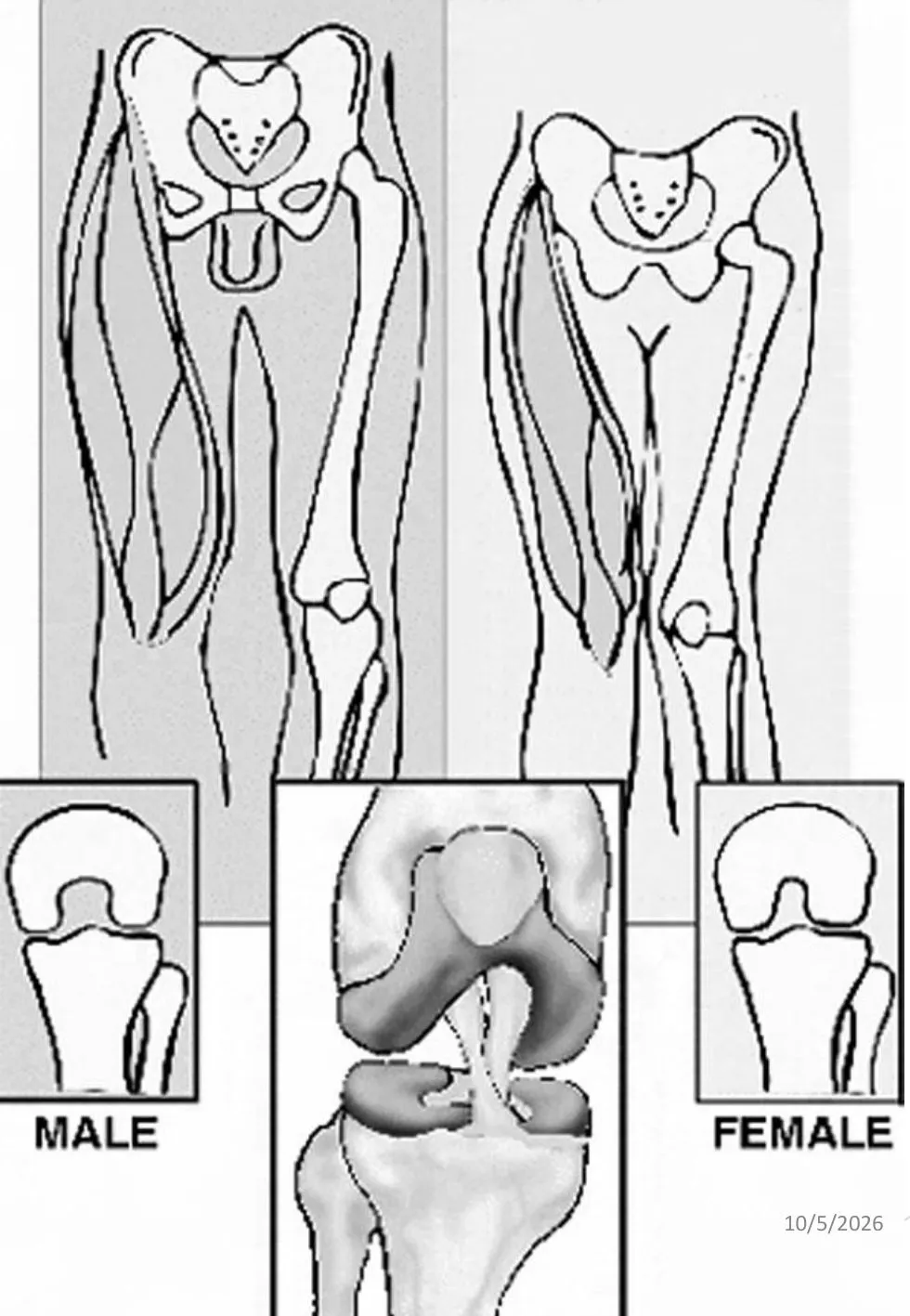
- It has been estimated that females are 4 to 8 times more likely to tear their ACLAnterior cruciate ligament: a strong band inside the knee that stops the shin bone (tibia) sliding forward under the thigh bone (femur).General meaning, not from the slides than males.
- Theories being investigated: forces with knee ValgusAngulation where the lower part of the limb points away from the midline. At the knee it is the inward collapse (knock-knee direction).General meaning, not from the slides or inward collapse of the knee on landing; less absorptive landing patterns such as straight-knee landing; muscular weakness; excessive QuadricepsThe large muscle group on the front of the thigh that straightens the knee.General meaning, not from the slides activation in an EccentricA muscle contraction in which the muscle lengthens while producing force.General meaning, not from the slides activity.
- Exam sheet — estimated causes in females: knee valgus, decreased knee FlexionBending a joint.General meaning, not from the slides angle, less landing absorption, straight-knee landing, muscle weakness and excessive quadriceps activation.
- Anatomical factors named on the slides:
- The wider pelvis in females.
- Increased Quadriceps angleThe angle between the pull of the quadriceps and the patellar tendon. A larger angle goes with knee valgus.General meaning, not from the slides (Q-angle) (knee valgus).
- Increased foot PronationRolling of the foot inward so the arch flattens.General meaning, not from the slides.
- Body mass index: its role is not clear, but higher indices seem to be associated.
- Femoral notchThe groove between the two femoral condyles that the ACL passes through.General meaning, not from the slides indices, ACL geometry (smaller ACL) and tibial measurements are not definitively associated with increased risk of ACL tear. However, the smaller femoral notch in females, even when normalized to body weight, seems to be more associated.
- Increased femoral AnteversionA forward twist of the upper end of the thigh bone relative to its lower end.General meaning, not from the slides.
- Decreased muscular support, specifically the HamstringsThe muscle group on the back of the thigh that bends the knee.General meaning, not from the slides, as possible causes of the higher ACL injury rate in women.
- Exam sheet — anatomical risk factors in females: wider pelvis, increased Q-angle, foot pronation and dominant quadriceps.
Hormonal
- Females are more susceptible to tearing their ACLs just before or after their monthly Menstrual periodThe monthly bleeding phase of the menstrual cycle.General meaning, not from the slides. Exam sheet: the hormonal risk factor is increased susceptibility to ACL injury around the menstrual period.
- Females experience a rapid surge of EstrogenA female sex hormone.General meaning, not from the slides just prior to OvulationRelease of an egg from the ovary during the menstrual cycle.General meaning, not from the slides, usually between days 10 and 14 of the cycle. Exam sheet: ovulation usually occurs between days 10 and 14.
The slide ties “days 10 and 14” to the estrogen surge just before ovulation; the exam sheet words it as when ovulation occurs. Both wordings are kept.
Biomechanical
- The ACL has different mechanical properties in women, which makes them more susceptible to injury.
- NeuromuscularRelating to the nerves and muscles working together to control movement.General meaning, not from the slides factors appear to be the most critical difference between adult men and women and are modifiable.
- When landing from a jump or changing direction, women show:
- less knee and hip flexion
- increased knee valgus
- increased Internal rotationTurning a limb inward, toward the midline.General meaning, not from the slides of the hip
- increased External rotationTurning a limb outward, away from the midline.General meaning, not from the slides of the tibia
- Slide 46 shows the Figure 11-36 diagram (see Function and biomechanics).
Diagnosis and imaging
Clinical diagnosis
- The slide titled “Clinically” has no text on it.
- Doughy sensationA soft, dough-like feel of the knee.General meaning, not from the slides: associated with ACLAnterior cruciate ligament: a strong band inside the knee that stops the shin bone (tibia) sliding forward under the thigh bone (femur).General meaning, not from the slides injury with EffusionExcess fluid inside the joint, seen as a swollen knee. The protocol grades it as zero, trace, 1+, 2+ and higher.General meaning, not from the slides (exam sheet).
- Lachman testA hands-on test for ACL looseness: with the knee slightly bent, the examiner pulls the shin bone forward on the thigh bone.General meaning, not from the slides: performed at 20–30° of knee FlexionBending a joint.General meaning, not from the slides, because the knee is unlocked and both ACL bundles can be assessed (exam sheet).
Objective 4 (Stress testA test that applies a controlled force to a joint to see how much the ligaments let it move.General meaning, not from the slides for the cruciate injuries) has no slide of its own. The only stress-test content on the slides is the Lachman test and Anterior drawerA test for ACL looseness: with the knee bent, the examiner pulls the shin bone forward.General meaning, not from the slides in the StrainHow much a tissue stretches, given as a percentage of its resting length.General meaning, not from the slides chart (slide 23).
Radiological investigations
Plain X-ray; CTComputed tomography: an X-ray scan that builds detailed cross-section or 3D pictures.General meaning, not from the slides; MRIMagnetic resonance imaging: a scan that uses magnets and radio waves to show soft tissues such as ligaments.General meaning, not from the slides; Examination under anesthesiaExamining a joint while the patient is anaesthetised.General meaning, not from the slides and ArthroscopyLooking inside, or operating on, a joint through small cuts using a camera.General meaning, not from the slides.
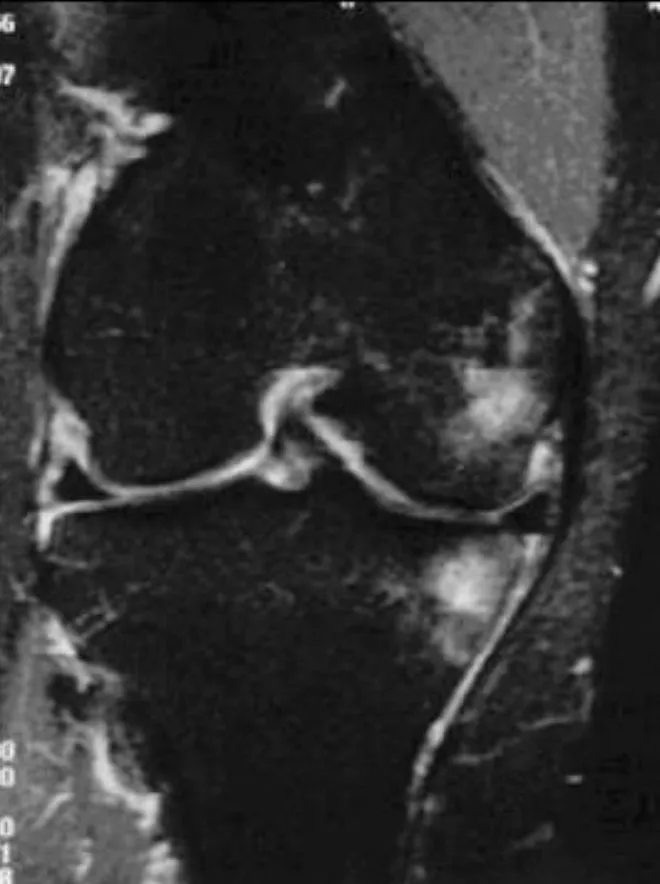
MRI of the ACL
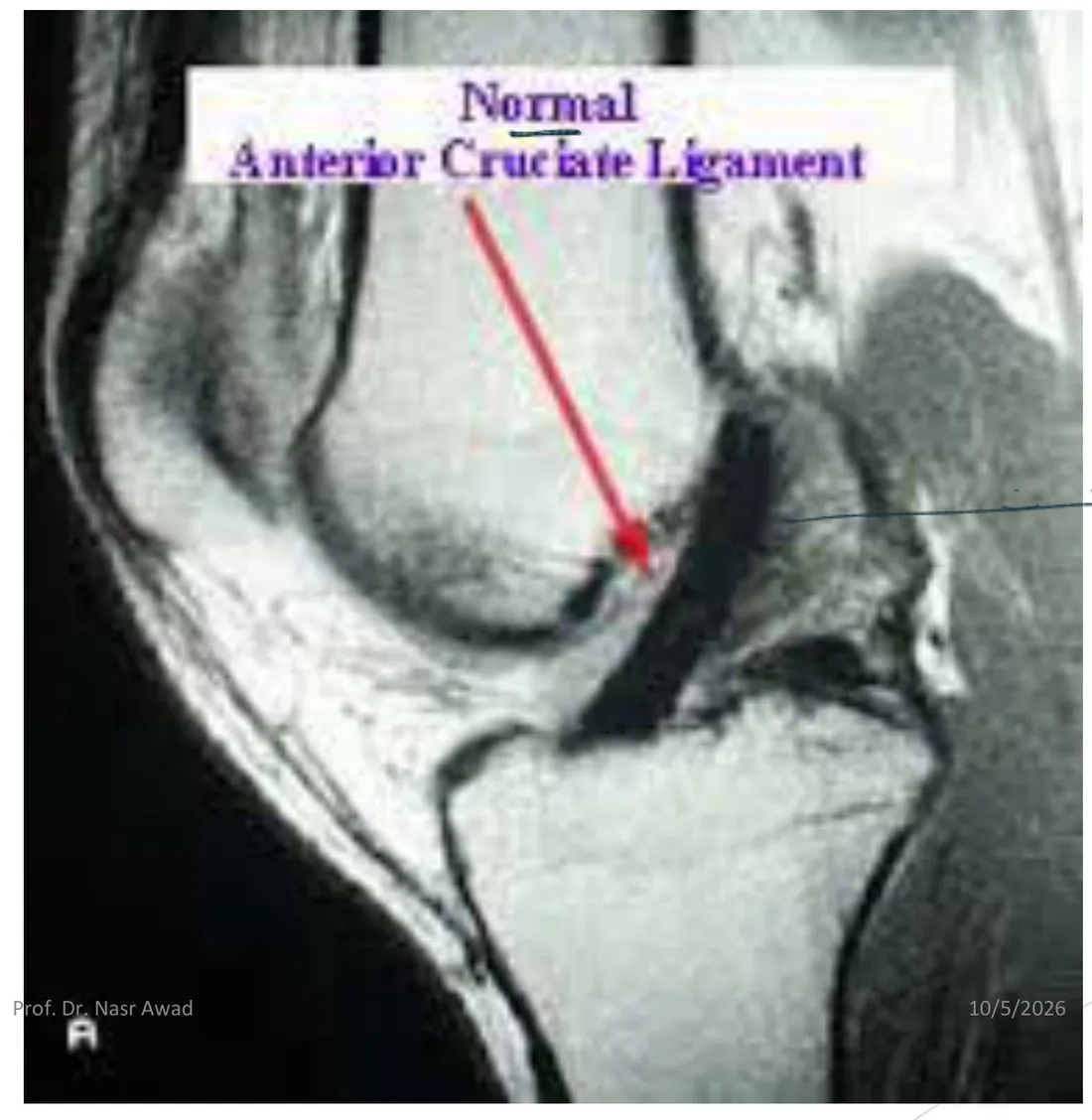
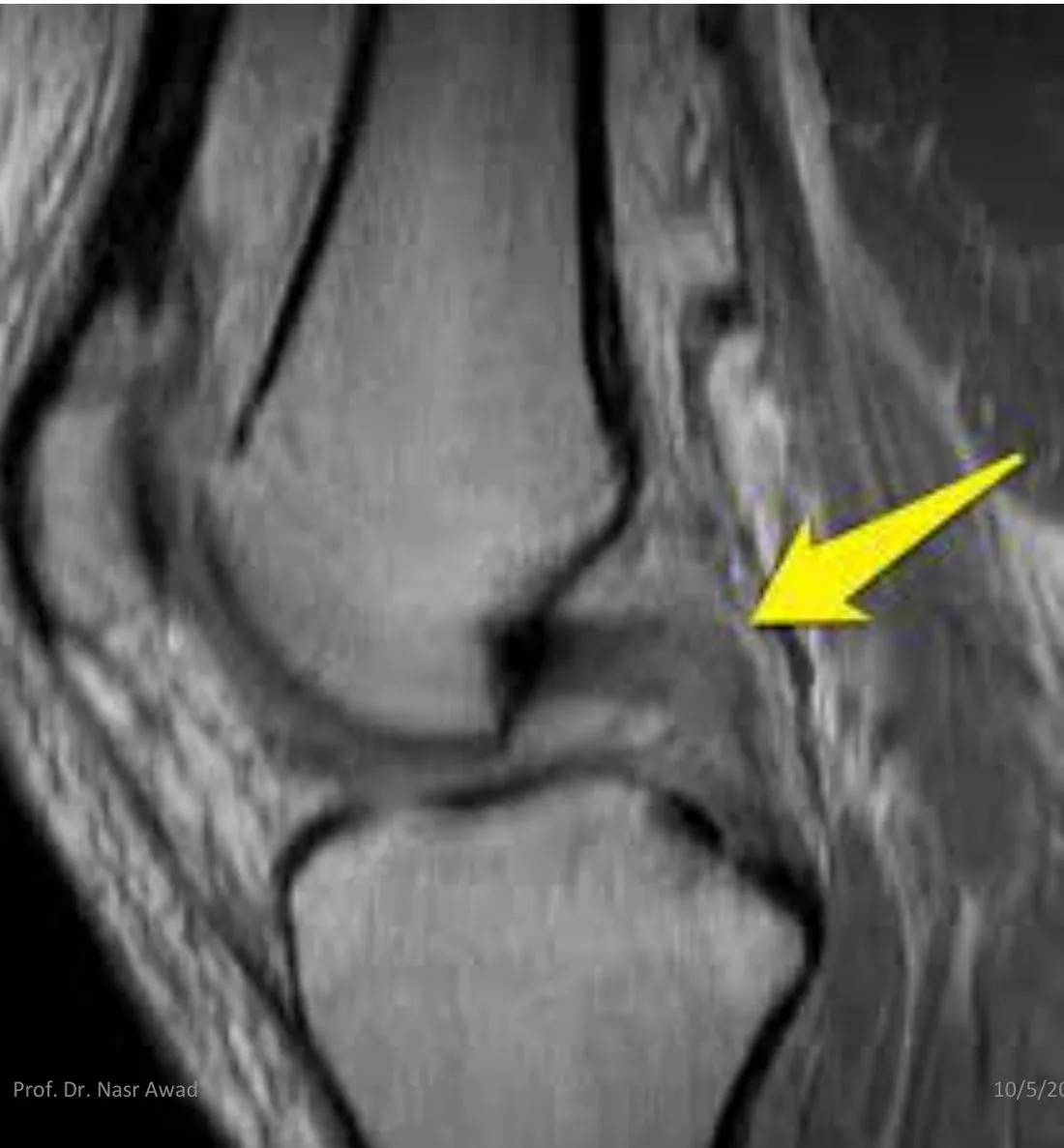
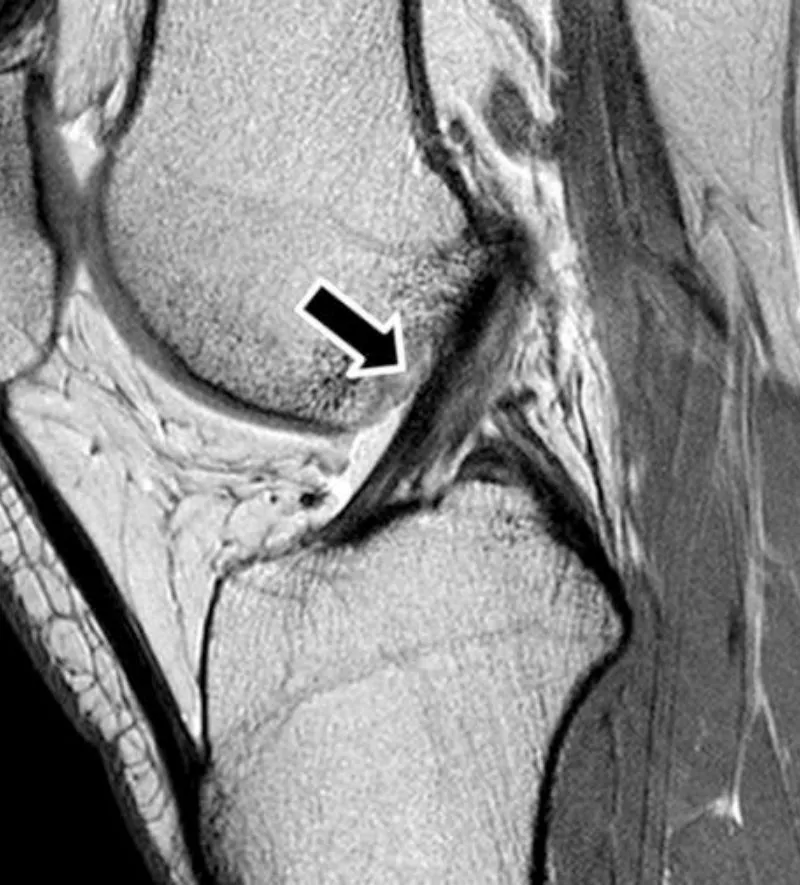
- Slide 51 shows an MRI labelled “Normal Anterior Cruciate Ligament”, with an arrow on the ligament.
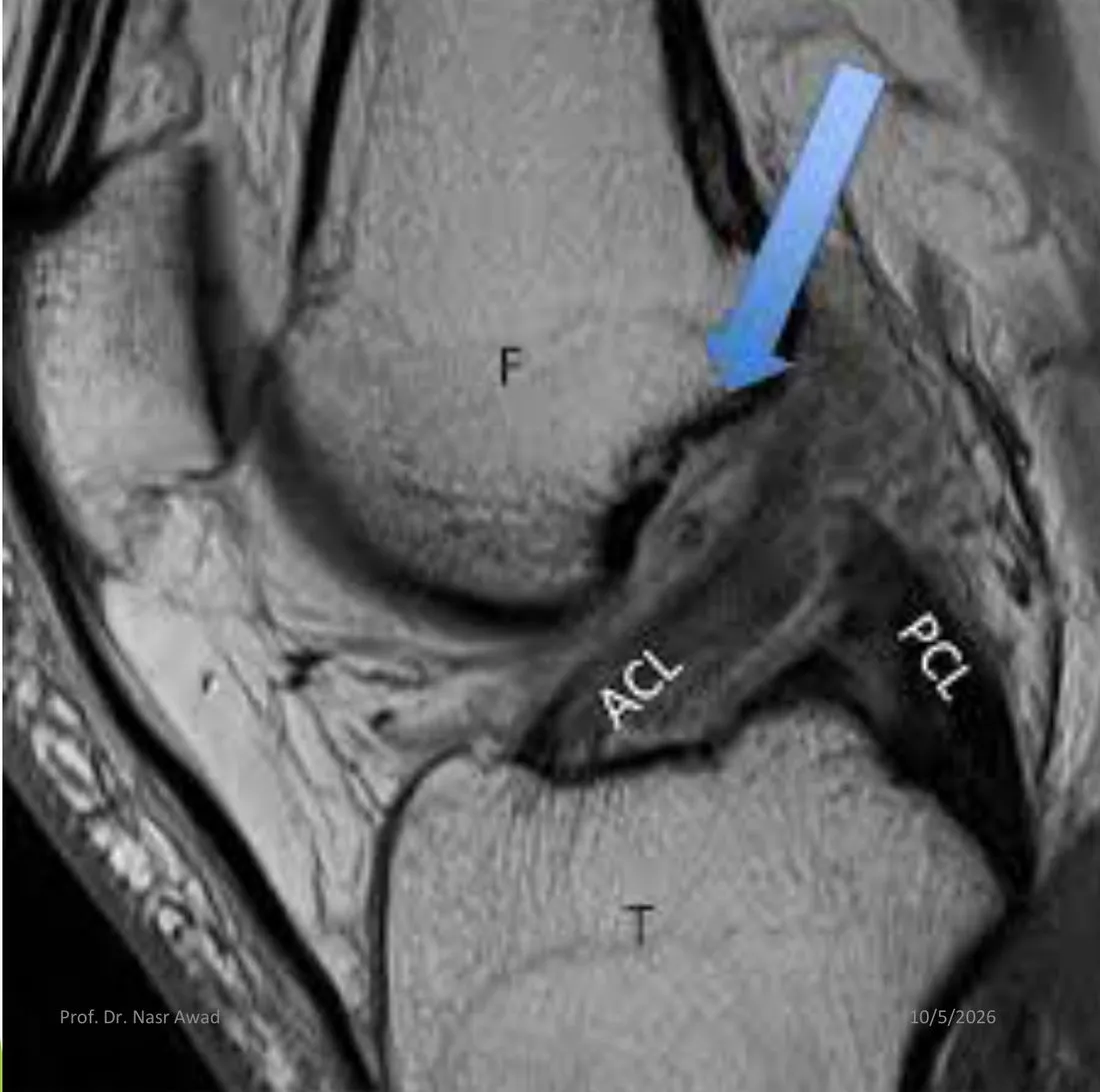
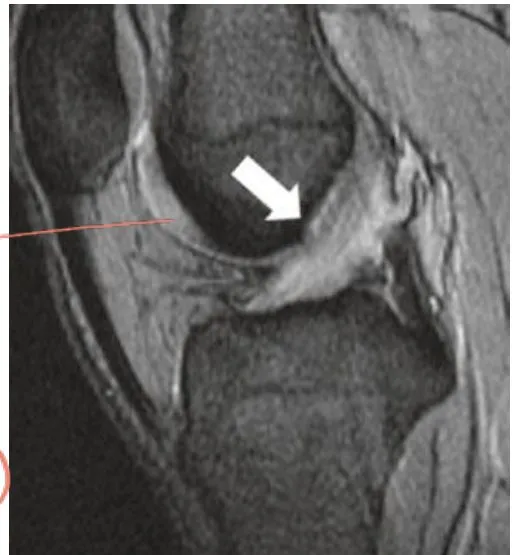
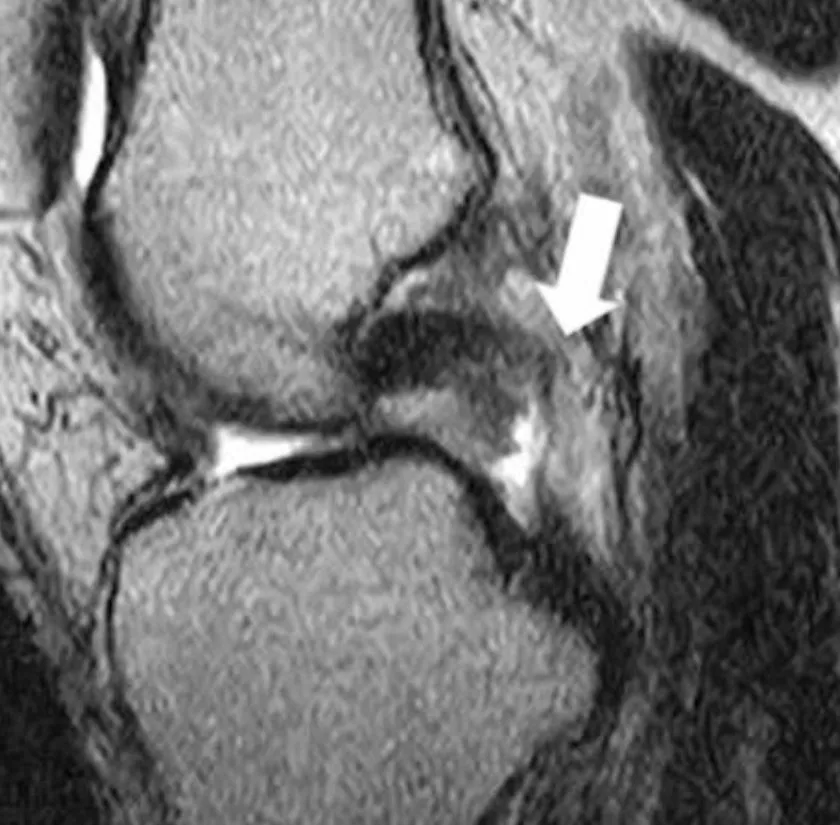
Primary signs of an acute ACL tear (slides 52–53):
- Abrupt angulationA sudden sharp bend in the course of the ligament on MRI.General meaning, not from the slides of the ACL.
- Rupture of the substance of the ACL, noticed by abnormal increased signal intensity (blue arrow).
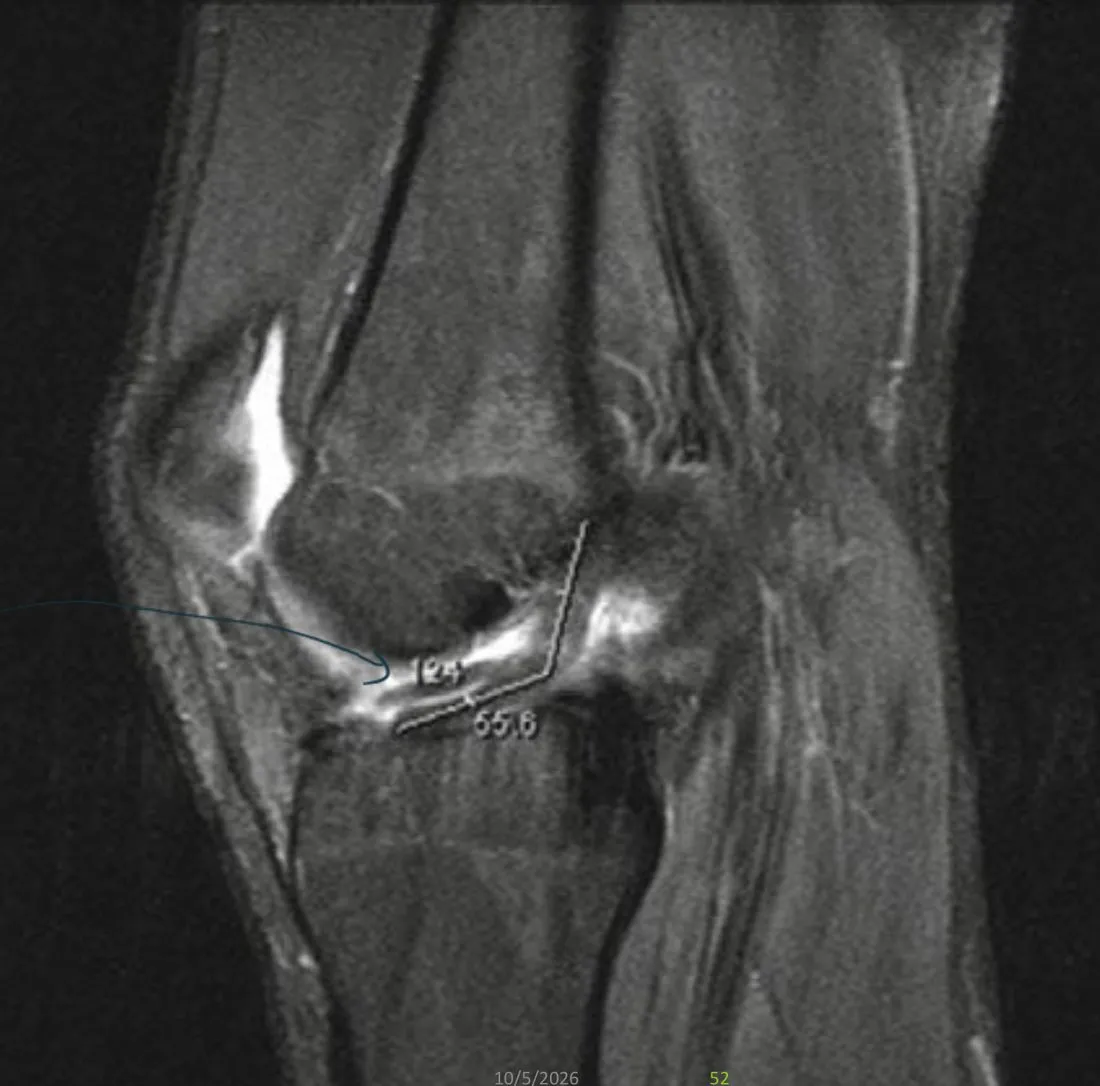
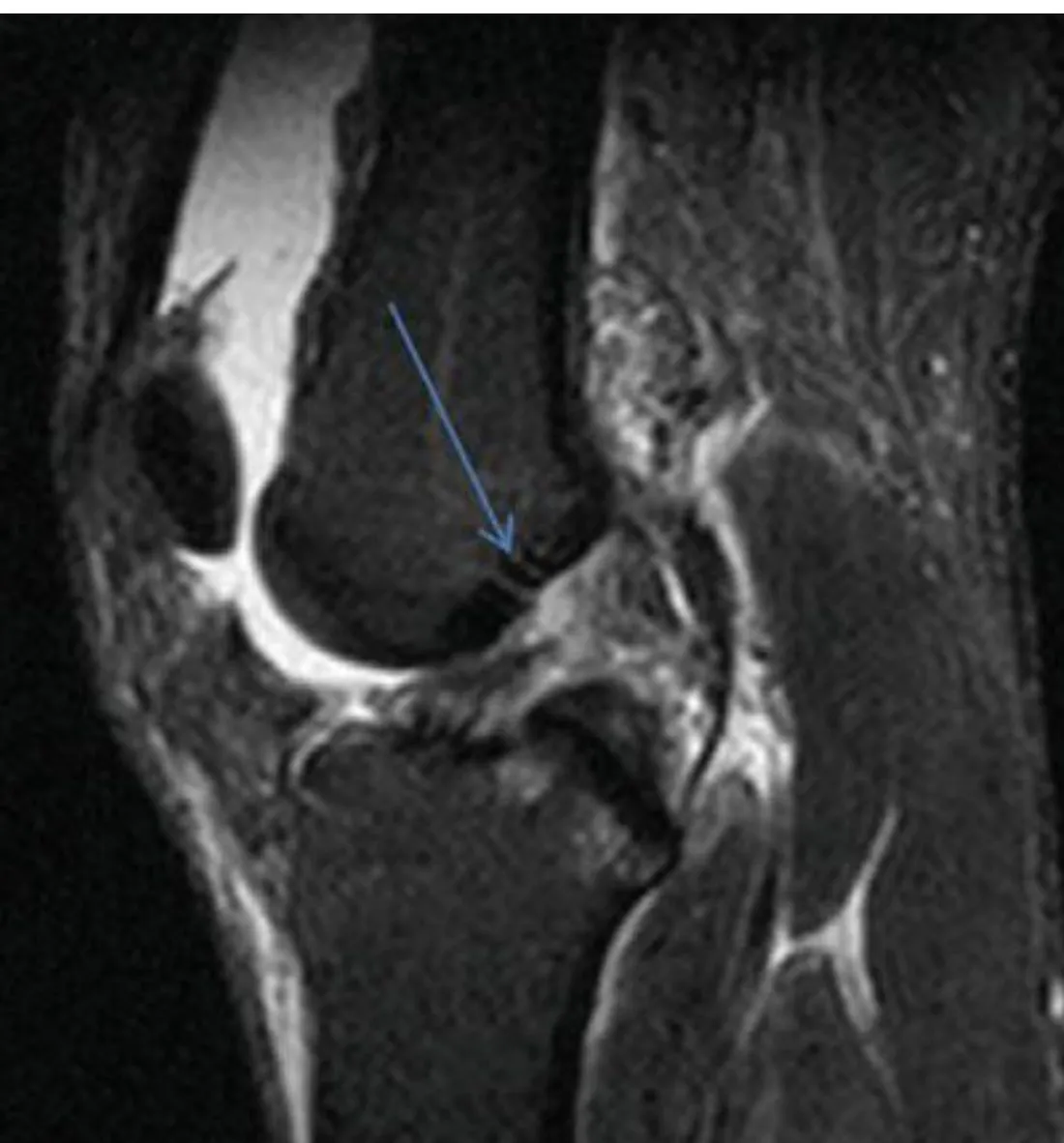
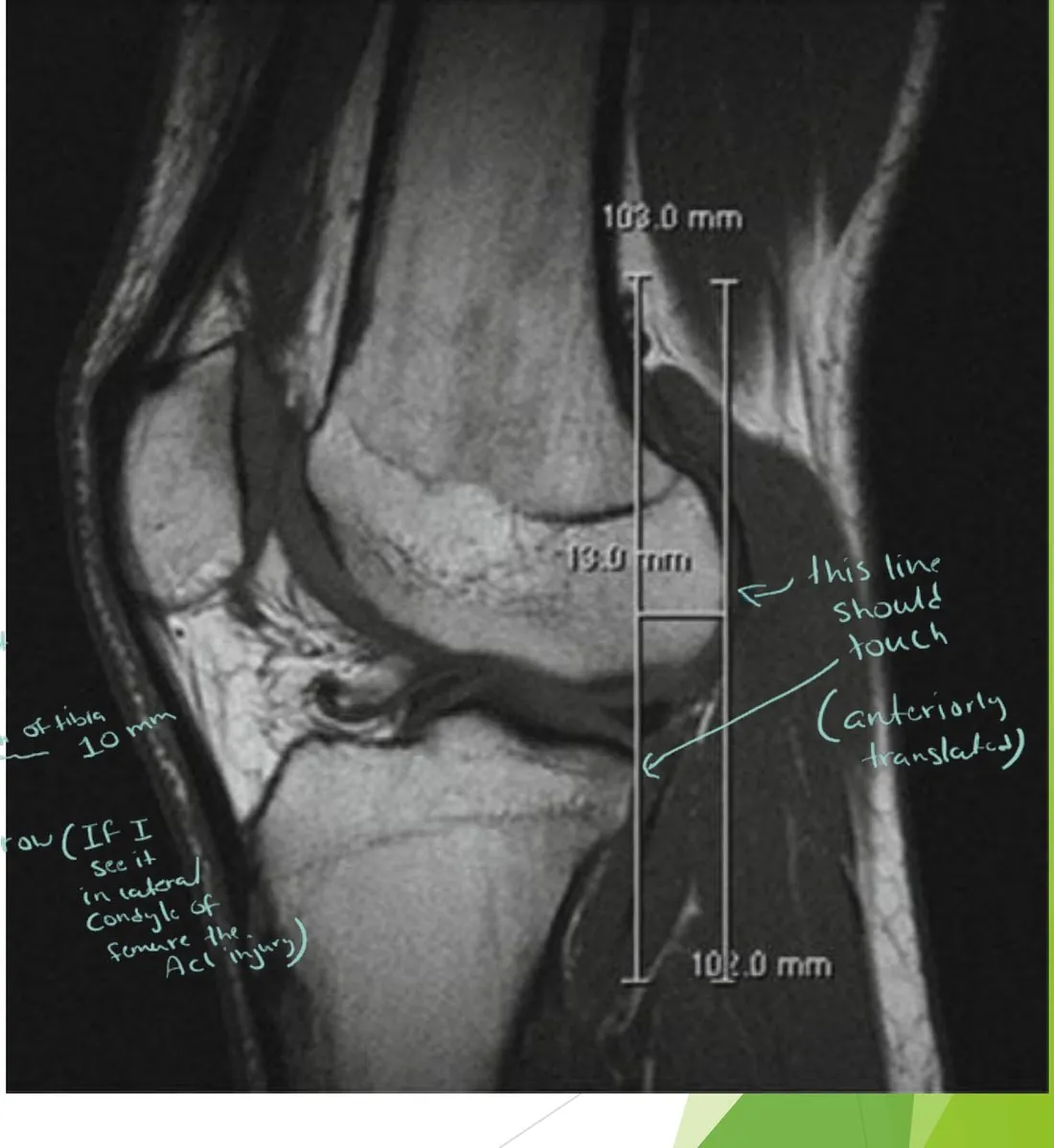
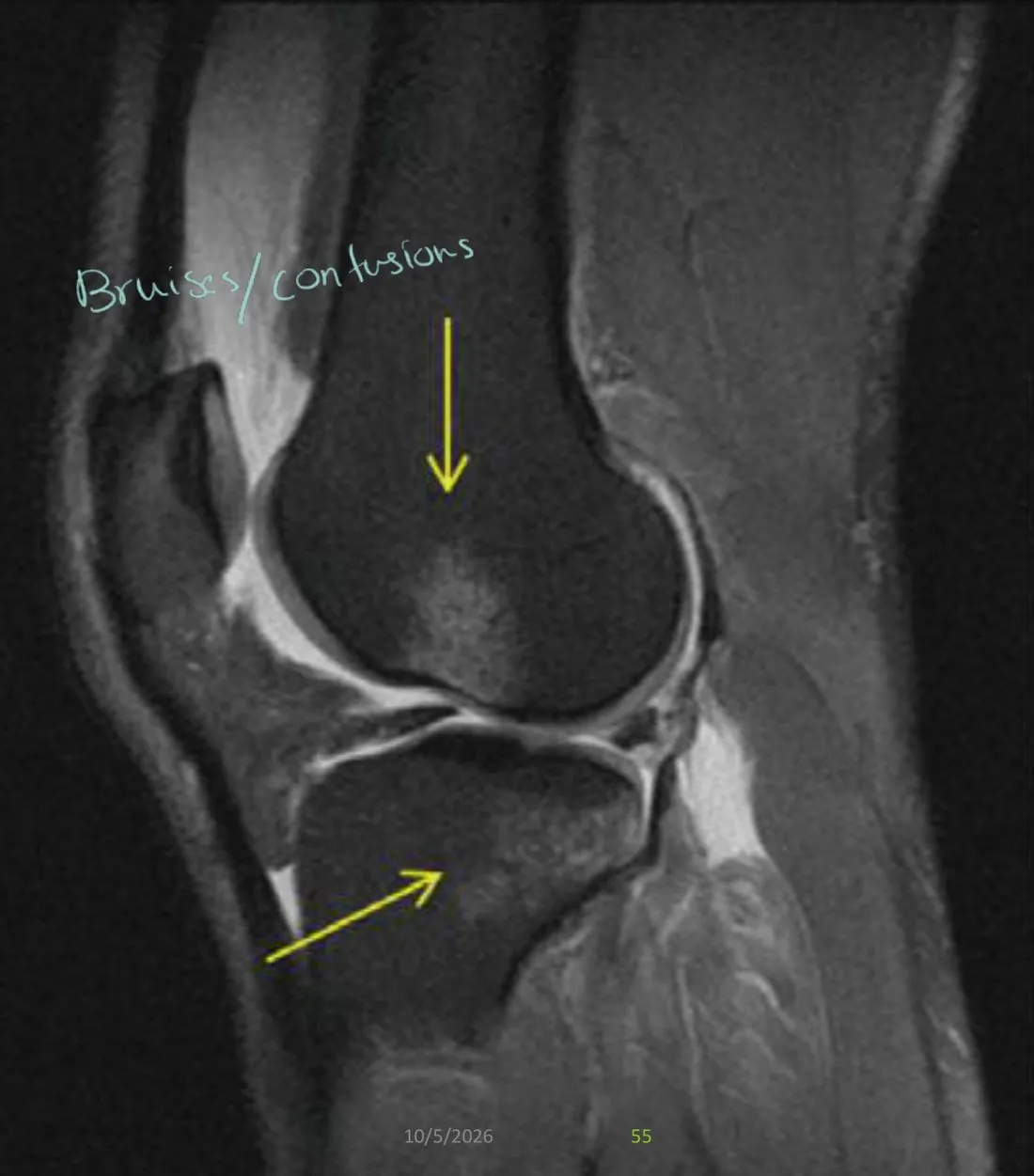
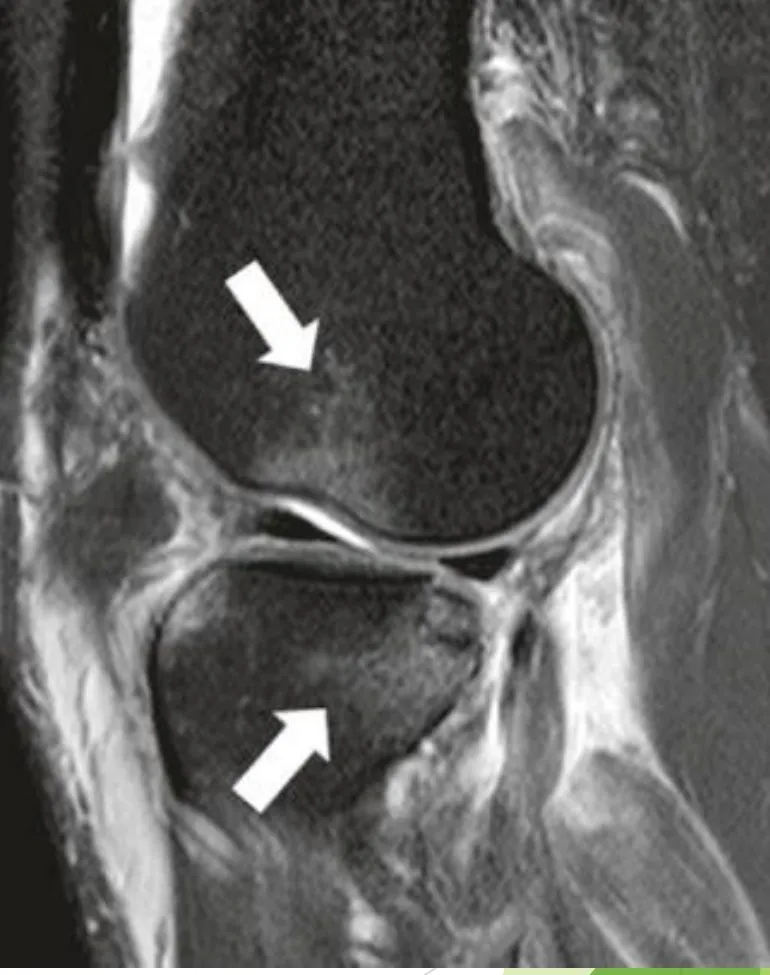
Secondary signs of an acute ACL tear (slides 54–55):
- Anterior tibial translationThe shin bone (tibia) sliding forward relative to the thigh bone (femur).General meaning, not from the slides (10 mm in the example).
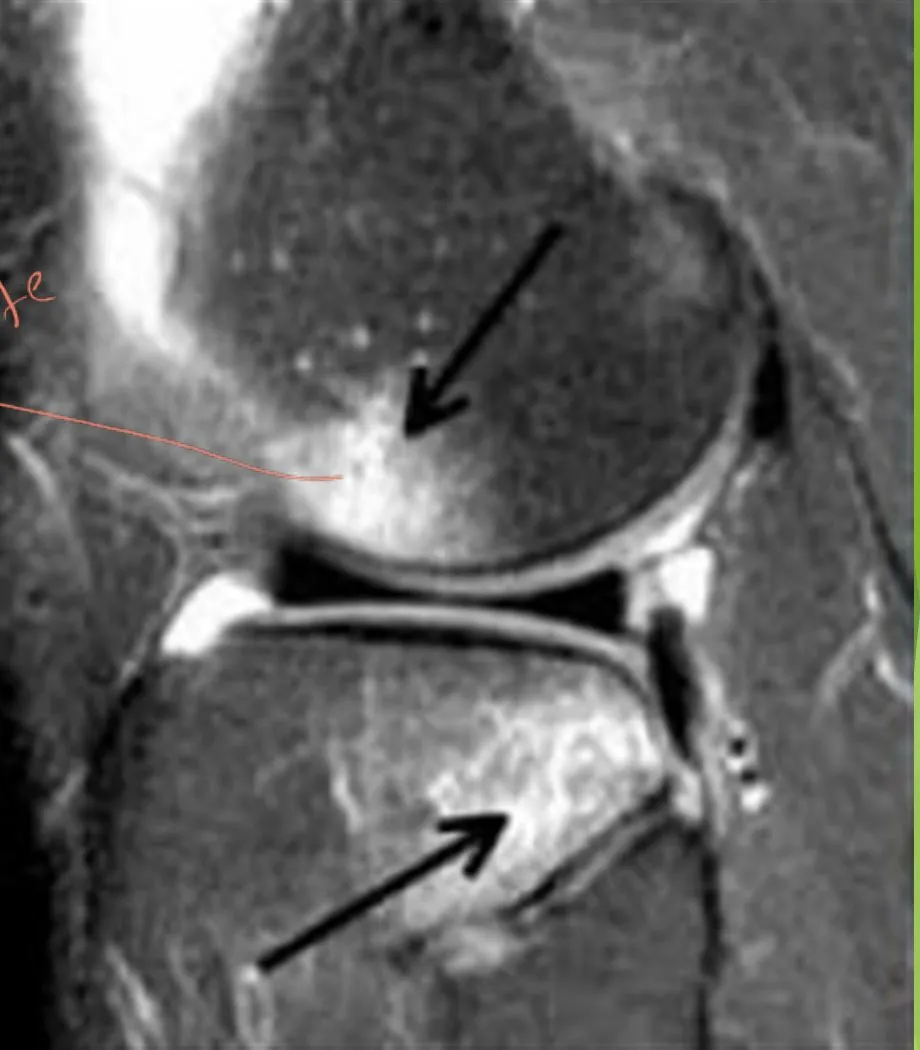
- Femoral and tibial Bone bruiseBleeding and swelling inside a bone without a visible break, often seen on MRI.General meaning, not from the slides (yellow arrows).
Exam sheet (MRI signs):
- Primary MRI sign of ACL rupture: anterior translation of the tibia.
- Secondary MRI signs: bone bruises and Bone marrow edemaExtra fluid in the spongy inner part of a bone, seen on MRI.General meaning, not from the slides.
- A Femoral condyleOne of the two rounded bumps at the lower end of the thigh bone (femur) that sit on top of the shin bone.General meaning, not from the slides bone bruise indicates ACL injury.
Conflict: the slides (54) list anterior translocation of the tibia as a secondary sign; the exam sheet calls it the primary sign. Both are kept. In the question bank the sheet’s answer is keyed and the explanation gives the slide’s version.
Segond fracture
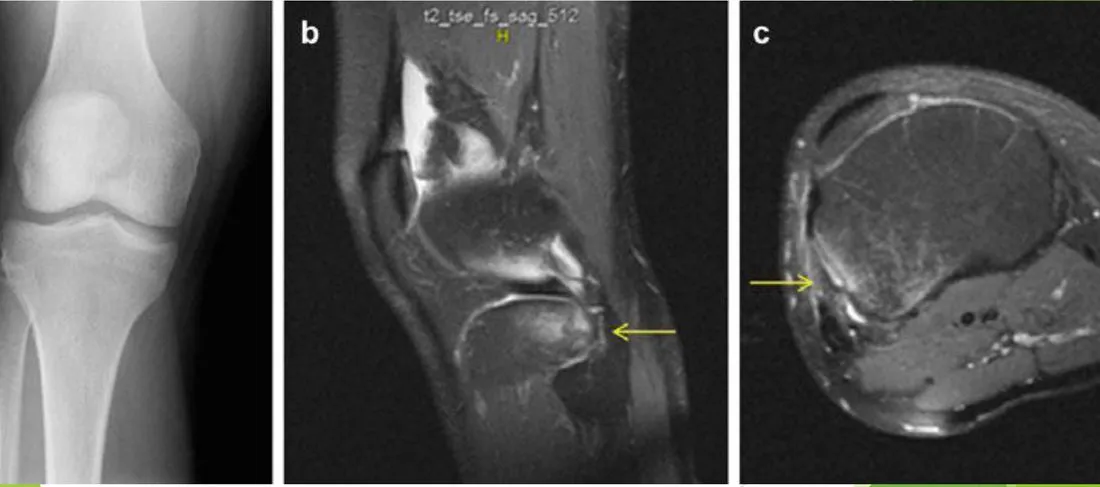
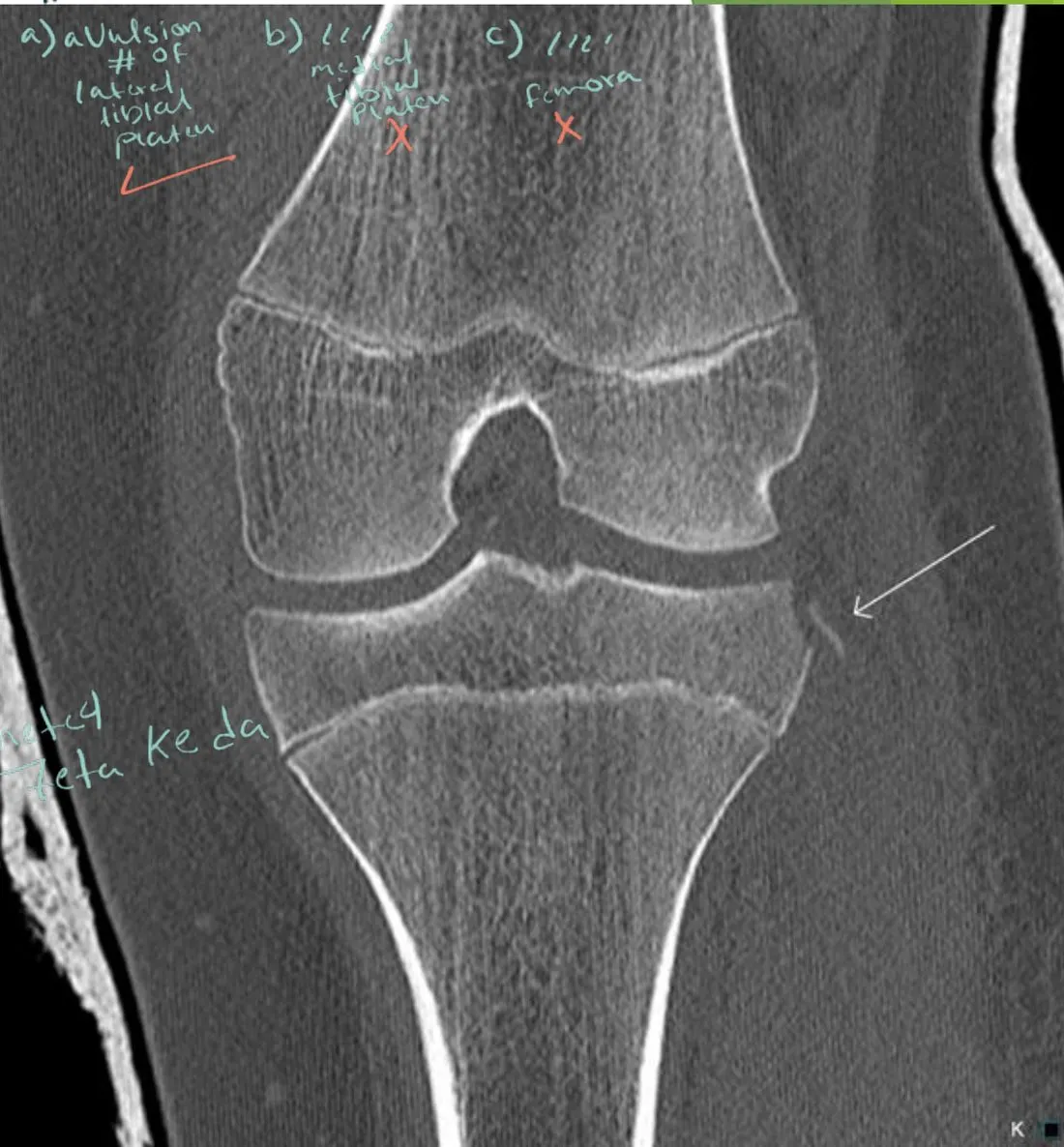
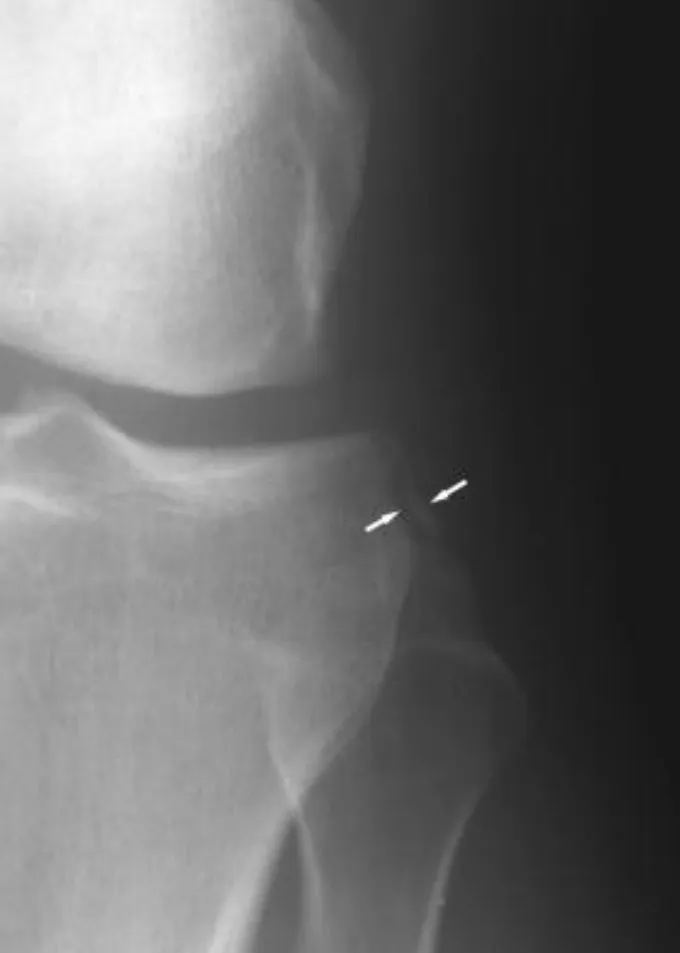
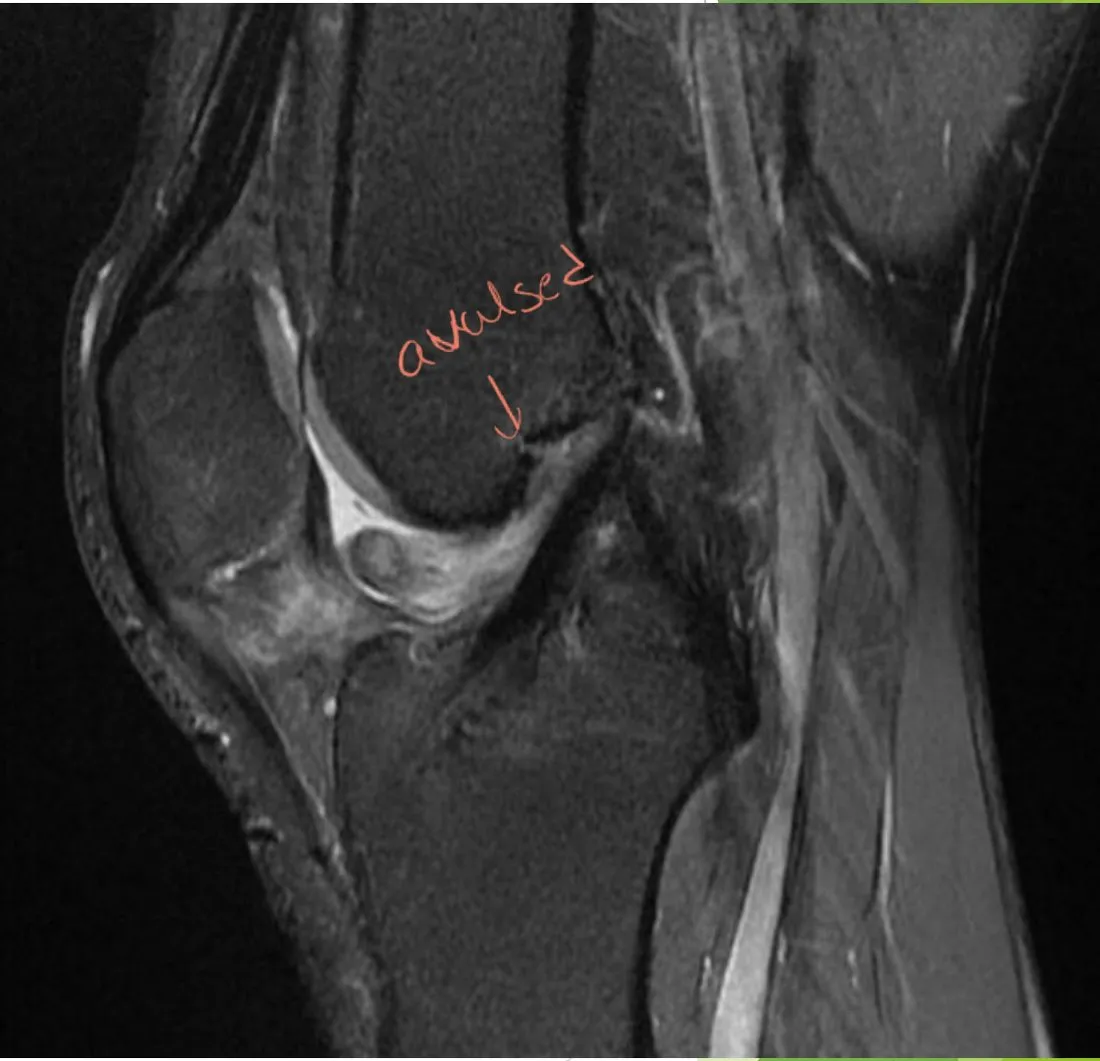
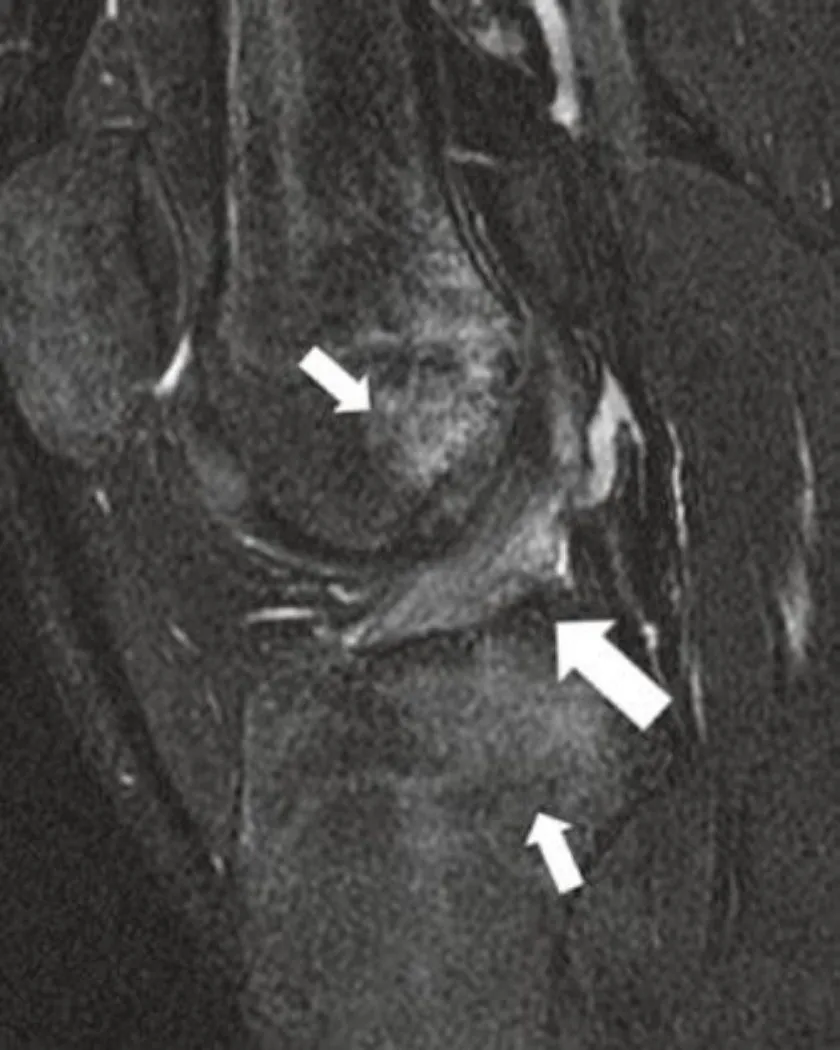
- A Segond fractureA small flake of bone pulled off the outer edge of the top of the shin bone, associated with an ACL tear.General meaning, not from the slides is difficult to identify on radiographs (yellow arrows, a) but better clarified on MRI: PD-weighted and T2-weighted MRITwo types of MRI image setting. Each makes different tissues look brighter or darker.General meaning, not from the slides SagittalA view or plane that divides the body into left and right parts, so the knee is seen from the side.General meaning, not from the slides view (b) and AxialA cross-section view, as if slicing across the body.General meaning, not from the slides view (c).
- A 2017 MRI study of 36 Segond fractures associated with ACL injury showed the fracture fragment is almost always attached to the posterior fibers of the Iliotibial band (ITB)A thick band of tissue running down the outer thigh to the outer shin.General meaning, not from the slides and the Lateral capsuleThe fibrous sleeve that surrounds the outer part of the knee joint.General meaning, not from the slides; the authors were unable to demonstrate attachment to the ALL.
- Exam sheet: a Segond fracture is an Avulsion fractureA fracture where a ligament or tendon pulls a small piece of bone away from the main bone.General meaning, not from the slides of the Tibial plateauThe flat top surface of the shin bone that forms the lower half of the knee joint.General meaning, not from the slides (the structure involved is the lateral tibial plateau).
Types of ACL tear
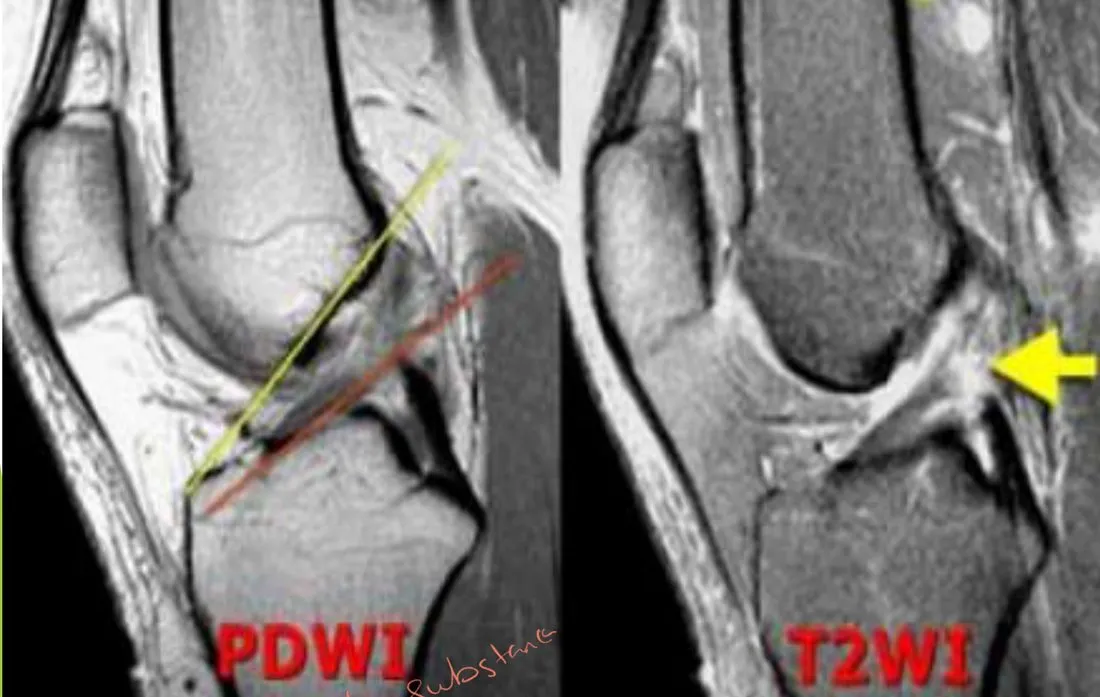
Slide 62 lists three types: intra-substance tear, Thickness (partial and full)Partial: only some of the ligament fibres are torn. Full: the fibres are torn all the way through.General meaning, not from the slides and full thickness tear.
Slides 59–61 are MRI images with no caption (slide 59 is labelled PCLPosterior cruciate ligament: the knee ligament that crosses the ACL inside the joint and stops the shin bone sliding backward.General meaning, not from the slides; slide 61 is labelled F, ACL, PCL and T). Slide 63 shows PDWI and T2WI images and slide 64 repeats the “Normal vs acute tear” picture of slide 58.
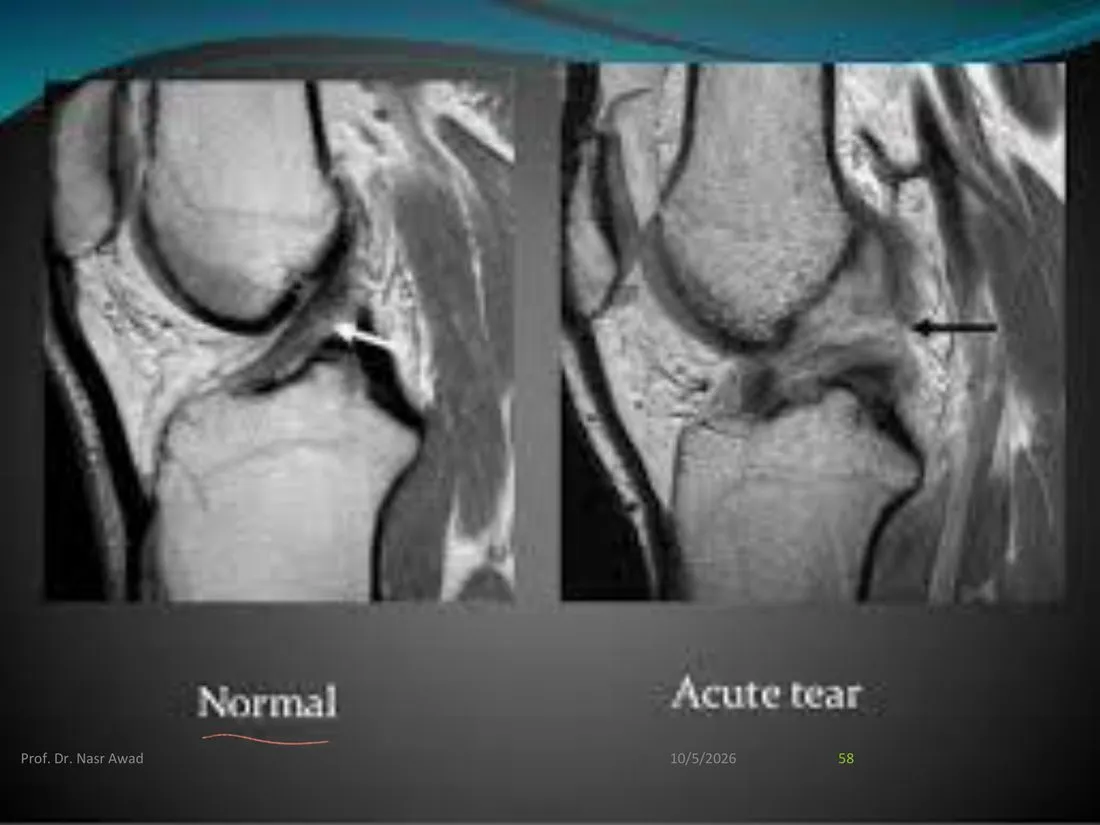
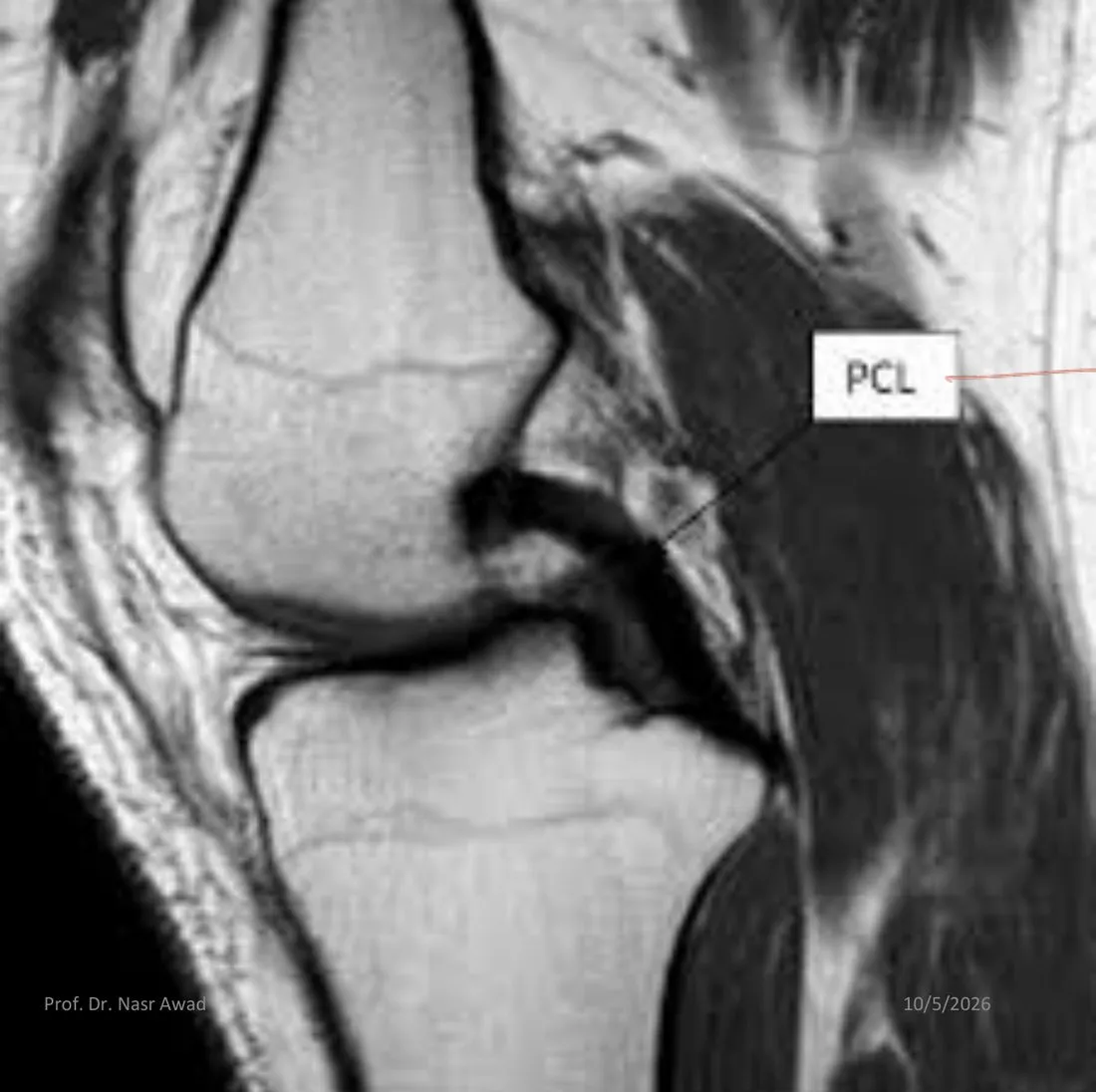
MRI examples (slides 65–77)
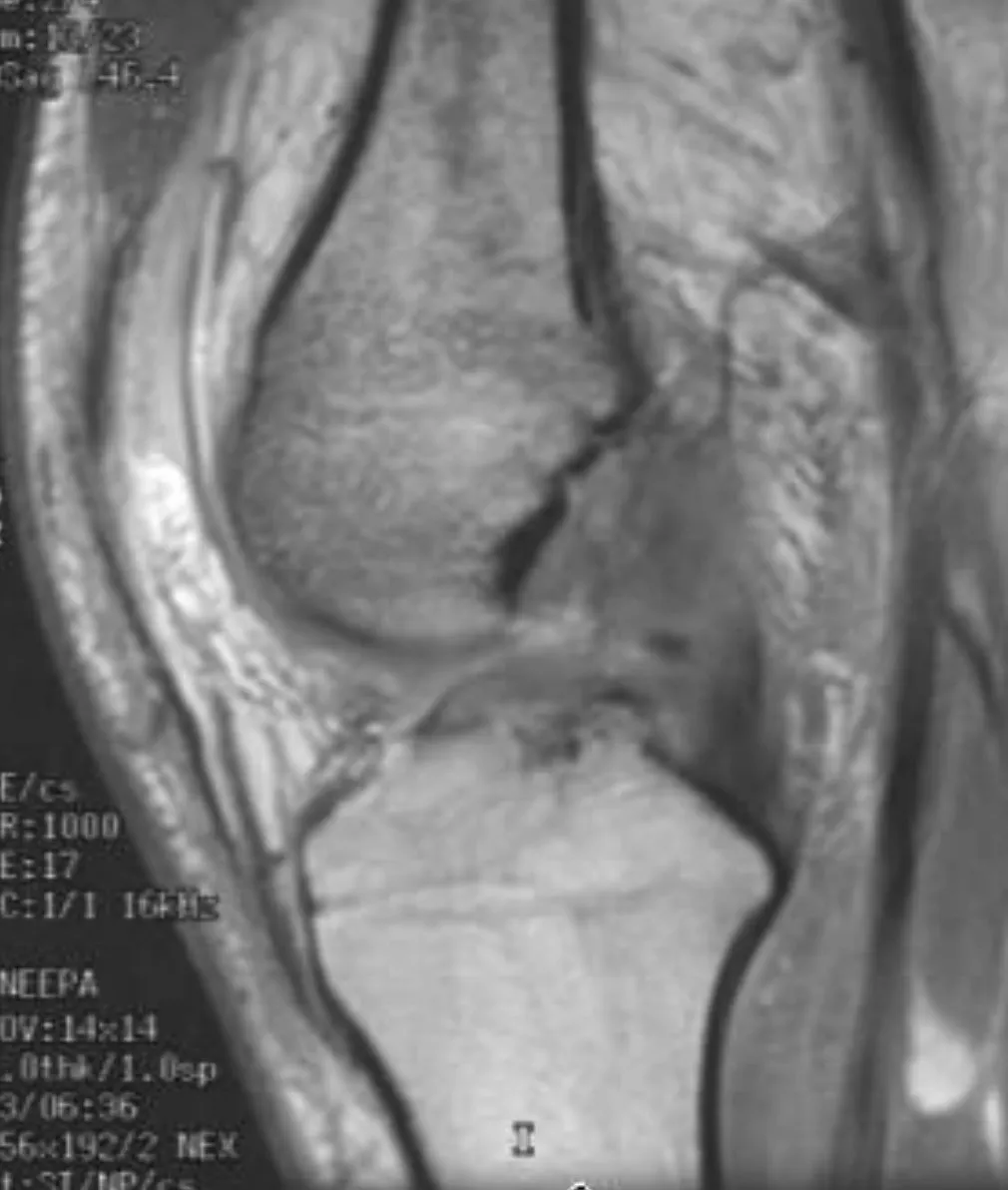
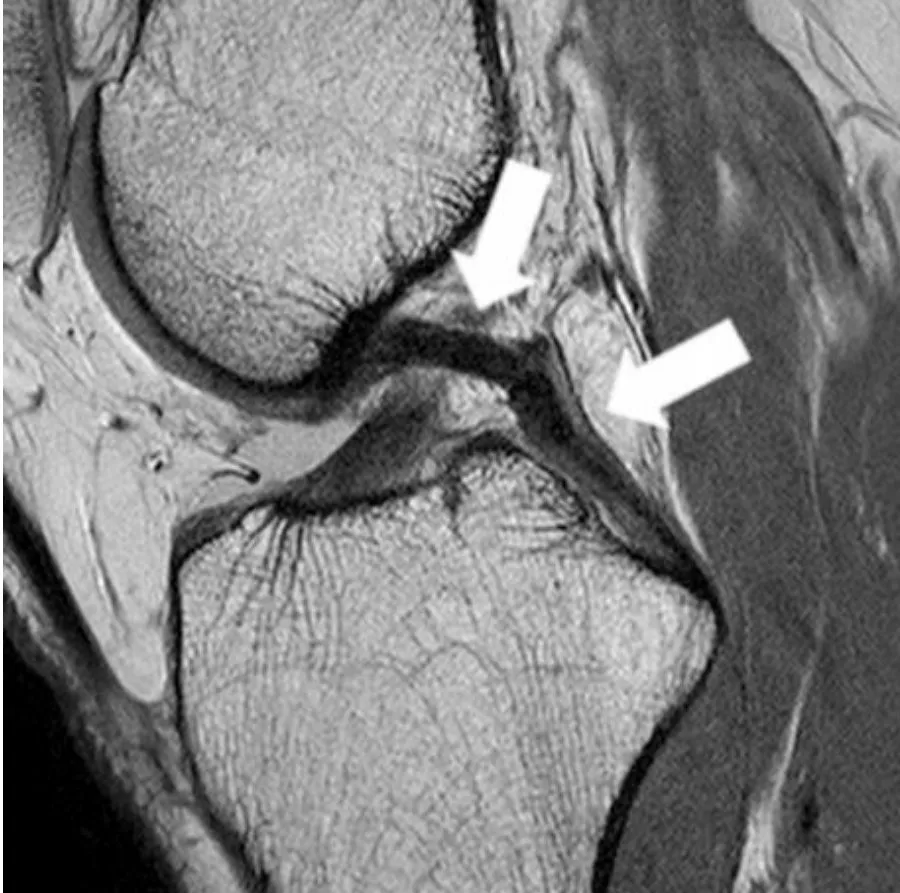
| Slide | Label on the slide |
|---|---|
| 65 | Complete tear ACL |
| 66, 67 | Lateral femoral and tibial contusion (bruises) associated with ACL tear |
| 68 | Segond fracture associated with ACL tear |
| 69 | ACL complete tear |
| 70 | ACL normal |
| 71 | ACL complete tear |
| 72 | Bone marrow edema of … (the title is cut off on the slide) |
| 73, 74 | Partial tear ACL |
| 75 | Partial ACL tear — lateral femoral and tibial bruises |
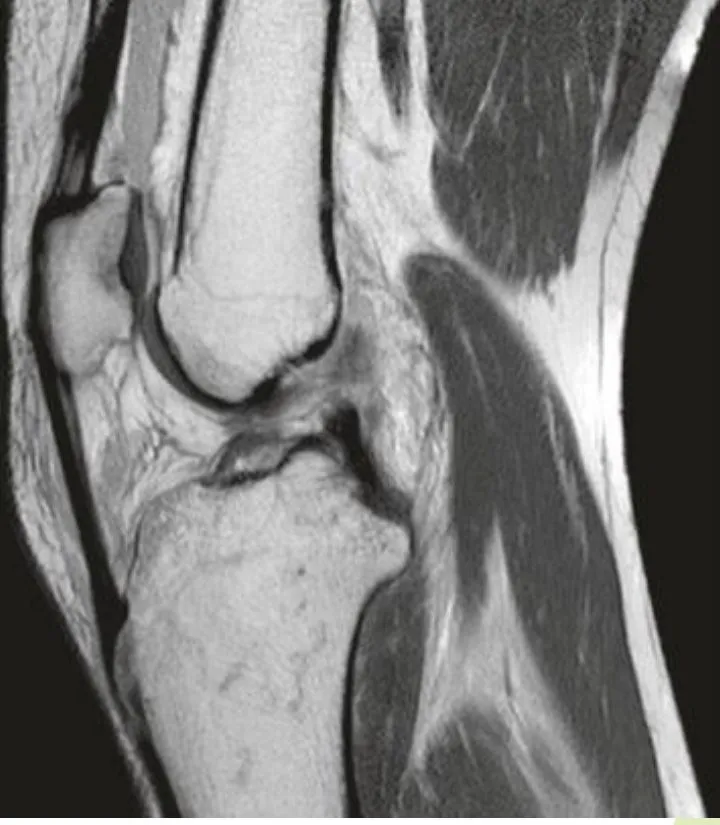
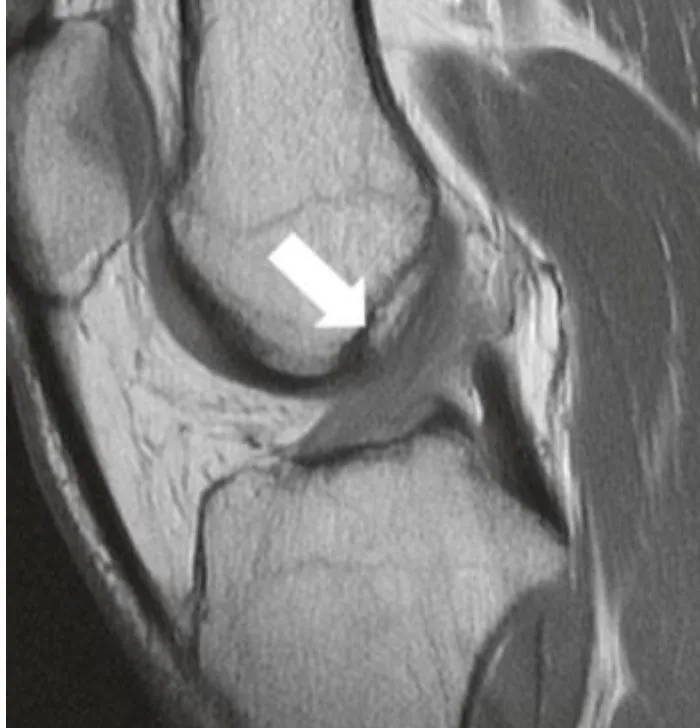
| 76 | Normal PCL (arrow), sagittal PD-weighted MR image |
| 77 | Complete PCL tear (arrow), sagittal PD-weighted MR image |
Treatment options and grafts
Choosing the treatment
- Treatment options for ACLAnterior cruciate ligament: a strong band inside the knee that stops the shin bone (tibia) sliding forward under the thigh bone (femur).General meaning, not from the slides injuries depend on age of the patient, activity level and intensity, and degree of InstabilityA sign or feeling that the joint moves abnormally or gives way.General meaning, not from the slides. Exam sheet: the factors determining the treatment choice are age, activity and degree of instability.
- Treatment choices:
- Give up or modify sport activities
- Brace and ArthroscopyLooking inside, or operating on, a joint through small cuts using a camera.General meaning, not from the slides MeniscectomySurgery to remove part or all of a torn meniscus.General meaning, not from the slides
- Anterior cruciate ligament reconstruction
When to operate (ACL reconstruction)
- Reduction of swelling.
- Full ROMRange of motion: how far a joint can move.General meaning, not from the slides is a must.
- Powerful muscle strength.
- Exam sheet: criteria before ACL reconstruction: no or minimal EdemaSwelling caused by extra fluid in the tissues.General meaning, not from the slides, full range of motion, and good QuadricepsThe large muscle group on the front of the thigh that straightens the knee.General meaning, not from the slides strength compared with the other side.
- Exam sheet: recommended PREProgressive resistive exercise: strengthening with gradually increasing resistance.General meaning, not from the slides-operative rehabilitation for a complete ACL tear is at least 6 weeks; some papers recommend 8 weeks.
COPPERS criteria (Eastlack et al)
The slide spells the term COPPERSThe slide’s name for a set of four criteria (Eastlack et al): an isolated ACL tear, pain-free full ROM with no effusion, at least 70% MVIC, and pain-free single-leg hopping.. Eastlack et al developed these criteria:
- An isolated tear of the ACL (no repairable MeniscusThe C-shaped cartilage cushion between the thigh bone and the shin bone.General meaning, not from the slides injury and no other ConcomitantHappening or done at the same time as something else.General meaning, not from the slides ligamentous damage).
- Full pain-free knee ROM, and no knee joint EffusionExcess fluid inside the joint, seen as a swollen knee. The protocol grades it as zero, trace, 1+, 2+ and higher.General meaning, not from the slides.
- At least 70% of the MVICMaximum voluntary isometric contraction: the hardest a muscle can contract without the joint moving. value of the Uninvolved limbUninvolved: the healthy, uninjured leg used as the comparison. Involved: the injured or operated leg.General meaning, not from the slides knee.
- Once this milestone is achieved, the patient must be able to tolerate single-leg Hop testingJumping on one leg and comparing the result with the other leg to check function.General meaning, not from the slides on the involved leg without pain.
Physiotherapy for a partial ACL tear (exam sheet)
- The first exercise for a partial ACL tear is the Mini-squatA shallow squat that bends the knees only a little.General meaning, not from the slides.
- Deep squat should be avoided initially; mini-squat is preferred.
- CKCClosed kinetic chain: exercise with the foot fixed on the floor or a surface, such as a squat.General meaning, not from the slides exercise is preferred initially.
Graft choice (slides 83–90)
- SemitendinosusOne of the hamstring muscles at the back of the thigh. Its tendon can be used as an ACL graft.General meaning, not from the slides or PatellaThe kneecap.General meaning, not from the slides GraftTissue used to replace the torn ligament.General meaning, not from the slides.
- The most common graft used in the sports clinic is the HamstringsThe muscle group on the back of the thigh that bends the knee.General meaning, not from the slides graft.
- The Patellar tendonThe tendon that joins the kneecap (patella) to the shin bone.General meaning, not from the slides graft is used for the athlete who wants to return to sports quickly, for example at three months. The earlier return to activities is based on the faster Bone-to-bone healingHealing of a graft’s bone block into the surrounding bone.General meaning, not from the slides of the patellar tendon graft compared with the Tendon-to-bone healingHealing of a tendon graft directly into bone.General meaning, not from the slides of the hamstring graft. The hamstring graft may take as long as three months to heal.
- Timed hop test score of 80% of the uninjured limb [male: 1.7 seconds, female: 2.25 seconds] (slide 84; the slide gives no context for the test).
The “three months” on slide 83 is about graft healing and earlier return to activities. The return-to-sport timeline on slides 95 and 139 is 9–12 months / at least 9 months (see rehabilitation). Both are kept.
| BPTBBone–patellar tendon–bone graft: the patient’s own patellar tendon taken with a small piece of bone at each end.General meaning, not from the slides (BPTB) AutograftA graft taken from the patient’s own body.General meaning, not from the slides | Hamstring graft | |
|---|---|---|
| Standing | “Gold standard” for ACL reconstruction: biomechanically compatible with the ACL, LigamentizationThe process by which a graft gradually remodels to behave like a real ligament.General meaning, not from the slides, very strong, rare tear | Most common graft used in the sports clinic |
| Advantages | — | Less Patellofemoral crepitanceGrinding or crunching felt or heard between the kneecap and the thigh bone when the knee moves.General meaning, not from the slides, less anterior knee pain, less ExtensionStraightening a joint.General meaning, not from the slides loss |
| Cons | Difficulty with kneeling, anterior knee pain, patellar fracture | Difficulty in FlexionBending a joint.General meaning, not from the slides, elongation, Tunnel wideningEnlargement of the drilled bone tunnels that hold the graft.General meaning, not from the slides |
| Other | — | The graft may be an AllograftA graft taken from a donor.General meaning, not from the slides or autograft. The operation may be single- or double-bundle, even quad-bundle reconstruction |
- Exam sheet: the muscle commonly harvested for the graft is the semitendinosus. Two strips are harvested and prepared as a Double-strand graftA graft made from two strands.General meaning, not from the slides.
- Exam sheet: the two graft fixation methods are Interference screwA small screw pushed into the bone tunnel beside the graft to hold it in place.General meaning, not from the slides fixation and Suspensory fixationHolding the graft with a button or loop fixed on the outside of the bone, so the graft hangs from it.General meaning, not from the slides.
Surgical indications (slide 91)
- A young competitive pivotal athlete who wants to return to sports.
- Failure of a non-operative program, with persistent pain, swelling and Giving wayA sudden feeling that the knee is about to buckle.General meaning, not from the slides.
- A desire to increase the level of athletic activity without the use of a brace.
- A repairable meniscal tear in a young athlete.
- Meniscus repair has a high failure rate unless the knee is stabilized with an ACL reconstruction.
Rehabilitation overview and pre-operative phase
Protocol at a glance
| Phase | Time | Goals | Milestones |
|---|---|---|---|
| PREProgressive resistive exercise: strengthening with gradually increasing resistance.General meaning, not from the slides-operative | As soon as possible after injury | See below | See below |
| Immediate post-op | Week 1 | ≥ 0° ExtensionStraightening a joint.General meaning, not from the slides; improve QuadricepsThe large muscle group on the front of the thigh that straightens the knee.General meaning, not from the slides activation; ↓ EffusionExcess fluid inside the joint, seen as a swollen knee. The protocol grades it as zero, trace, 1+, 2+ and higher.General meaning, not from the slides; ↓ pain; crutch gait | ROMRange of motion: how far a joint can move.General meaning, not from the slides 0–90°; active quad contraction with superior Patellar glideSliding movement of the kneecap.General meaning, not from the slides; walking on crutches |
| Early post-op | Weeks 2–3 | Continue impairment resolution; normalize gait; SLRStraight leg raise: lifting the straightened leg off the bed while lying on the back.General meaning, not from the slides without a Extension lagBeing unable to straighten the knee fully by your own muscle power, although it can be straightened by hand.General meaning, not from the slides | ROM 0–115°; walk without crutches or Knee immobilizerA brace that keeps the knee straight and still.General meaning, not from the slides; KOS-ADLKnee outcome score, activity of daily living subscale: a score of how well the knee copes with everyday activities. ≥ 65%; effusion < 2+ |
| Intermediate post-op | Weeks 4–6 | Complete impairment resolution; progressive quad strengthening; full ROM; resume ADLActivities of daily living: everyday tasks such as walking, climbing stairs and dressing.General meaning, not from the slides | FlexionBending a joint.General meaning, not from the slides within 10° of Uninvolved limbUninvolved: the healthy, uninjured leg used as the comparison. Involved: the injured or operated leg.General meaning, not from the slides; quad MVICMaximum voluntary isometric contraction: the hardest a muscle can contract without the joint moving. ≥ 60%; effusion ≤ 1+; normal gait; Reciprocal stair climbingGoing up or down stairs one foot per step, alternating legs.General meaning, not from the slides |
| Late post-op | Weeks 7–9 | Improve load tolerance, aerobic conditioning, variability, ADL function | Full symmetrical ROM; quad ≥ 70%; effusion ≤ 1+; normal gait; KOS-ADLS ≥ 70% |
| Transitional I | Weeks 10–12 | Start gym-based / supervised training | Full pain-free ROM; quad ≥ 75%; effusion ≤ 1+; KOS-ADLS ≥ 80% |
| Transitional II | Weeks 13–16 | Initiate running | Quad ≥ 80%; effusion ≤ trace; no pain/swelling with running |
| Transitional III | Months 4–6 | Sprint progressionA staged build-up of running speed toward full sprinting.General meaning, not from the slides, AgilityThe ability to change direction quickly and under control.General meaning, not from the slides, jumping, Secondary preventionMeasures to prevent a second injury after the first one has happened.General meaning, not from the slides | Quad ≥ 85%; Hop testingJumping on one leg and comparing the result with the other leg to check function.General meaning, not from the slides ≥ 85%; KOS-ADLS ≥ 85%; ACL-RSIACL return to sport after injury scale. > 60% (at 6 months) |
| Transitional IV | Months 6–9 | Sport-specific skills; pre-injury conditioning | Quad ≥ 90–100%; hop ≥ 90%; KOS-ADLS ≥ 90%; ACL-RSI ≥ 70% |
| RTSReturn to sport.General meaning, not from the slides (V) | Months 9–12 | Sport-specific skills; confidence with opponents | ≥ 9 months post-op (AllograftA graft taken from a donor.General meaning, not from the slides 12+); quad ≥ 90% (level 1 athletes ≥ 100%); hop ≥ 90%; KOS-ADLS ≥ 90% |
Slide 124’s title says “Immediate-post-operative (week 4-6)”, but the table on that slide is headed “Intermediate Post-Operative Phase (week 4-6)”. The notes use Intermediate.
Pre-operative rehabilitation (slides 93–95)
Phase goals: begin as soon as possible after the initial injury and re-establish the following before surgery:
- Full active (AROMActive range of motion: movement the patient produces with their own muscles.General meaning, not from the slides) and passive (PROMPassive range of motion: movement produced by someone else or a machine.General meaning, not from the slides) knee extension.
- Knee flexion ROM within 10° of the uninvolved limb.
- Trace to zero knee effusion.
- No knee extension lag with straight leg raise (SLR).
- QIQuadriceps Strength Index: quadriceps strength of the involved limb compared with the uninvolved limb. (QI) ≥ 80% of the uninvolved limb.
- Retain these values for post-operative comparison to minimize overestimation of strength.
Patient education:
- Importance of PrehabRehabilitation done before surgery to prepare the knee.General meaning, not from the slides for optimal post-operative outcomes.
- What to do immediately after surgery (0–48 hours).
- Anticipated return-to-sport timeline: 9–12 months; allografts 12+ months.
- Expected outcomes.
- Return to the prior level of competition is often difficult, but possible.
- Osteoarthritis risk.
Exam sheet:
- Pre-operative rehabilitation for a complete tear: at least 6 weeks; some papers recommend 8 weeks.
- The criterion-based time for return to sport after reconstruction is approximately 9 months or more, based on maturation and return-to-sport criteria.
Abbreviations used in the protocol (slide 141)
| Abbreviation | Meaning |
|---|---|
| LAQLong arc quadriceps: a knee-extension exercise through the long range from 90° to 0°. | long arc quadriceps |
| MVIC | maximum voluntary isometric contraction |
| WBATWeight bearing as tolerated. | weight bearing as tolerated |
| NMESNeuromuscular electrical stimulation: using electrical current to make a muscle contract. | neuromuscular electrical stimulation |
| KOS-ADL | knee outcome score, activity of daily living subscale |
| PRNLatin “pro re nata”: as needed. | Latin “pro re nata” = “as needed” |
| BFRBlood flow restriction: strength training with a cuff that partly limits blood flow to the limb, so light loads can be used.General meaning, not from the slides | blood flow restriction |
| FESFunctional electrical stimulation: electrical stimulation used to help a muscle work during a movement. | functional electrical stimulation |
| ATCAthletic training certified. | athletic training certified |
| Romanian deadlift (RDL)Romanian deadlift: a hip-hinge lift performed with nearly straight knees. | Romanian deadlift |
| ACL RSI | ACLAnterior cruciate ligament: a strong band inside the knee that stops the shin bone (tibia) sliding forward under the thigh bone (femur).General meaning, not from the slides return to sport after injury scale |
| IKDCInternational Knee Documentation Committee. | International Knee Documentation Committee |
| CPGClinical practice guidelines. | clinical practice guidelines |
| RM (repetition maximum)Repetition maximum: the heaviest load that can be lifted for the stated number of repetitions (1-RM = one, 5-RM = five).General meaning, not from the slides | repetition maximum |
| OATSOsteochondral autograft transfer system: a cartilage-repair operation. | osteochondral autograft transfer system |
| MACIMatrix-induced autologous chondrocyte implantation: a cartilage-repair operation. | matrix-induced autologous chondrocyte implantation |
| ACIAutologous chondrocyte implantation: a cartilage-repair operation. | autologous chondrocyte implantation |
Early post-operative rehabilitation (weeks 1–6)
Immediate post-operative (week 1)
| Immediate post-operative phase (week 1) | |
|---|---|
| Phase goals | At least 0° knee ExtensionStraightening a joint.General meaning, not from the slides ROMRange of motion: how far a joint can move.General meaning, not from the slides; improve QuadricepsThe large muscle group on the front of the thigh that straightens the knee.General meaning, not from the slides activation; decrease knee joint EffusionExcess fluid inside the joint, seen as a swollen knee. The protocol grades it as zero, trace, 1+, 2+ and higher.General meaning, not from the slides; decrease pain; gait retraining on crutches |
| Milestones | ROM = 0–90°; active quad contraction with superior Patellar glideSliding movement of the kneecap.General meaning, not from the slides; walking on crutches with superior patellar glide |
| Visits and frequency | Total visits 1–2; PTPhysical therapy, or physical therapist.General meaning, not from the slides 1–2× per week; HEPHome exercise program.General meaning, not from the slides 4–6× per day |
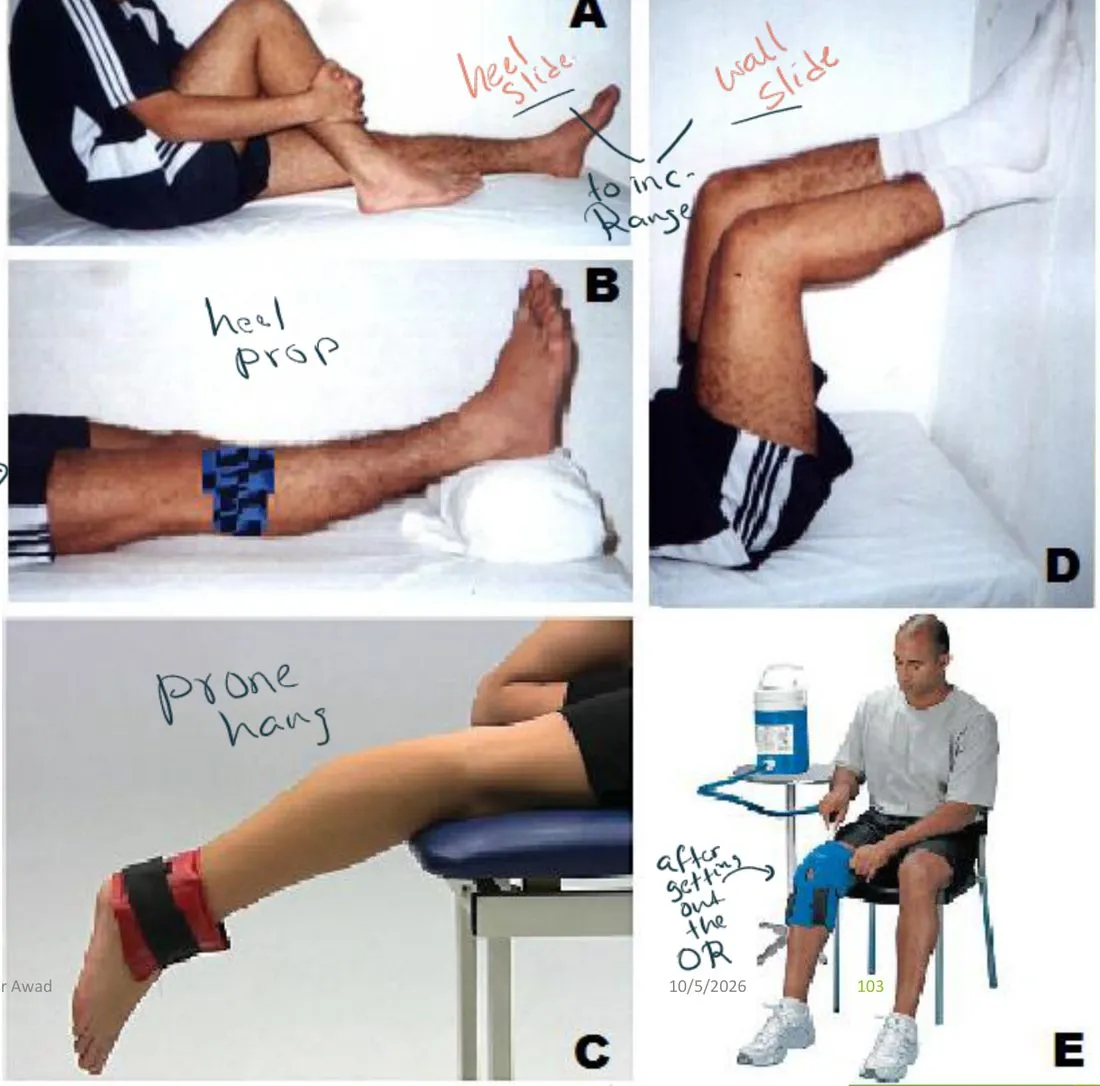
| ROM | FlexionBending a joint.General meaning, not from the slides 0–90°: Wall slidesLying on the back with the foot on a wall and letting it slide down to bend the knee.General meaning, not from the slides, Heel slidesSliding the heel toward the buttock along the bed to bend the knee.General meaning, not from the slides with strap, stationary bike. Extension: Heel propResting the heel on a block or rolled towel so gravity gently straightens the knee.General meaning, not from the slides, extension overpressure |
| Muscle performance | Quad setTightening the thigh muscle while the leg rests straight, without moving the knee.General meaning, not from the slides, long arc quad 90–0° (LAQLong arc quadriceps: a knee-extension exercise through the long range from 90° to 0°.), standing and prone TKETerminal knee extension: straightening the last few degrees of the knee.General meaning, not from the slides (TKEs), SLRStraight leg raise: lifting the straightened leg off the bed while lying on the back.General meaning, not from the slides (SLR), ankle pumps. Optional: low-intensity BFRBlood flow restriction: strength training with a cuff that partly limits blood flow to the limb, so light loads can be used.General meaning, not from the slides (BFR) strength training for patients limited by pain or poor load tolerance |
| Manual therapy | Patellar mobilizationGentle hand movement of the kneecap to keep it gliding freely.General meaning, not from the slides, flexion/extension PROMPassive range of motion: movement produced by someone else or a machine.General meaning, not from the slides |
| Electric stimulationUsing electrical current on a muscle (e-stim).General meaning, not from the slides | NMESNeuromuscular electrical stimulation: using electrical current to make a muscle contract. dosed at ≥ 50% of IsometricA muscle contraction without movement at the joint.General meaning, not from the slides MVICMaximum voluntary isometric contraction: the hardest a muscle can contract without the joint moving. (appendix 5) |
| Gait training | WBATWeight bearing as tolerated. on crutches with active quadriceps contraction |
| Modalities | Ice, elevation and compression (for example sleeve, compression wrap or donut wrap) |
Slide 96 repeats only the goals and milestones part of this table (slide 97 has the full table). Further week-1 points from slide 120:
- Avoid unnecessary weight bearing throughout the day to minimize effusion and pain. Elevate the knee above heart level and ice as often as possible.
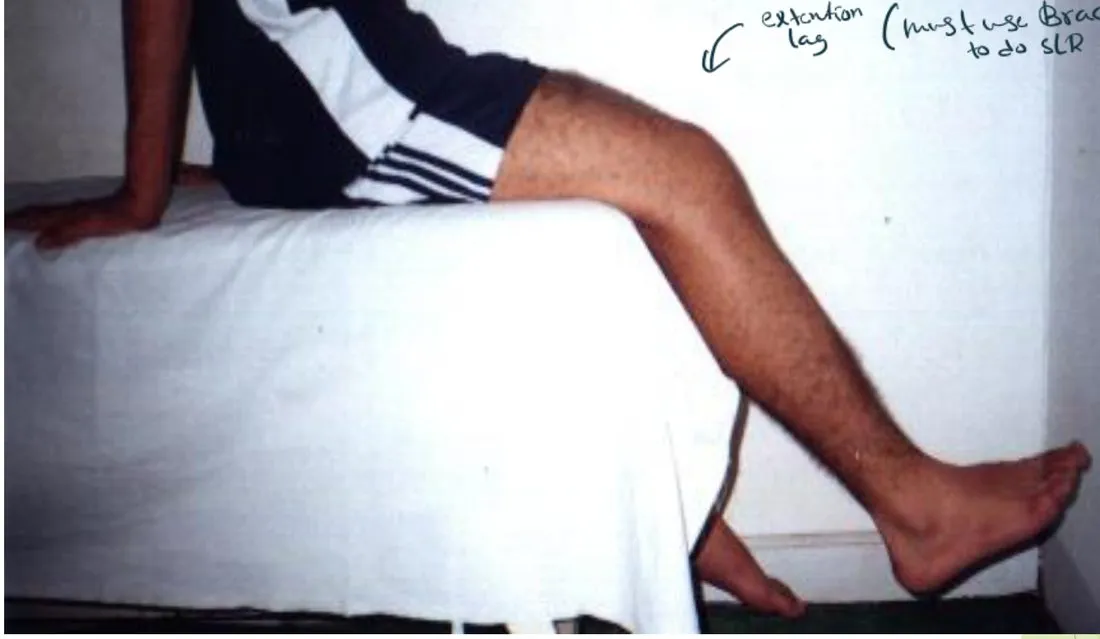
- Criteria to discontinue the brace / Knee immobilizerA brace that keeps the knee straight and still.General meaning, not from the slides (if used): SLR without Extension lagBeing unable to straighten the knee fully by your own muscle power, although it can be straightened by hand.General meaning, not from the slides, no increased pain or effusion with weight bearing, and visible quad activation while ambulating in clinic. Crutches should be used as needed to normalize the gait pattern and help reduce knee effusion.
- Quadriceps MVIC strength testing: isometric testing performed once the patient can assume the test position (45–90° knee flexion) without pain. Use it to dose NMES for quad strengthening at each visit.
- Home exercise program (HEP): quad sets 5–10 sets of 100 × 5–10” per day; SLR (assisted as needed) 3 × 10; LAQ (90–0°) 30 × 5”; heel slides / seated assisted knee flexion / wall slides 30 × 5”; heel prop with ice 5 × 10 minutes per day; self-mobilization of the patella 20 × 5” each direction.
Exercises shown in the week-1 slides (99–119):
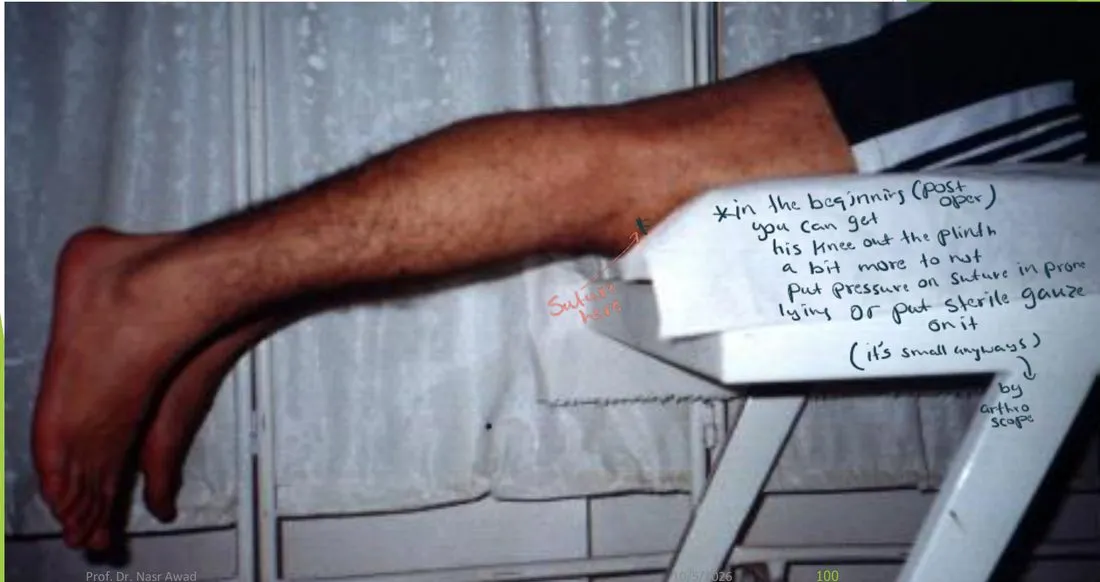
Passive knee extension and weight shifting (slides 99–101)
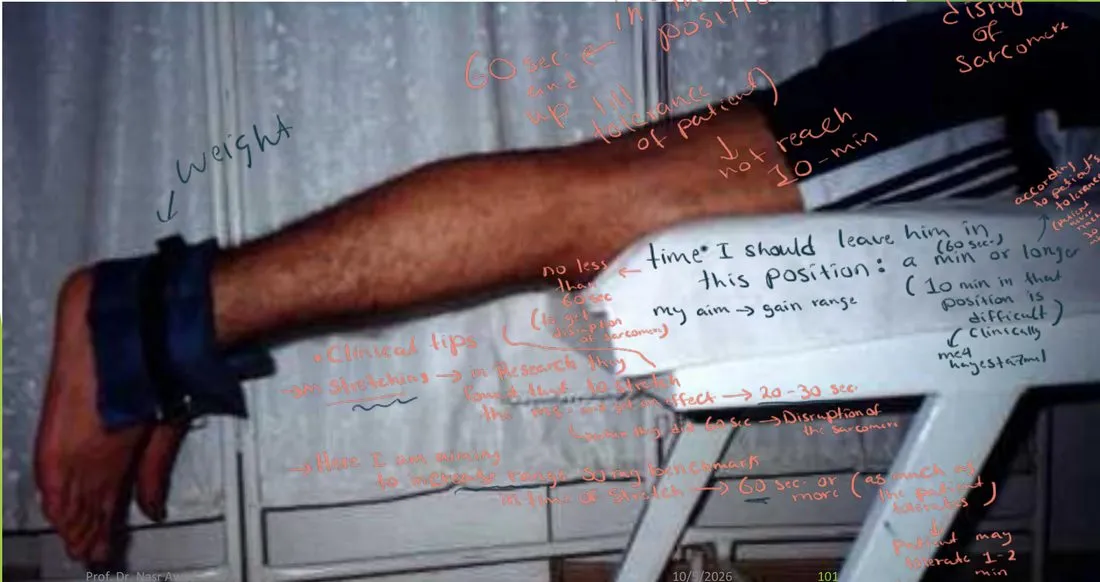
- Prone hangLying face down with the lower legs hanging off the bed so the knee straightens passively.General meaning, not from the slides or heel propped in supine for passive knee extension.
- Weight shifting in standing for weight-bearing tolerance (anteroposterior and side to side).
CPMContinuous passive motion: a machine that bends and straightens the knee for the patient.General meaning, not from the slides, gait training and CryotherapyTreatment with cold, such as ice.General meaning, not from the slides (slides 102–103)
- Continuous passive motion (CPM): 6 hours/day, increasing 5–10 degrees/day.
- Gait training with crutches and brace, level ground and stairs.
- Cryotherapy to reduce … (the slide text is cut off at the bottom edge).
Full knee extension and stretching (slides 104–108)
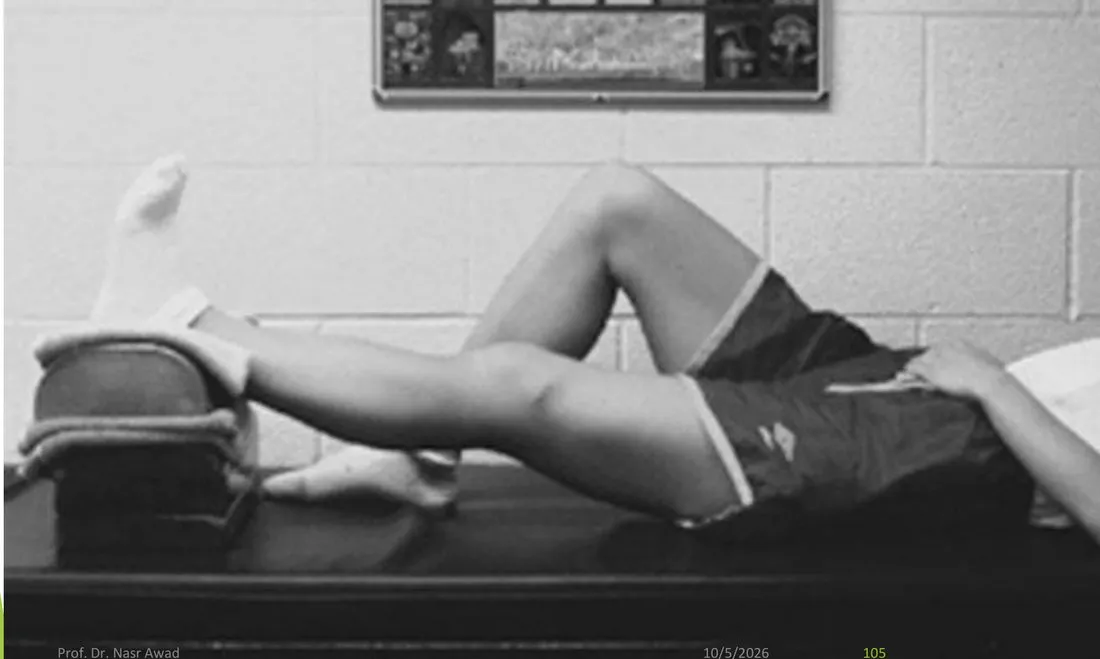
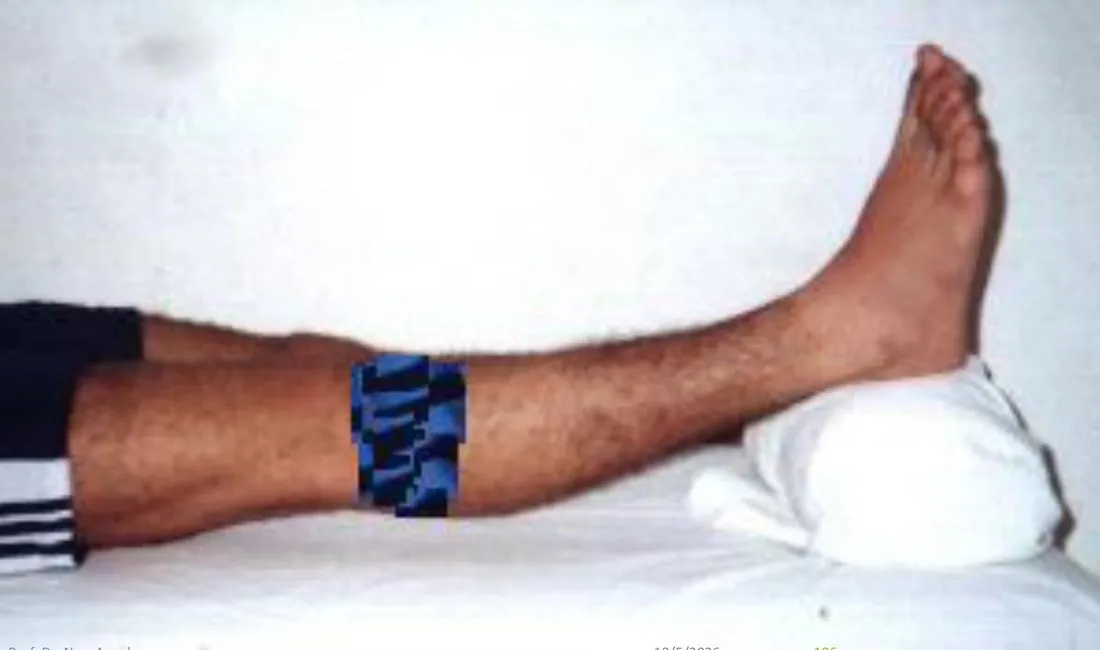
- Full knee extension is achieved by the heel on a block (heel prop, slide 105; heel prop exercise, slide 106).
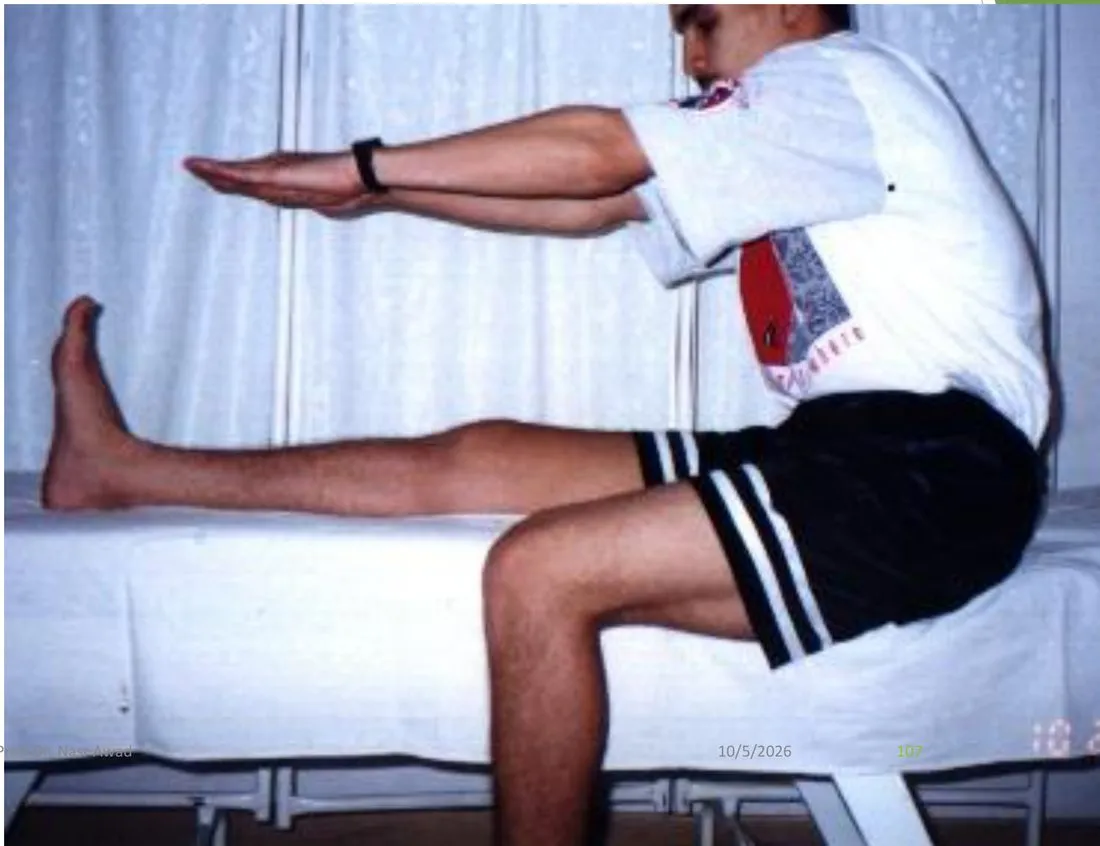
- HamstringsThe muscle group on the back of the thigh that bends the knee.General meaning, not from the slides stretching — very gentle in case of a SemitendinosusOne of the hamstring muscles at the back of the thigh. Its tendon can be used as an ACL graft.General meaning, not from the slides GraftTissue used to replace the torn ligament.General meaning, not from the slides (slide 107).
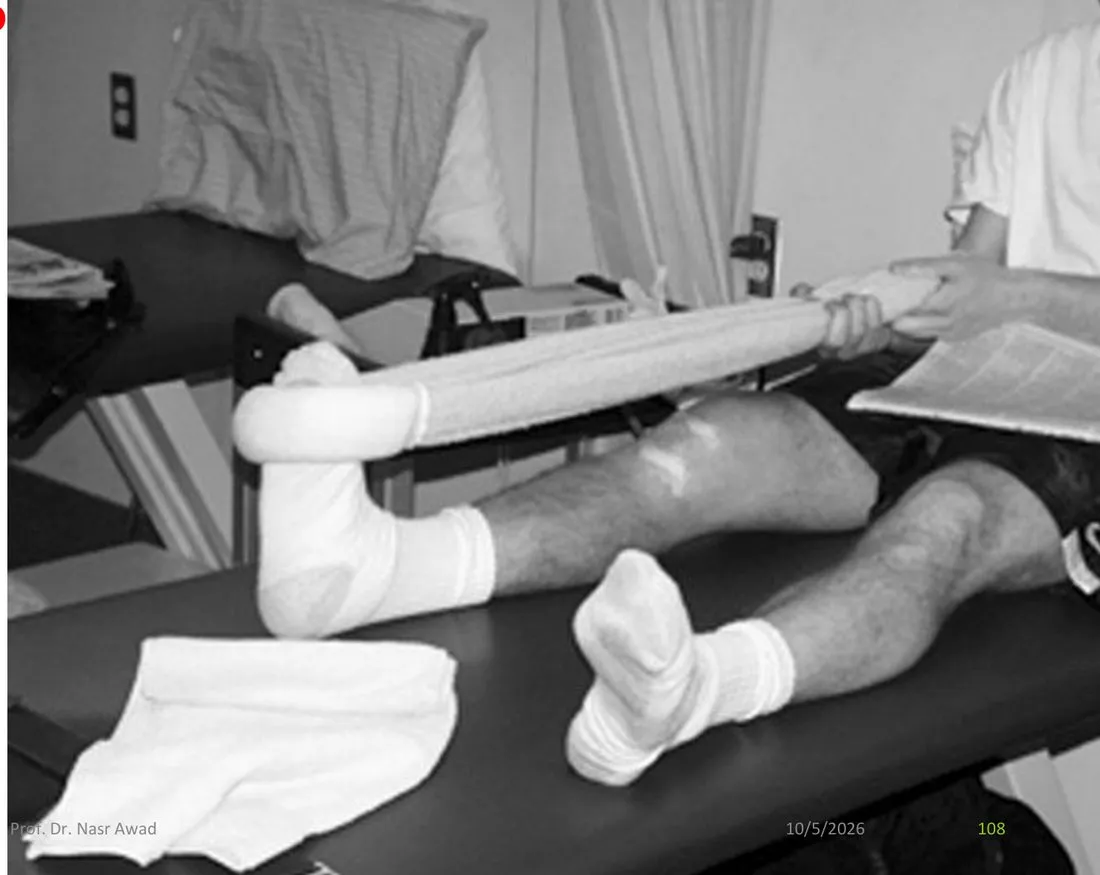
- GastrocnemiusThe main calf muscle.General meaning, not from the slides stretches are done with a towel around the foot (slide 108).
Flexion up to 90° (slides 109–113)
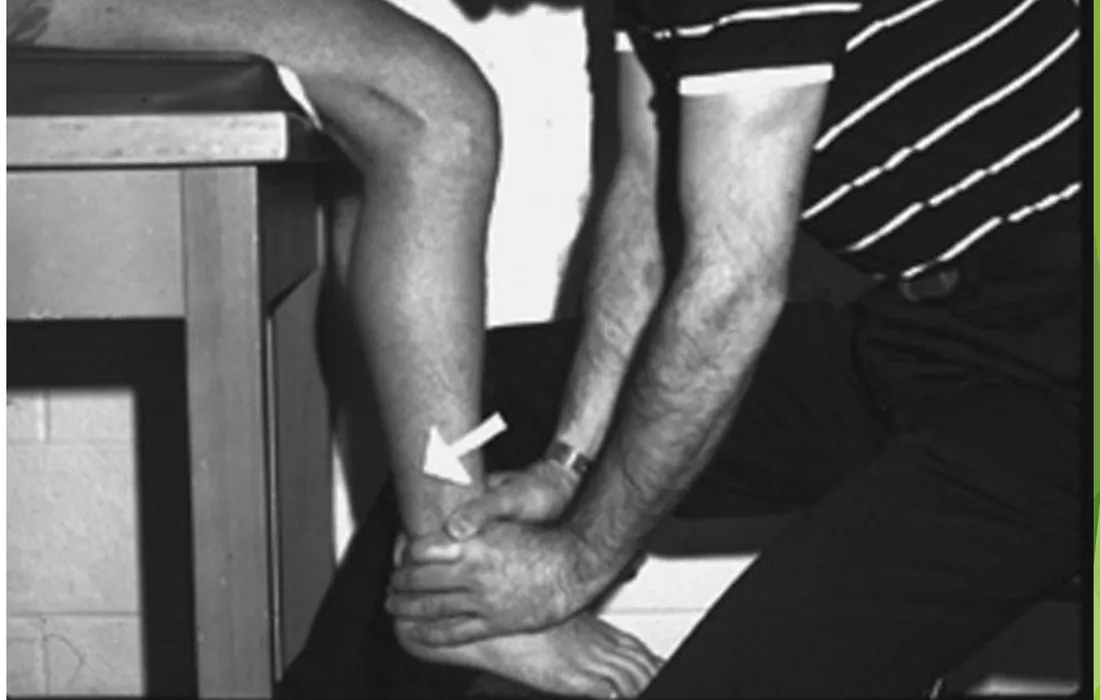
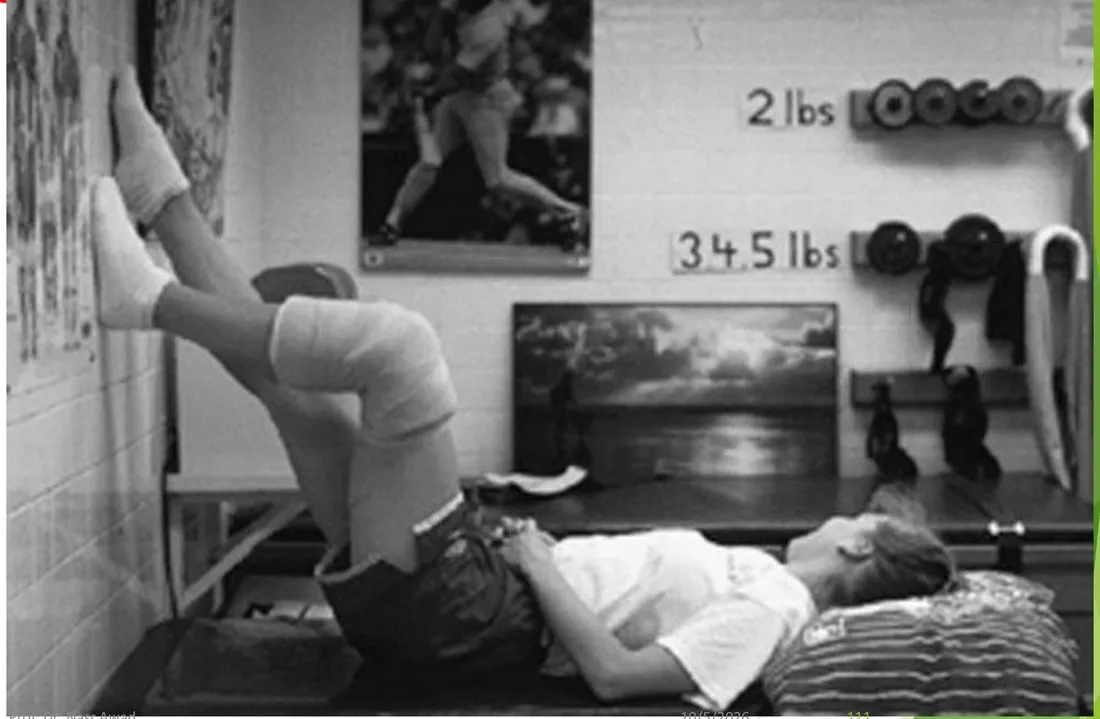
- Increase flexion up to 90° is achieved by: passive flexion at the edge of the bed (slide 110), wall slides (slides 111–112) and heel slides (slide 113).
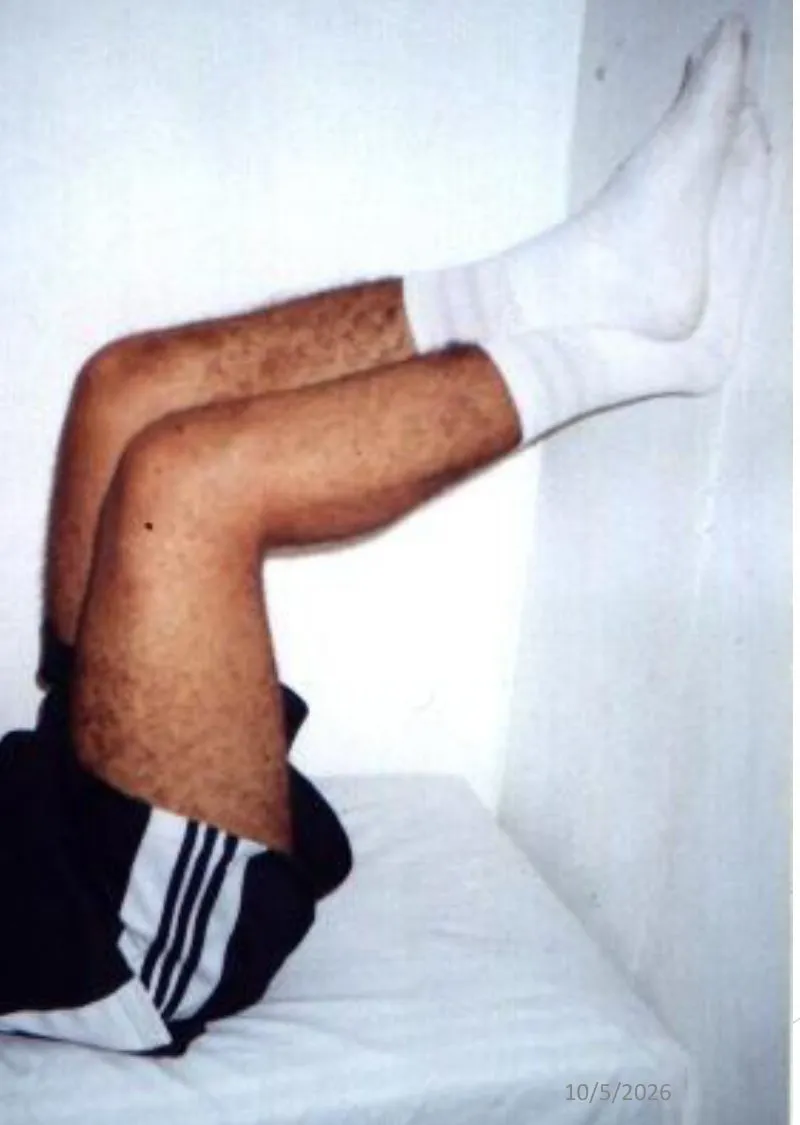
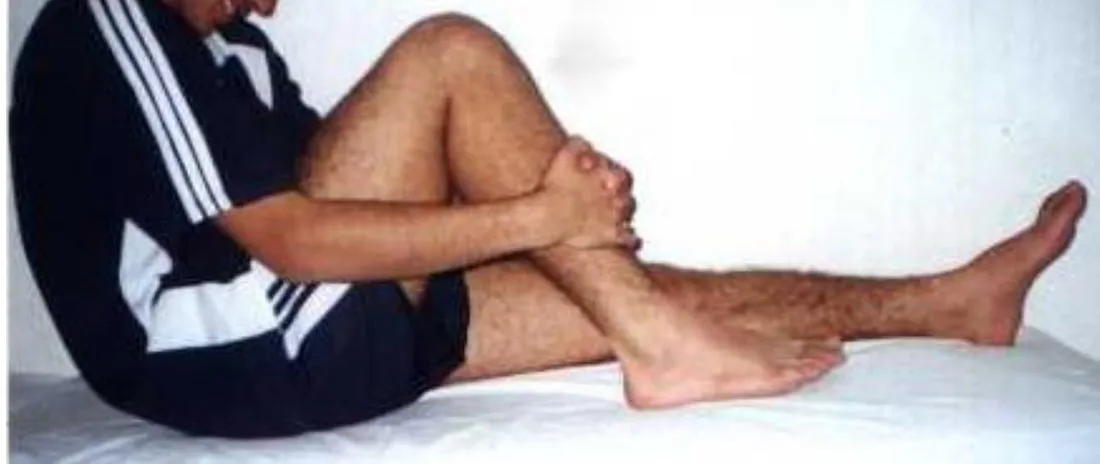
Quadriceps control (slides 114–119)
- Quadriceps (muscle/leg) control is achieved by: the quadriceps set exercise (slide 115), with electrical muscle stimulation performed at the same time (slide 116); then 2. SLR exercises (slide 117) and 3. Short-arc quadricepsA quadriceps exercise straightening the knee over a short range near full extension.General meaning, not from the slides muscle exercise, marked with a red (X) (slide 118).
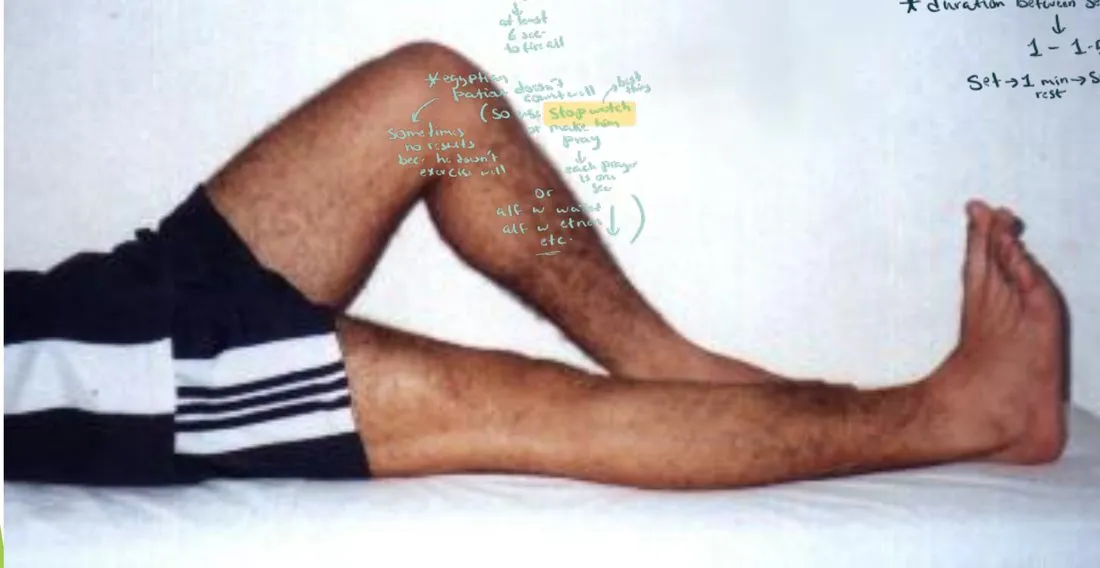
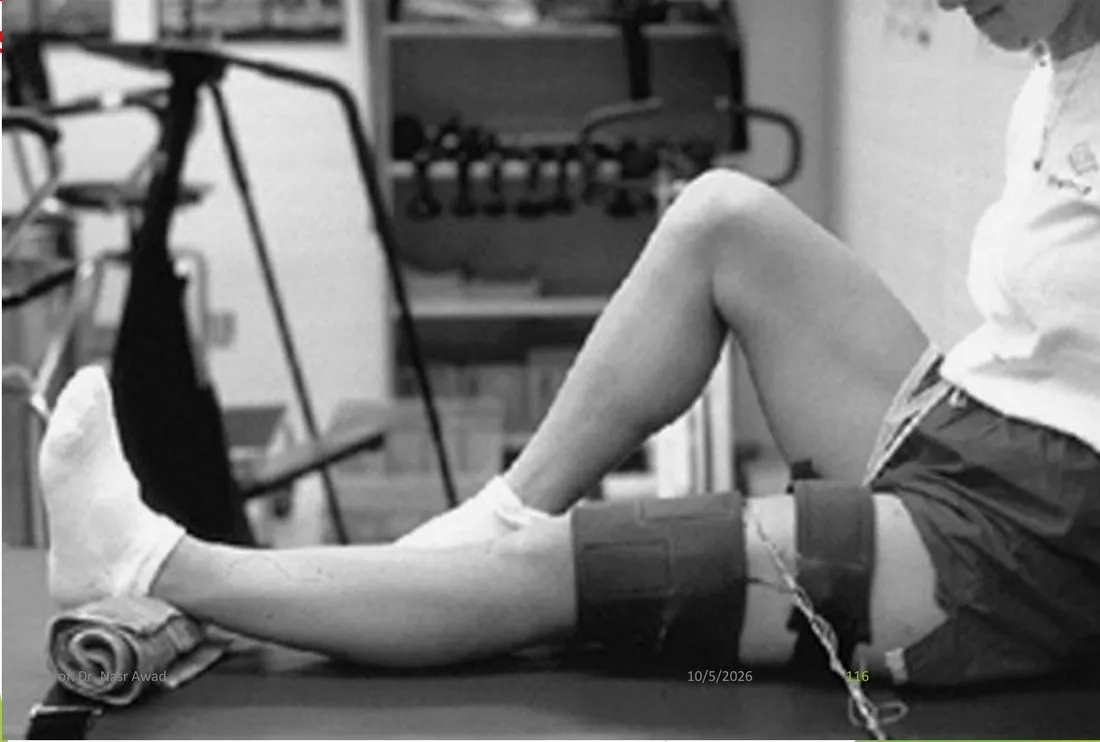
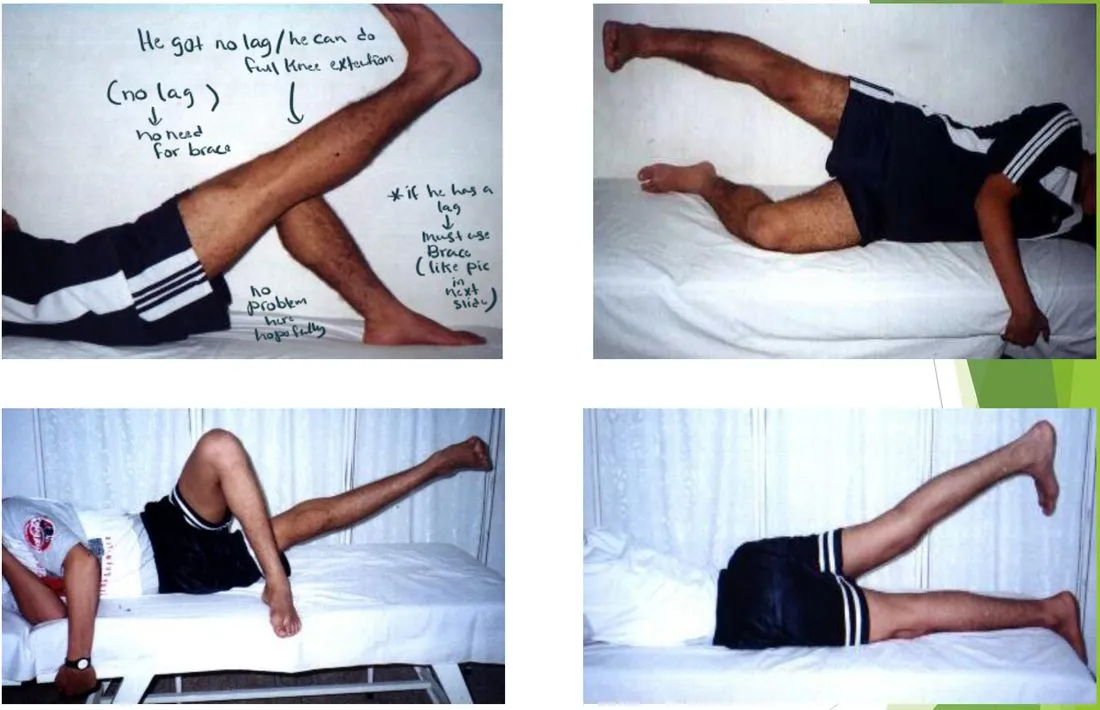
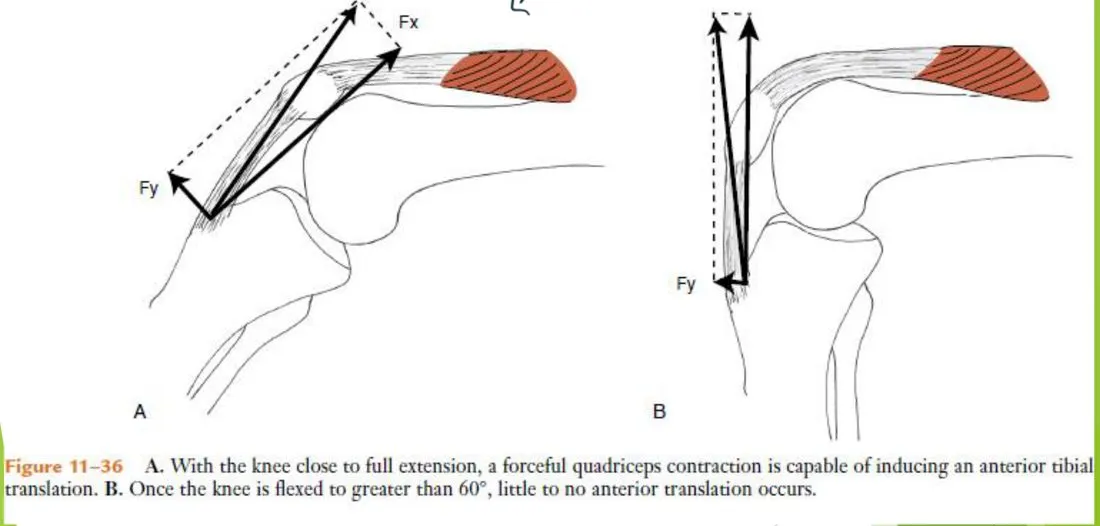
The red (X) on slide 118 is on the slide; the slide does not give a reason in words. The next slide (119) is the Figure 11-36 diagram: close to full extension a forceful quadriceps contraction can induce Anterior tibial translationThe shin bone (tibia) sliding forward relative to the thigh bone (femur).General meaning, not from the slides, and past 60° of flexion there is little to no translation.
Early post-operative (weeks 2–3)
| Early post-operative phase (weeks 2–3) | |
|---|---|
| Phase goals | Continue progressive impairment resolution; normalize gait; SLR without a lag |
| Milestones | ROM = 0–115° (aim for hyperextension symmetrical to the contralateral side); walking without crutches or immobilizer; KOS-ADLKnee outcome score, activity of daily living subscale: a score of how well the knee copes with everyday activities. ≥ 65%; effusion < 2+ |
| Visits and frequency | Total visits 5–6; PT 2× per week; HEP 4–6× per day |
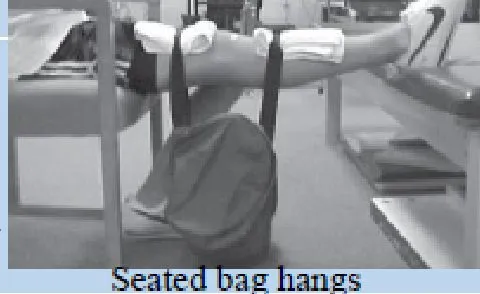
| ROM | Continue previous-phase exercises. Add bag/prone hangs with light weight if lacking full knee extension, for a low-load, long-duration stretch |
| Muscle performance | Quadriceps strengthening (90–0°). OKCOpen kinetic chain: exercise with the foot free, such as a seated knee extension.General meaning, not from the slides: multi-angle isometrics, LAQ with cuff weights / resistance band / knee extension machine, variable-range IsokineticExercise or testing where a machine keeps the limb moving at a constant speed.General meaning, not from the slides. Global lower extremity strengthening. CKCClosed kinetic chain: exercise with the foot fixed on the floor or a surface, such as a squat.General meaning, not from the slides: wall sits, air squats. Accessory: core, hip and calf strengthening, hamstring curls (appendix 1: precautions and ConcomitantHappening or done at the same time as something else.General meaning, not from the slides procedure modifications). Optional: BFR strength training |
| Neuro re-education | Weight shifts and single-leg balance; FESFunctional electrical stimulation: electrical stimulation used to help a muscle work during a movement. if poor quad control |
| Manual therapy | Incision mobilizations PRNLatin “pro re nata”: as needed. (once healed), patellar mobilizations, flexion/extension stretching |
| Electric stimulation | NMES dosed at ≥ 50% of isometric MVIC (appendix 5) |
| Gait training | Cue “land on bent knee, push knee back while squeezing quad”; retro walking to promote TKE; progress to a functional brace as swelling permits (if used) |
| Modalities | Continue for effusion management |
Monitoring and home programme (slide 123):
- Criteria to discontinue crutches: normal gait pattern with good active quad control, no lag with SLR and effusion ≤ 2+.
- Effusion monitoring: assess the response to exercises frequently; stay at the same intensity or decrease if effusion increases; do not progress exercise with a 2+ effusion. Refer to the Soreness Rules (appendix 2).
- Pain monitoring: modify exercise ROM and load to minimize irritation of the quad and Patellar tendonThe tendon that joins the kneecap (patella) to the shin bone.General meaning, not from the slides graft site (keep pain < 5/10).
- HEP: quad sets 5–10 sets of 100 × 5–10” per day; SLR (assisted as needed) 3 × 10; LAQ (90–0°) with resistance 30 × 5”; heel slides / seated assisted knee flexion / wall slides 30 × 5”; heel prop with ice 5 × 10 minutes per day; self-mobilizations of the patella 20 × 5” each direction; frequent short bouts of ambulation (3–5 minutes/hour).
Slide 121 gives the milestone “effusion < 2+”, while slide 123 gives the crutch criterion “effusion ≤ 2+”. Both are kept as written.
Intermediate post-operative (weeks 4–6)
| Intermediate post-operative phase (weeks 4–6) | |
|---|---|
| Phase goals | Complete impairment resolution; progressive quadriceps strengthening; restoration of full ROM; resumption of ADLActivities of daily living: everyday tasks such as walking, climbing stairs and dressing.General meaning, not from the slides |
| Milestones | Flexion ROM within 10° of the Uninvolved limbUninvolved: the healthy, uninjured leg used as the comparison. Involved: the injured or operated leg.General meaning, not from the slides limb; quad strength MVIC ≥ 60% of uninvolved (see the comment below); effusion ≤ 1+; normal gait pattern; Reciprocal stair climbingGoing up or down stairs one foot per step, alternating legs.General meaning, not from the slides |
| Visits and frequency | Total visits 11–12; PT 2× per week; HEP 1–2× per day |
| ROM / manual therapy | PRN for knee ROM and mobility deficits; formally assess hip and ankle for impairments |
| Muscle performance | Quadriceps strengthening (90–0°). OKC: progressive isokinetic (for example speed and ROM), knee extension machine. Global lower extremity strengthening. CKC: leg press, single-leg squats, step ups/downs, forward and side lunges, bridges. Accessory: core, hip and calf strengthening, hamstring curl machine. Optional: BFR strength training (discontinue when able to tolerate > 70% RM (repetition maximum)Repetition maximum: the heaviest load that can be lifted for the stated number of repetitions (1-RM = one, 5-RM = five).General meaning, not from the slides load) |
| Neuro re-education | Balance and ProprioceptiveRelating to the sense of where the joints are and how they are moving.General meaning, not from the slides activities on variable surfaces (for example BOSUA half-dome balance trainer that makes standing exercises less stable.General meaning, not from the slides, foam); Perturbation trainingBalance training in which the patient is unexpectedly pushed or the surface is moved, so the patient has to react.General meaning, not from the slides |
| Aerobic training | Bike, elliptical, stair master (10 minutes minimum) |
| Electric stimulation | NMES dosed at ≥ 50% of isometric MVIC (appendix 5) |
| Gait training / modalities | PRN for remaining abnormalities / PRN for pain and effusion |
- Effusion and pain monitoring: continue as outlined above.
- Preferred methods for assessing quad strength: isokinetic DynamometerA device that measures muscle force.General meaning, not from the slides (for example Biodex) in isometric or isokinetic (60/90/120 degrees/sec) mode, handheld dynamometry with fixation, or 1 repetition maximum on a knee extension machine, 90–45° or 90°–0° (week 7+).
- QIQuadriceps Strength Index: quadriceps strength of the involved limb compared with the uninvolved limb. (QI): monitor for bilateral strength loss after injury. QI should be calculated using PREProgressive resistive exercise: strengthening with gradually increasing resistance.General meaning, not from the slides-injury data for the uninvolved limb (if available) or the highest value collected during rehab, to avoid overestimating quadriceps strength in the involved limb.
- HEP (slide 126): SLR with resistance 3 × 10; LAQ with resistance 30 × 5”; prone quad stretch 3 × 30”; SLS 10 × 15”; squats (0–90°) 3 × 10; heel raises 3 × 10; self-patellar mobs PRN 20 × 5”; aerobic conditioning 10–15 minutes; step ups 3 × 10; single-leg squat EccentricA muscle contraction in which the muscle lengthens while producing force.General meaning, not from the slides 3 × 10; planks 5 × 30”; hip strengthening 3 × 10.
Later rehabilitation and return to sport (week 7 to month 12)
Late post-operative (weeks 7–9)
| Late post-operative phase (weeks 7–9) | |
|---|---|
| Phase goals | Improve tolerance to loading; improve aerobic conditioning; increase variability; improve ADLActivities of daily living: everyday tasks such as walking, climbing stairs and dressing.General meaning, not from the slides function and efficiency |
| Milestones | Full and symmetrical ROMRange of motion: how far a joint can move.General meaning, not from the slides; QuadricepsThe large muscle group on the front of the thigh that straightens the knee.General meaning, not from the slides strength ≥ 70% of Uninvolved limbUninvolved: the healthy, uninjured leg used as the comparison. Involved: the injured or operated leg.General meaning, not from the slides; EffusionExcess fluid inside the joint, seen as a swollen knee. The protocol grades it as zero, trace, 1+, 2+ and higher.General meaning, not from the slides ≤ 1+; normal gait pattern; KOS-ADLKnee outcome score, activity of daily living subscale: a score of how well the knee copes with everyday activities. ≥ 70% |
| Visits and frequency | Total visits 17–18; PTPhysical therapy, or physical therapist.General meaning, not from the slides 2× per week; HEPHome exercise program.General meaning, not from the slides 2–3× per week |
| Muscle performance | ConcentricA muscle contraction in which the muscle shortens while producing force.General meaning, not from the slides and EccentricA muscle contraction in which the muscle lengthens while producing force.General meaning, not from the slides overload at 60–75% RM (repetition maximum)Repetition maximum: the heaviest load that can be lifted for the stated number of repetitions (1-RM = one, 5-RM = five).General meaning, not from the slides. Quadriceps (90–0°), posterior chain and accessory strengthening: knee ExtensionStraightening a joint.General meaning, not from the slides machine, leg press, single-leg variations, HamstringsThe muscle group on the back of the thigh that bends the knee.General meaning, not from the slides curls, weighted step ups and lunges |
| Neuro re-education | Perturbation trainingBalance training in which the patient is unexpectedly pushed or the surface is moved, so the patient has to react.General meaning, not from the slides and higher-level balance progressions (for example multi-task, ball toss, sport-specific equipment as appropriate) |
| Aerobic training | Increase duration and intensity |
| Electric stimulationUsing electrical current on a muscle (e-stim).General meaning, not from the slides | May discontinue if quad strength ≥ 80% |
| Gait training / modalities | PRNLatin “pro re nata”: as needed. for remaining abnormalities / PRN for pain and effusion |
Exercise constraints (slide 130):
| External load constraints (strengthening examples) | Internal load constraints (strengthening examples) | |
|---|---|---|
| Load | 1-RM percentage: 65–85% of 1-RM, 5–8 reps, 3–5 sets. 5-RM percentage: 80–100% of 5-RM, 5–8 reps, 3–5 sets | RPERate of perceived exertion: how hard the effort feels on a scale of 0 to 10.General meaning, not from the slides (RPE): working sets at 6–8/10 |
| TempoThe speed of each part of a repetition (lifting, pausing, lowering).General meaning, not from the slides / reserve | Tempo: 3–5 second concentric, 0–2 second pause at transition, 3–5 second eccentric | RIRRepetitions in reserve: how many more repetitions the patient could still do before reaching maximal fatigue. (RIR): prescribe a load at which the patient can complete 5–8 reps through the prescribed ROM, with a theoretical ability to complete 2–3 additional reps before maximal fatigue. If the patient reports RIR is ≥ 3–4 repetitions, increase the load |
| Rest / method | Work/rest ratioTime spent working compared with time resting between sets.General meaning, not from the slides: 3–4 minutes between sets (variable based on exercise goal) | DAPREDaily Adjustable Progressive Resistive Exercise: a method that uses the working weight and the maximum reps completed in a set to adjust the load. (Daily Adjustable PREProgressive resistive exercise: strengthening with gradually increasing resistance.General meaning, not from the slides) method: uses the working weight and the maximum number of reps completed during a set to determine load adjustments |
HEP (slide 130): resisted squats (0–90°) 5 × 8; LAQLong arc quadriceps: a knee-extension exercise through the long range from 90° to 0°. with heavy resistance 3 × 15; unilateral heel raises 3 × 10; aerobic conditioning 15–30 minutes; resisted step ups 3 × 10; SLSingle-leg.General meaning, not from the slides squats 3 × 10; planks 5 × 60”; resisted SL Romanian deadlift (RDL)Romanian deadlift: a hip-hinge lift performed with nearly straight knees. 3 × 12; hip strengthening 3 × 10.
Transitional phases I and II
| Transitional phase I (weeks 10–12) | Transitional phase II (weeks 13–16) | |
|---|---|---|
| Goals | Initiate transition to a gym-based program and/or supervised training with ATCAthletic training certified. or strength coach if appropriate | Initiate running; transition to gym-based program and/or supervised training with ATC or strength coach if appropriate |
| Milestones | Full and pain-free ROM; quad strength ≥ 75% of uninvolved; effusion ≤ 1+; KOS-ADLS ≥ 80% | Quad strength ≥ 80% of uninvolved; effusion ≤ trace; no pain or swelling with running |
| Visits / frequency | Total visits 20–24; PT 1–2× per week; HEP 2–3× per week | Total visits 24–32; PT 1–2× per week; HEP 2–3× per week |
| Muscle performance | Concentric and eccentric overload at 60–85% 1-RM. Progressive quadriceps and lower extremity strength training: knee extension machine, deadlifts, barbell squatting, light leg press/shuttle PlyometricsJumping and bounding exercises that train fast, powerful muscle action.General meaning, not from the slides (week 12+) | Concentric and eccentric overload at 60–85% 1-RM. Progressive strength training: light power training (for example Cleans and snatchesPower lifts that move a barbell from the floor to the shoulders (clean) or overhead (snatch).General meaning, not from the slides, snatches), circuit training |
| Neuro re-education | Higher-level balance progressions (for example reactive vs anticipatory; sport-specific equipment as appropriate) | Controlled landing mechanics (begin with 2” Box dropsStepping down off a box and landing under control.General meaning, not from the slides) and higher-level balance progressions as appropriate |
| Aerobic training | Initiate Alter-GA treadmill that uses air pressure to take part of the body weight off the legs.General meaning, not from the slides or pool running | Continue Alter-G or pool running; progress duration and intensity as appropriate |
| Electric stimulation | May discontinue if quad strength ≥ 80% | — |
| Modalities | PRN for pain and effusion | — |
Return to level ground running criteria (slides 132–133, the same slide twice): quadriceps strength ≥ 80%, effusion ≤ trace, understanding of soreness rules; appendix 1 for considerations specific to AllograftA graft taken from a donor.General meaning, not from the slides.
Transitional phase III (months 4–6)
| Transitional phase III (months 4–6) | |
|---|---|
| Phase goals | Initiate Sprint progressionA staged build-up of running speed toward full sprinting.General meaning, not from the slides; initiate AgilityThe ability to change direction quickly and under control.General meaning, not from the slides; initiate jumping; initiate Secondary preventionMeasures to prevent a second injury after the first one has happened.General meaning, not from the slides program |
| Milestones | Quad strength ≥ 85% of uninvolved; Hop testingJumping on one leg and comparing the result with the other leg to check function.General meaning, not from the slides ≥ 85%; KOS-ADLS ≥ 85%; ACL-RSIACL return to sport after injury scale. > 60% (at 6 months) |
| Visits and frequency | Total visits 27–38; PT 1–2× per month; HEP 3–4× per week; supervised by ATC or strength coach if able |
| Muscle performance | Concentric and eccentric overload at 60–85% 1-RM. High-intensity strength training: heavy barbell squats, deadlifts, kettlebell swings, Nordic hamstring curlKneeling with the feet held and slowly lowering the body forward, using the hamstrings to control the fall.General meaning, not from the slides, lateral sled pulls |
Return to agilities criteria (for example forward and lateral cone shuttle, figure-8): progress from pre-planned to reactive, include sport-specific equipment as appropriate.
- Quadriceps strength ≥ 80%; effusion ≤ trace; hop testing ≥ 80% (appendix 7); understanding of soreness rules; completion of running and Stage 1 sprint progression; appendix 1 for allografts.
Return to high-intensity plyometrics criteria (for example box jump, drop jumps, broad jump): progress from two-feet landing to one-foot landing, single plane to multiplanar.
- Quadriceps strength ≥ 85%; effusion ≤ trace; hop testing ≥ 85% (appendix 7); completion of running progression; completion of Stage 1 sprint progression; no ApprehensionFear or hesitation that the knee will give way.General meaning, not from the slides with light agilities.
Home exercise programme (slides 135–136): individualized to the specific sport and patient needs; ensure the demand is enough to improve working capacity with sport-specific skills (example: soccer player, not fully inclusive).
| Strength training (2–3× per week) | Aerobic conditioning (3–4× per week) |
|---|---|
| Unilateral and bilateral knee extension 5 × 5 at 60–85% 1-RM | Aerobic training on level ground or treadmill, 20–30 minutes continuous |
| Kettlebell/dumbbell squats 3 × 12 | Tempo runs on track or soccer field |
| Single-leg squat with heel raises 3 × 12 | Speed ladders on a sport-specific surface (for example grass, turf) |
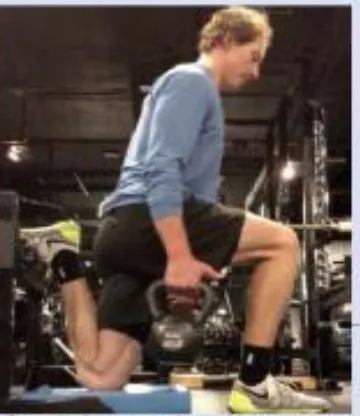
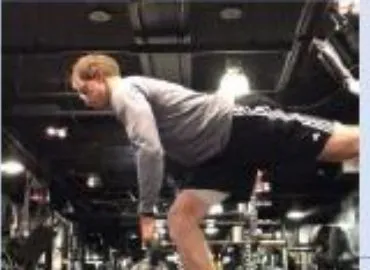
| Single-leg RDLs with kettlebell 3 × 12 (figure) | Short-burst acceleration/deceleration cone drills with soccer ball |
| Rearfoot-elevated split squats with dumbbells 3 × 10 (figure) | |
| Nordic hamstring curls 3 × 7 | |
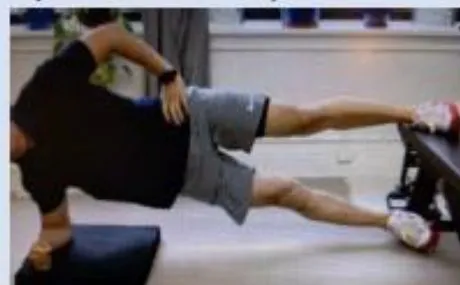
| Copenhagen plankA side plank with the top leg supported on a bench, working the inner thigh muscles.General meaning, not from the slides 3 × 30” (figure) |
Transitional phase IV (months 6–9)
| Transitional phase IV (months 6–9) | |
|---|---|
| Phase goals | Sport-specific skill acquisition; restoration of conditioning level to the pre-injury level |
| Milestones | Quad strength ≥ 90–100% of uninvolved; hop testing ≥ 90%; KOS-ADLS ≥ 90%; ACL-RSI ≥ 70%; no effusion or pain with running, sprinting or agilities |
| Visits and frequency | Total visits 31–46; PT 1–2× per month; HEP 3–4× per week; supervised by ATC or strength coach if able |
| Muscle performance | High-intensity power training and maximal-effort strength training |
| Agility training | 80–100% intensity, reactive, unpredictable and sport-specific |
| Sport-specific training | Individualized to sport/position, incorporate sport-specific equipment and environments as able |
| Dynamic anaerobic/aerobic training | Maximal-effort sled push/pull and circuit training |
Criteria listed on slide 138:
| Stage | Criteria |
|---|---|
| Stage 2 sprint progression | Quad ≥ 90%; effusion ≤ trace; hop testing ≥ 90% (appendix 7); completion of Stage 1 sprint progression; no apprehension with moderate to high-level agilities |
| Return to cutting and pivoting | Quad ≥ 90%; effusion ≤ trace; hop testing ≥ 90%; no apprehension with moderate to high-level agilities; completion of Stage 1 and 2 sprint progression; appendix 1 for allografts |
| Stage 3 sprint progression | Quad ≥ 90%; effusion ≤ trace; hop testing ≥ 90%; no apprehension with moderate to high-level agilities; completion of Stage 2 sprint progression |
The criteria for Stage 1 sprint progression are not on the slides.
Return to sport, phase V (months 9–12)
| RTSReturn to sport.General meaning, not from the slides phase V (months 9–12) | |
|---|---|
| Phase goals | Sport-specific skill acquisition; build confidence during play with opponents |
| Milestones | At least 9 months post-op (allografts 12+ months); quad strength ≥ 90% of uninvolved (level 1 athletes ≥ 100%); hop testing ≥ 90%; KOS-ADLS ≥ 90% |
| Visits and frequency | Total visits 35–50; PT 1–2× per month or until all RTS criteria are met (injury prevention); HEP 2–3× per week |
Return to competition progression:
- Non-contact injuryAn injury that happens without a direct blow from another player or object.General meaning, not from the slides practice
- Small-sided contact practices (1v1, 2v2, 3v3)
- Full practice
- Return to competition with restricted workload
- Return to competition unrestricted
All stages without apprehension, pain, InstabilityA sign or feeling that the joint moves abnormally or gives way.General meaning, not from the slides, effusion or compensations.
ACLAnterior cruciate ligament: a strong band inside the knee that stops the shin bone (tibia) sliding forward under the thigh bone (femur).General meaning, not from the slides secondary prevention program:
- 2× per week moving forward.
- Maintain quadriceps strength and periodically assess it with a 1-RM knee extension strength test (pre/post season).
- See the Knee Injury Prevention CPGClinical practice guidelines. for guidelines and video examples.
- Consider long-term implementation of Copenhagen planks and Nordic hamstring curls for lower extremity injury risk reduction.
- If a functional ACL brace is used, it may be discontinued after 1 year.
Additional considerations:
- No effusion, pain or apprehension with sport-specific training and practice progressions.
- Return to pre-injury conditioning level.
- Minimal to no dynamic knee ValgusAngulation where the lower part of the limb points away from the midline. At the knee it is the inward collapse (knock-knee direction).General meaning, not from the slides with jumping and landing.
- Hamstring/quadriceps ratio.
- Vertical hop symmetry assessment.
Concomitant procedure modifications
Slides 142–145 list how the rehab changes when another procedure is done at the same time as the ACLAnterior cruciate ligament: a strong band inside the knee that stops the shin bone (tibia) sliding forward under the thigh bone (femur).General meaning, not from the slides reconstruction (procedure → rehab modification).
| Procedure | Rehab modification |
|---|---|
| Patellar tendonThe tendon that joins the kneecap (patella) to the shin bone.General meaning, not from the slides AutograftA graft taken from the patient’s own body.General meaning, not from the slides (BPTBBone–patellar tendon–bone graft: the patient’s own patellar tendon taken with a small piece of bone at each end.General meaning, not from the slides) | Be aware of PatellofemoralRelating to the joint between the kneecap and the thigh bone.General meaning, not from the slides forces and possible irritation during PREProgressive resistive exercise: strengthening with gradually increasing resistance.General meaning, not from the slides (PREs). Treat anterior knee pain PRNLatin “pro re nata”: as needed. with noxious Electric stimulationUsing electrical current on a muscle (e-stim).General meaning, not from the slides and PatellaThe kneecap.General meaning, not from the slides taping; consider modifying the strength program (treat TendinopathyA painful tendon problem, often from overload.General meaning, not from the slides using the Pain Monitoring Model). Consider altering the knee FlexionBending a joint.General meaning, not from the slides angle to the most comfortable between 45° and 60° for MVICMaximum voluntary isometric contraction: the hardest a muscle can contract without the joint moving. and NMESNeuromuscular electrical stimulation: using electrical current to make a muscle contract. treatments. Initial burst test at 12 weeks if no pain (< 5/10) |
| HamstringsThe muscle group on the back of the thigh that bends the knee.General meaning, not from the slides tendon autograft | Begin IsometricA muscle contraction without movement at the joint.General meaning, not from the slides knee flexion no earlier than week 6. Begin dynamic knee flexion no earlier than week 8; dynamic knee flexion with load and pain-free 0–90°, weeks 8–12. No hamstring restrictions beyond 12 weeks. Delay PlyometricsJumping and bounding exercises that train fast, powerful muscle action.General meaning, not from the slides until 16 weeks |
| QuadricepsThe large muscle group on the front of the thigh that straightens the knee.General meaning, not from the slides tendon autograft | Similar to BPTB and tendinopathy protocols; slower to regain quad strength. Modify hip angle (minimize hip flexion) to focus on strengthening the Rectus femorisThe part of the quadriceps that runs straight down the front of the thigh.General meaning, not from the slides |
| AllograftA graft taken from a donor.General meaning, not from the slides | Slower GraftTissue used to replace the torn ligament.General meaning, not from the slides incorporation, therefore slower progression to running, jumping, cutting and pivoting. Ensure all objective criteria are satisfied before progression. Delay return to level 1 sport until all criteria are met and 1 year post-operative |
| Partial MeniscectomySurgery to remove part or all of a torn meniscus.General meaning, not from the slides | No modifications required; progress per patient tolerance and protocol |
| Meniscal repairStitching a torn meniscus so it can heal instead of removing it.General meaning, not from the slides — simple repair | WBATWeight bearing as tolerated. in a brace locked in full ExtensionStraightening a joint.General meaning, not from the slides, or Knee immobilizerA brace that keeps the knee straight and still.General meaning, not from the slides, immediately for 4 weeks. ROMRange of motion: how far a joint can move.General meaning, not from the slides progression 0–90° by week 2, then as tolerated |
| Meniscal repair — complex or root repair | NWBNon-weight-bearing: no body weight is put through the leg.General meaning, not from the slides in knee immobilizer for 6 weeks. ROM progression 0–90° by week 2, then as tolerated. Progress to full weight bearing by week 9. Initiate CKCClosed kinetic chain: exercise with the foot fixed on the floor or a surface, such as a squat.General meaning, not from the slides PRE at week 9. Weight-bearing flexion limited to 0–45° weeks 8–12, 0–70° through week 16. No isolated hamstring strengthening for 16 weeks. Resume the standard ACL protocol after 16 weeks. Seated IsokineticExercise or testing where a machine keeps the limb moving at a constant speed.General meaning, not from the slides and multi-angle quadriceps isometrics can substitute for weight-bearing exercises early on |
| Abrasion chondroplastySmoothing damaged cartilage surfaces.General meaning, not from the slides | WBAT with axillary crutches 3–5 days; no modifications required, progress per patient tolerance and protocol |
| MicrofractureSurgery that makes tiny holes in the bone under damaged cartilage to stimulate new repair tissue.General meaning, not from the slides | NWB 2–4 weeks with axillary crutches; no weight-bearing activities in treatment for 4 weeks; consider the location and size of the lesion for exercise-specific alterations |
| Chondral repairRepair of damaged joint cartilage.General meaning, not from the slides (OATSOsteochondral autograft transfer system: a cartilage-repair operation., ACIAutologous chondrocyte implantation: a cartilage-repair operation., MACIMatrix-induced autologous chondrocyte implantation: a cartilage-repair operation.) | Follow the procedure-specific protocol if done ConcomitantHappening or done at the same time as something else.General meaning, not from the slides |
| Meniscal transplantationReplacing a damaged meniscus with a donor meniscus.General meaning, not from the slides | Follow the procedure-specific protocol if done concomitantly |
| Concomitant MCLMedial collateral ligament: the ligament on the inner side of the knee that resists the knee being pushed inward.General meaning, not from the slides injury | Restrict motion to the SagittalA view or plane that divides the body into left and right parts, so the knee is seen from the side.General meaning, not from the slides plane until week 4–6 to allow MCL healing. Perform PREs with the tibia in Internal rotationTurning a limb inward, toward the midline.General meaning, not from the slides during the early post-op period to decrease MCL stress. Consider a brace for exercise and periods of activity if severe sprain and/or pain. After MCL repair: PWBPartial weight bearing: only part of the body weight is put through the leg.General meaning, not from the slides locked in extension for 1–2 weeks; unlock the brace with weight bearing at weeks 2–6 and wean from brace and assistive devices; flexion ROM 0–90°, then as tolerated; avoid exercises that put a ValgusAngulation where the lower part of the limb points away from the midline. At the knee it is the inward collapse (knock-knee direction).General meaning, not from the slides stress on the knee |
High-yield exam review
The 41 questions and answers from the course sheet “ACLAnterior cruciate ligament: a strong band inside the knee that stops the shin bone (tibia) sliding forward under the thigh bone (femur).General meaning, not from the slides 1 – Important Exam Questions”, worded as on the sheet.
| Question | Answer |
|---|---|
| 1. What is a Doughy sensationA soft, dough-like feel of the knee.General meaning, not from the slides associated with? | ACL injury with EffusionExcess fluid inside the joint, seen as a swollen knee. The protocol grades it as zero, trace, 1+, 2+ and higher.General meaning, not from the slides. |
| 2. What radiological investigations are used in ACL diagnosis? | Plain X-ray, CTComputed tomography: an X-ray scan that builds detailed cross-section or 3D pictures.General meaning, not from the slides, MRIMagnetic resonance imaging: a scan that uses magnets and radio waves to show soft tissues such as ligaments.General meaning, not from the slides, Examination under anesthesiaExamining a joint while the patient is anaesthetised.General meaning, not from the slides, and ArthroscopyLooking inside, or operating on, a joint through small cuts using a camera.General meaning, not from the slides. |
| 3. What is the primary MRI sign of ACL rupture? | Anterior tibial translationThe shin bone (tibia) sliding forward relative to the thigh bone (femur).General meaning, not from the slides. |
| 4. What are the secondary MRI signs of ACL injury? | Bone bruiseBleeding and swelling inside a bone without a visible break, often seen on MRI.General meaning, not from the slides and Bone marrow edemaExtra fluid in the spongy inner part of a bone, seen on MRI.General meaning, not from the slides. |
| 5. What does a Femoral condyleOne of the two rounded bumps at the lower end of the thigh bone (femur) that sit on top of the shin bone.General meaning, not from the slides bone bruise indicate? | ACL injury. |
| 6. What is a Segond fractureA small flake of bone pulled off the outer edge of the top of the shin bone, associated with an ACL tear.General meaning, not from the slides? | An Avulsion fractureA fracture where a ligament or tendon pulls a small piece of bone away from the main bone.General meaning, not from the slides of the Tibial plateauThe flat top surface of the shin bone that forms the lower half of the knee joint.General meaning, not from the slides. |
| 7. What structure is involved in a Segond fracture? | The lateral tibial plateau. |
| 8. What is the mechanism of Non-contact injuryAn injury that happens without a direct blow from another player or object.General meaning, not from the slides ACL injury? | Landing with knee ValgusAngulation where the lower part of the limb points away from the midline. At the knee it is the inward collapse (knock-knee direction).General meaning, not from the slides, hip FlexionBending a joint.General meaning, not from the slides, and Internal rotationTurning a limb inward, toward the midline.General meaning, not from the slides of the hip. |
| 9. What are the important landing factors predisposing females to ACL injury? | Less knee and hip flexion. Increased knee valgus. Increased internal rotation of the hip. Increased External rotationTurning a limb outward, away from the midline.General meaning, not from the slides of the tibia. |
| 10. What are examples of anatomical risk factors for ACL injury in females? | Wider pelvis, increased Quadriceps angleThe angle between the pull of the quadriceps and the patellar tendon. A larger angle goes with knee valgus.General meaning, not from the slides, foot PronationRolling of the foot inward so the arch flattens.General meaning, not from the slides, and dominant QuadricepsThe large muscle group on the front of the thigh that straightens the knee.General meaning, not from the slides. |
| 11. What is the hormonal risk factor mentioned for females? | Increased susceptibility to ACL injury around the Menstrual periodThe monthly bleeding phase of the menstrual cycle.General meaning, not from the slides. |
| 12. When does OvulationRelease of an egg from the ovary during the menstrual cycle.General meaning, not from the slides usually occur? | Between days 10 and 14. |
| 13. What are the estimated causes/risk factors associated with female ACL injury? | Knee valgus, decreased knee flexion angle, less landing absorption, straight-knee landing, muscle weakness, and excessive quadriceps activation. |
| 14. What is the important contact mechanism of ACL injury? | A lateral blow to the knee with the knee flexed and rotated. |
| 15. Which ligament is injured first in the described lateral blow mechanism? | MCLMedial collateral ligament: the ligament on the inner side of the knee that resists the knee being pushed inward.General meaning, not from the slides (MCL). |
| 16. What can be done to help prevent ACL injury? | HamstringsThe muscle group on the back of the thigh that bends the knee.General meaning, not from the slides strengthening. |
| 17. What is the quadriceps-to-hamstring strength ratio? | 0.6; 0.55 is also accepted. |
| 18. Which is stronger: the young ligament or the older ligament? | The young ligament. |
| 19. How does the speed of force applied to a ligament affect the type of tear? | Slow-velocity injury may elongate the ligament and progress to partial rupture. |
| 20. What are the two main ACL bundles? | Anteromedial bundleOne of the two bundles of the ACL (AMB). It is slack in knee extension and taut in flexion. and Posterolateral bundleOne of the two bundles of the ACL (PLB). It is slack in knee flexion and taut in extension, and gives more rotational stability.. |
| 21. Which ACL bundle is more resistant in flexion? | Anteromedial bundle. |
| 22. Which ACL bundle is more resistant in ExtensionStraightening a joint.General meaning, not from the slides? | Posterolateral bundle. |
| 23. At what knee angle is the Lachman testA hands-on test for ACL looseness: with the knee slightly bent, the examiner pulls the shin bone forward on the thigh bone.General meaning, not from the slides performed? | 20–30° of knee flexion. |
| 24. Why is the Lachman test performed at 20–30°? | The knee is unlocked and both ACL bundles can be assessed. |
| 25. What is the ACL width? | 7–12 mm. |
| 26. What is the articular length of the ACL? | 25–35 mm, approximately 3 cm. |
| 27. What is the Ultimate failure loadThe greatest pulling force a ligament can take before it breaks, measured in newtons (N).General meaning, not from the slides of the ACL? | 1750 N; some reviews report 2200 N, and both are accepted. |
| 28. Is the ACL Intra-articularInside the joint.General meaning, not from the slides or extra-articular? | Intra-articular and Extra-synovialOutside the synovial cavity: inside the joint but not bathed in the joint fluid.General meaning, not from the slides. |
| 29. Where does the ACL originate? | From the medial side of the lateral femoral condyle. |
| 30. Where does the ACL insert on the tibia? | Between the medial and lateral Tibial spinesThe two small bony points (medial and lateral) on the top of the shin bone.General meaning, not from the slides. |
| 31. What are the factors determining ACL treatment choice? | Age, activity, and degree of InstabilityA sign or feeling that the joint moves abnormally or gives way.General meaning, not from the slides. |
| 32. What is the first exercise for a patient with a partial ACL tear during physiotherapy? | Mini-squatA shallow squat that bends the knees only a little.General meaning, not from the slides. |
| 33. Which should be avoided initially: deep squat or mini-squat? | Deep squat should be avoided; mini-squat is preferred. |
| 34. What type of kinetic chain exercise is preferred initially? | CKCClosed kinetic chain: exercise with the foot fixed on the floor or a surface, such as a squat.General meaning, not from the slides exercise. |
| 35. What are the criteria before ACL reconstruction? | No or minimal EdemaSwelling caused by extra fluid in the tissues.General meaning, not from the slides, full ROMRange of motion: how far a joint can move.General meaning, not from the slides, and good quadriceps strength compared with the other side. |
| 36. What is the recommended preoperative rehabilitation duration for complete ACL tear? | At least 6 weeks; some papers recommend 8 weeks. |
| 37. What is the criterion-based time for RTSReturn to sport.General meaning, not from the slides after ACL reconstruction? | Approximately 9 months or more, based on maturation and return-to-sport criteria. |
| 38. At what knee angle does IsometricA muscle contraction without movement at the joint.General meaning, not from the slides quadriceps contraction produce high ACL tension? | 15° of knee flexion. |
| 39. What muscle is commonly harvested for an ACL GraftTissue used to replace the torn ligament.General meaning, not from the slides? | SemitendinosusOne of the hamstring muscles at the back of the thigh. Its tendon can be used as an ACL graft.General meaning, not from the slides. |
| 40. How is the semitendinosus graft prepared? | Two strips are harvested and prepared as a Double-strand graftA graft made from two strands.General meaning, not from the slides. |
| 41. What are the two graft fixation methods mentioned? | Interference screwA small screw pushed into the bone tunnel beside the graft to hold it in place.General meaning, not from the slides fixation and Suspensory fixationHolding the graft with a button or loop fixed on the outside of the bone, so the graft hangs from it.General meaning, not from the slides. |